
Podcast 241: Two Herbal UTI Formulae – Moving Beyond Uva Ursi and Cranberry
When you think of UTI and herbs, you probably think of cranberry and uva ursi first. You’re not wrong to do so! They’re reliable and effective remedies. But if you stop there, though, you’ll be missing out on some herbs who can also do the job, and do it well. In this episode we outline two herbal UTI formulae we work with ourselves, and explain why and how they’re helpful.
We also take this opportunity to demonstrate our method of formulation, and show how the same actions and qualities can be achieved from different sets of plants.
Formula 1:
primary – yarrow (Achillea millefolium) flower, goldenrod (Solidago spp.) flower;
support – linden (Tilia spp.), marshmallow (Althaea off.) leaf, chamomile (Matricaria recutita)
catalyst – juniper (Juniperus spp.)
Formula 2:
primary – heather (Calluna vulgaris), calendula (Calendula off.)
support – marshmallow (Althaea off.) root, catnip (Nepeta cataria), fennel (Foeniculum vulgare)
catalyst – cedar (Thuja plicata) leaf
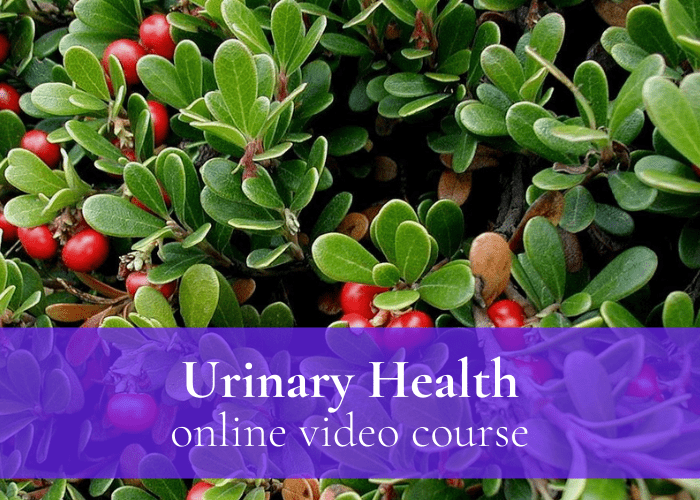
If you’d like to learn more about supporting your urinary system, our Urinary Health course is for you! It’s too common to neglect this system of the body – until something goes wrong. Take proactive steps to prevent UTIs and kidney stones, and learn methods to manage issues such as interstitial cystitis or incontinence. You’ll be glad you did!
And if you’d like to dig deeper into formulation, well, then our Fundamentals of Formulation course is where to go next! Learn our strategies for combining herbal actions and balancing the qualities of herbs to produce more effective remedies.
Like all our offerings, these are self-paced online video courses, which come with free access to twice-weekly live Q&A sessions with us, lifetime access to current & future course material, open discussion threads integrated in each lesson, an active student community, study guides, quizzes & capstone assignments, and more!
If you enjoyed the episode, it helps us a lot if you subscribe, rate, & review our podcast wherever you listen. This helps others find us more easily. Thank you!
Our theme music is “Wings” by Nicolai Heidlas.
Episode Transcript
Katja (00:13):
Hi, I’m Katja.
Ryn (00:14):
And I’m Ryn.
Katja (00:15):
We’re here at Commonwealth Holistic Herbalism in Boston, Massachusetts.
Ryn (00:19):
And on the internet everywhere thanks to the power of the podcast.
Katja (00:22):
I just came in from taking Elsie out to pee before we got started, and my lips are still numb.
Ryn (00:27):
A little blue.
Katja (00:29):
Yeah. I feel like oh, I need to very clearly enunciate, and it’s hard because my lips are numb. It’s cold out there.
Ryn (00:35):
You’re doing great. It is cold out there lately. Yeah. It’s wintertime for real where we live. And, you know, with winter come infections. And we tend to think about respiratory infections first and foremost: cold, flu, COVID. That’s all one word now, right?
Katja (00:52):
It’s all one word. Yeah.
Ryn (00:54):
Oh, it’s cold flu covid. Yeah, we’re dealing with that. But hey, guess what? We can get infected in all kinds of places on these human bodies, and that includes the urinary tract.
Katja (01:04):
Yeah. So, I’m really excited to talk about UTIs today. And specifically to talk about… You know, if you’ve been studying herbalism, you’ve probably learned that oh, if you have a UTI then cranberry, unsweetened cranberry juice and uva-ursi. Listen, there’s so much more than unsweetened cranberry juice and uva-ursi. And I really want to branch out. So, I want to talk about more herbs. And I want to talk about formulating them for the people that you’re working with. Because listen, there are times that you really maybe don’t want to work with uva-ursi. Maybe it’s not appropriate for a particular situation. So, we ought to learn more.
Ryn (01:45):
Yeah. So, that’s what we’re doing today. But first, let’s remind you that we’re not doctors. We’re herbalists and holistic health educators.
Katja (01:52):
The ideas discussed in this podcast do not constitute medical advice. No state or federal authority licenses herbalists in the US. So, these discussions are for educational purposes only.
Ryn (02:02):
We want to remind you that good health doesn’t mean the same thing for everyone. Good health doesn’t exist as an objective standard. It’s influenced by your individual needs, experiences, and goals. So, keep in mind we’re not trying to present a single dogmatic right way that you should adhere to.
Katja (02:19):
Everyone’s body is different. So, the things that we’re talking about may or may not apply directly to you. But we hope that they’ll give you some new information to think about and some ideas to research and experiment with further.
Ryn (02:31):
Finding your way to better health is both your right and your own personal responsibility. This doesn’t mean that you’re alone on the journey, and it doesn’t mean that you’re to blame for your current state of health. But it does mean that the final decision, when you’re considering any course of action, whether it was discussed on the internet or prescribed by a physician, that’s always your choice to make. Yeah. And listen. If you could choose to work with uva-ursi and unsweetened cranberry juice for your UTI, you wouldn’t be wrong.
Katja (02:58):
Oh, no. There’s nothing wrong with that. There’s totally nothing wrong with that. But it’s just that your knowledge doesn’t have to stop there. You could know more.
Ryn (03:08):
Yeah. Because there’s days when you don’t have that herb. Or like you said earlier, there’s days when that’s not actually the right choice.
When Uva-Ursi Isn’t the Right Choice
Katja (03:14):
Right. For example, let’s say we’re working with someone who has a really dry constitution, just like super bone dry. It’s going to be very hard for them to work with uva-ursi. And you’re going to be constantly trying to balance the super drying aspects of uva-ursi with the fact that their constitution is already super dry. And now let’s imagine that that person has a UTI as they’re just coming off of a round of COVID. So, COVID typically is super dry. There’s other things that could be super dry too. It doesn’t have to be COVID. You could have a super dry bronchitis or whatever kind of respiratory infection that really dried you out, and you had that super dry, hacking cough and whatever. Okay, great. And it’s common to get a UTI. It’s common to get other infections when you have an infection, right? So, if you already have the flu or something, a bunch of other pathogens are going to have a much easier time knocking you down than they would if you weren’t already weakened because of the flu. So, it’s common to see this kind of a pattern where somebody gets something. Let’s say it’s COVID because that’s notoriously drying. And then on the tail end of it a UTI. And you’re like this person has just spent 10 days being the driest they’ve ever been in their life. I can’t give them a ton of uva-ursi because it’s going to… Yeah, it’ll help the UTI, but it’s not going to help their lungs at all right now.
Ryn (04:52):
Yeah. And if you were to at that point, you would really need to formulate. You’d be like all right, my formula has four parts marshmallow, two parts licorice, which is a lot.
Katja (05:01):
It is a lot, actually. Yeah.
Ryn (05:03):
And then one part uva-ursi. And that should be tolerable, but flavor is going to be an issue for some folks.
Katja (05:10):
It could be pretty weird.
Ryn (05:11):
There’s limitations.
Katja (05:13):
Also to just be clear here, you don’t have to put… You could have the uva-ursi separate from the moistening stuff.
Ryn (05:21):
Sure, yeah.
Katja (05:22):
And marshmallow and uva-ursi together get a little weird because we get super astringency and super demulcency. And then there’s just some weirdness there. So okay, fine. Okay. If we were in that situation, and we were going to work with uva-ursi, I would probably do something like a whole quart of marshmallow and maybe some cinnamon or something just to give it a little nice flavor. And then uva-ursi by the shot glass. So, every 30 minutes a shot glass of uva-ursi all by itself, and then the whole rest of the half hour a quart of marshmallow. Yeah.
Ryn (05:55):
This is like an adoption of the elecampane strategy.
Katja (05:58):
Yes.
Ryn (05:59):
Yeah, yeah. I see it. I see it. That’s cool. Nice. But listen, again, sometimes we can solve these problems, the urinary tract infection, and we don’t even need to call on uva-ursi. We can work with other plants. So, we’ve put together a couple of formulae here which neither include cranberry juice, nor uva-ursi leaf, but are still going to make a really solid dent in that UTI. Chase it away and help you feeling more comfortable.
Katja (06:30):
Yeah.
Formula #1: Aromatic Flowers
Ryn (06:32):
Yeah. So, the first one, we’ll say all the herbs in it, and then we’ll kind of dissect what’s going on here. We’ve got yarrow and especially, if you can, yarrow flower preferentially.
Katja (06:45):
Yeah. I feel it does really make a difference to have the yarrow flower, because you’re going to get much more of the aromatic profile. And as we talk about this whole formula, we’re going to talk about those aromatics. But the thing is that you can’t buy yarrow flower, or I don’t know anyone who sells it. You can buy yarrow, but it’ll be mostly leaf and a little bit of flower. And so this means that you need to grow it in order to have yarrow flower in quantity. The flip side of that is yarrow is pretty easy to grow. So, if you don’t already grow yarrow, even if you don’t have a garden, but if you have a yard. If you have neither of those, buckets will work. Go ahead right now. because tis the season for buying seeds. Buy yourself some yarrow seeds and plan to plant that this year.
Ryn (07:38):
Yeah. It’s so nice to be able to harvest your own. And honestly, when it comes to goldenrod as well, that’s another one where we really love to harvest our own, because we can preferentially gather the flowers just at the right moment. Like they’re not fully open yet. They’re beautiful. They’re super gold, but they’re about to open. You grab them in that moment. You get them right into the dehydrator, and they dehydrate beautiful. Beautiful. So effective.
Katja (08:03):
And also you can buy goldenrod in commerce, but it’ll be mostly leaf. In this case, we really want the flower because it is higher in the volatile oil content. The leaves are not bad. They’re great. But they’re higher in the bitter constituents.
Ryn (08:17):
Yeah.
Katja (08:19):
Yeah. Okay. So, yarrow flower, goldenrod.
Ryn (08:23):
And then linden, and marshmallow, and chamomile, and then juniper. And so you can look at this formula. One of the ways that we structure formulas is we’ve got our primary. They’re doing the heavy lifting, the major work, the primary job. So, yarrow and goldenrod are doing that here. And then we’ve got support herbs. And they’re often softening the formula, making it more palatable, making it a little gentler on some potentially irritable mucous membranes, for instance. And that’s a big part of what our demulcent herbs in this particular blend are doing. And then in the third position you have the catalyst. And that’s often strong, and active, and moving, and has a lot of oomph to it. And juniper’s playing that role here.
Katja (09:09):
Just a reminder, sometimes the oomph that you need is relaxation. Right? Sometimes you need relaxation like it’s a two by four. And you know to whack somebody, you know, metaphorically. And so when we talk about catalyst as like the mover, the power, the whatever, just remember don’t be thinking oh, well only strong, stabby, hot, intense thing. Because relaxation can be intense. You can have intense relaxation. You can have strong relaxation. You can have really catalyzing relaxation. So, just remember that that is also in this category. We’re not going to exhibit that in these two formulas.
Ryn (09:57):
Yeah. In this particular case, actually, both of these, yeah. So, the juniper, juniper is again an aromatic, rich plant. Really strong, right? You can get the juniper berries here. And if you have some, if you haven’t already, then grab one and just chew on it and feel the flood of the aromatics in your mouth. It’ll make you salivate. You’ll feel the fumes kind of rising up into your sinuses. It should feel pleasant, I hope, but…
Katja (10:24):
Yeah, that sounded a little weird, but it’s actually quite nice. Yeah.
Ryn (10:27):
Yeah. But it’s powerful stuff. And you know, with juniper, and also with the yarrow and the goldenrod, all these aromatic compounds. We keep using that word aromatic because you can smell them, right? And what does that mean? Well, it means that they float on the air, and they reach your nose. That’s true if you just open the jar or sniff the flower. It’s true if you chew the berry. It’s true when you pour hot water on them and make your tea. There’s a big flood of scent that comes up to you. So, those are also small molecules. They need to be small in order to float on the air like that. And that means that they can move through your body easily. They can move through the mucous membranes. They can move through the digestive membranes. They can get into the blood circulation. They can zip all around your body. And your body will ultimately eliminate them. And where does it do that? The kidneys, the urinary system, which is where your infection was. And hey, guess what? These compounds can also kill infections. Oh, it’s all coming together.
Katja (11:29):
Yeah. Really, when we’re talking about volatile oils, like volatile components, these are almost always super antimicrobial. If a plant has antimicrobial action, there are other constituents that are not volatile oils that can provide that. But most commonly you will see that that is also a plant that has a high fraction of volatile oil content. So, that is the case with the yarrow flower and the goldenrod, and also the juniper here. And this is also why I really want those flowers. Because yarrow as a plant, goldenrod as a plant, these are plants that have high volatile oil content in general. But then within the plant specifically, the flowers hold more of that content than the leaves do.
Ryn (12:23):
Yeah. So, all right.
Katja (12:27):
So, yeah. So, that primary position there is getting the antiseptic action to the place we need it. It doesn’t matter if you drink it. That does not help your UTI. What matters is does it get to the actual kidneys, and bladder, and tubes? And so if you are drinking something that has constituents in it that do not get to that location, then it’s not going to help the UTI. But in this case, these volatile oils are going to be eliminated from the body through the kidneys, through the urinary tract, and be removed from the body in the urine. And then also bonus, both of these have diuretic action. So, they’re also doing some stimulation in the kidneys. Kind of saying hey, you know, I think we should pee right now. That seems like a great idea.
Ryn (13:18):
Yeah, yeah. Sort of a general approach to the UTI is we want to kill some microbes, and we want to flush them out as much as we can. So, this is not something that we would advise you to prepare as a tincture blend and just take squirts of tincture and not drink any fluid all day long.
Katja (13:34):
Right, right, right.
Ryn (13:35):
Or to mix powders of all of these, and just take them by the spoonful, and not have any moisture in your day. That would be weird, yeah, but also not very effective. We want to flood the system.
Katja (13:47):
Yeah, yeah, yeah. So, just quarts of this. Yeah.
Soothing Add Ins
Ryn (13:50):
Yeah. So, let’s not leave out though the linden, the marshmallow, the chamomile, because they’re really important to this formula. You know, it is possible to irritate your kidneys. If you go hard and heavy. If you were to be like I’m just going to take juniper, and I’m going to make the strongest possible preparation of this I can and drink that all day long. You might feel more irritation in your urethra. You might feel a little extra burni-ness going on because that’s a very fiery hot herb there. And that’ll irritate. But linden, marshmallow, even chamomile, they offer things that are soothing to those irritated mucous membranes. Part of the discomfort is that your body’s reacting to the infection. It’s reacting with inflammation. But inflammation in your urethra isn’t super pleasant. So, we can combine these elements that are soothing to that, that are calming the inflammation, and that are also improving the integrity of those mucous membranes. When a mucous membrane is inflamed for a long time, its functions get compromised. You can feel that easier in your sinuses. You have a runny nose or a sinus infection. It starts out sticky and thick. You blow your nose a lot. After several days of this, the mucosa have been inflamed and irritated for a while. Now they get permeable. And now it’s just like watery grippiness.
Katja (15:16):
And also you feel the kind of stabby hotness…
Ryn (15:18):
They’re extra sensitive.
Katja (15:20):
in there. They’re just really sensitive. Yeah.
Ryn (15:22):
Right, right. So, when it’s a UTI, same situations going on in these mucosa, and they could use some love. So, the marshmallow, the linden, they’re giving that love.
Katja (15:33):
Yeah. Also marshmallow, linden, and chamomile, they all have on the nervous system a soothing action as well. And when you have a UTI, that irritability does not just stay in the urethra. Your nerves are also irritated, all of you, Emotionally you’re irritated too. You know we don’t always give UTIs enough credit. They’re real infections. They’re serious. And just like if you have a respiratory infection, you’re running a fever, whatever, you stay home from work. You stay home from school, right? But nobody really stays home for a UTI. But I really just want to advocate for that. It’s a real infection. And so all the stuff about all the nervous system components of that, besides the pain. That’s like a whole separate issue, right? It just hurts.
Ryn (16:26):
Yeah. Plus pain leads to fatigue, you know? Like when it’s there all day, it’s constant, it’s irritated, it’s uncomfortable. I can’t quite find a good way to sit. Like that wears on you. That drags your energy down. And your body generating the immune response to combat it takes energy, takes resources. So, sleep is the secret ingredient in all of these formulae.
Katja (16:54):
Yeah. It’s really true. But at any rate, yeah. I do want to say the mucous membrane actions of these three – linden, marshmallow, chamomile – are super important, critically important. But I don’t want to discount the nervous system actions too, because that is a huge part of helping somebody just get through this whole experience with less misery. Yeah.
Ryn (17:18):
Flavorwise, this formula, because of the juniper in particular, you’re going to have a little bit of a hint of a gin sort of a situation, right? The juniper is the dominant taste that comes through there. And then the flowery yarrow-goldenrod combo. The chamomile with its own sweeter type of floral flavor and smell to it.
Katja (17:41):
And linden too, a little on the sweeter side. Yeah. The juniper, you know, you don’t need very much. If you’re making a whole quart of tea, five or 10 of the little berries. You don’t really need more than that.
Ryn (17:55):
Yeah. That’ll do it.
Katja (17:57):
And if you’re feeling super irritable, or if you have compromised kidney health to begin with. Maybe you have a UTI, and also you have some kind of low-grade chronic kidney inflammation going on. Oh, then maybe leave the juniper out for this formula.
Ryn (18:19):
Yeah, we probably would. All right. The next one?
Katja (18:23):
Yeah.
Formula #2: Lymph Movers
Ryn (18:25):
All right. So, in this one we’re going to combine heather and calendula. Marshmallow’s going to reappear here alongside catnip and fennel. And then Cedar, cedar. In this case we’re thinking of cedar leaf. And by the way, when we say cedar, we’re thinking of Thuja plicata. Yes, because the word cedar can be used for Thuja species, and Cedrus species, and a couple of others as well. So, if we say cedar, and for our pod here today, we mean Thuja plicata.
Katja (18:57):
And so what you normally get with the cedar is the tips, the last oh 3, 6, 8 inches of the branch. Just the delicate twiggy part and then the scaly leaves. Yeah.
Ryn (19:15):
So, we actually tend to think of heather and cedar right next to each other. And this is probably just because of our history with the plants. And when we started to really dive into both of them, it was at the same time. And we were like well, let’s put them in the same tea. And it turns out they taste amazing together.
Katja (19:33):
They’re so good. They’re so good together. And so although we are assigning cedar that catalyst position here, in terms of quantity, normally with the catalyst you don’t need as much. But in terms of quantity there was quite a bit of cedar and heather. They were sort of equal parts cedar and heather. Yeah. And flavorwise that’s awesome. But urinary-wise, that’s awesome too. First off, super diuretic. You are going to pee. Yeah. And we’ve got those volatiles there. So, we’ve got the antimicrobial action, and we’ve got the diuretic action. And so yeah, quarts of this. And you’re really well-served.
Ryn (20:19):
Yeah. You know, action-wise or formulation-wise, it’s like heather and calendula are playing the major role. Cedar is that catalyst. Marshmallow, catnip and fennel are in that support role there. And we can divide them by actions here as well, right? Like heather and calendula, heather’s very interesting. Heather is both an aromatic with some kidney affinity. It’s got the diuretic quality. But heather is also a lymphatic herb. And as a general rule, never neglect your lymphatics when there’s an infection going on. It’s critically important to keep that lymph circulating. So, this is a formula where we’re paying attention to more than one fluid of the body. Yep.
Katja (21:01):
And then when we get into that support position… Oh wait, we didn’t talk much about calendula beyond the lymphatic action. But Calendula also has a vulnerary action for the mucous membranes. So, we’re back in that place again. And that’s like crossing over. Really, we could have an herbalism debate about how to break up the actions in this formula. Because the calendula and the marshmallow are functioning together with that mucous membrane soothing action. So, there’s just a lot of piggybacking going on.
Ryn (21:37):
And there’s the affinity driver quality of this formula as well. So, that is that calendula, when you take it by itself, or say if you take it in a formula with ginger and chamomile, then your focus is on the digestive tract. But here we’ve got calendula alongside cedar and heather. And they’re like we’re going to the urinary system. You’re coming with us. So, they’re bringing calendula along with them to that system specifically.
Katja (22:10):
You know, and marshmallow has a lot of urinary affinity as well. Again, if you are just starting learning herbalism, or if you’ve been learning for a while, you’re maybe at an intermediate level. Then you probably don’t think of marshmallow as a urinary system herb. You’re probably thinking about it as a digestive herb and a respiratory herb. And maybe you learned it as a topical herb, which yes. But you may not have learned it as a urinary system herb. But it has a lot of affinity for the urinary tract. And a lot of importance too, especially if we got into kidney stones. But we’re not doing that today. We’re sticking with UTIs.
Ryn (22:50):
Yeah. Yeah. Because the herb is acting on a tissue type. It’s not like oh, I’m only interested in these particular organs of the respiratory system or the digestive system. It’s interested in the tissue type, the mucosa. And all your tubes are lined with those. So, that includes the bladder, the urethra, ureter.
Katja (23:11):
Okay. So, catnip and fennel in this particular formula, you might look at that and be like what are they doing there? What do they have to do with the urinary system?
Ryn (23:22):
Or you might know those herbs and be like well, they taste good. That’s got to be it, right? They taste good.
Katja (23:26):
Yeah.
Ryn (23:27):
And look, taste matters.
Katja (23:28):
Taste matters.
Ryn (23:29):
Especially when… I’m sorry.
Katja (23:30):
No, go ahead.
Ryn (23:31):
I’m speaking over you. But especially when it’s like you need to drink three quarts of this today. Taste matters.
Taste+ Add Ins
Katja (23:40):
Yeah, seriously. Yeah. If it tastes disgusting, you’re not going to do it. Fortunately in this formula… I personally am not a huge fan of the flavor of calendula, but many people are. But really kind of everything in this formula is non objectionable. It tastes pretty fine. But still, we do really want to make sure that you’re tailoring something for the person who’s going to drink it and make sure that it tastes good to them. But I don’t want catnip and fennel to just sit in there as like oh, well they taste good. They’re just taking up space. Because catnip also has a really good volatile oil profile. And again, those volatile oils are the antimicrobial aspect. Plus, it’s very relaxing to the nervous system, very settling to the stomach. A lot of people when they’re sick, even if what they’re sick with has nothing to do with digestive health, they’ll still get an upset stomach just because that’s how their body goes. So, if that’s the case, this is going to cover that too.
Ryn (24:48):
Yeah. I mean, one way to look at that is if you have some persistent trouble in digestion. It’s got an inflammatory component to it. There’s irritation there. When you get sick, your body’s amping up inflammation to fight the sickness, right? That’s where your immune defenses are activated by. But that’s also going to take existing inflammation and dial that up a little bit. So, your low-grade stomach trouble that you usually manage by having ginger tablets and chamomile tea and all of that. Well, now it’s a little higher than it normally is. And so getting these calming, relaxing, soothing herbs into there is very beneficial.
Katja (25:29):
Yeah. And then the same with the fennel, just bringing in a little moisture. I mean, okay, it’s bringing in the good flavor. It also has volatile oil constituents. But it’s also bringing in some moisture, bringing in some soothing action as well. So you can make something taste good with herbs that also serve your purpose. Yeah.
Ryn (25:50):
Right. So, you could remix these. You could combine all of these herbs together into one massive formula. That would be fine. You could say well, I really want to emphasize this aspect in terms of taste. Or I want to make sure I get a stronger presentation of fiery aromatics, and so I boost up this and that herb in here. That’s all fine. Formulas are always flexible, at least in our opinion. They’re something you start out with, and then you adjust as you go. You say oh, I want to make the same basic thing but increase the proportion of this herb and decrease that one. Or swap out this one for another herb with similar actions and qualities and so on.
Katja (26:32):
Which actually this is. If you look at it, actually these are the same formula. These are two formulas that are actually the same formula. And especially if you consider that the first formula with marshmallow, I am actually specifying the leaf in that particular situation. Maybe that formula was for somebody who doesn’t need quite as much moistening action. But then the second formula, I was specifying the root. And maybe that’s for somebody who needs a lot more moistening action. Then you can really say look, there’s nothing repeated in these two formulas, and yet they are the same formula with the same collection of actions.
Ryn (27:16):
Yeah. That’s the way to think about herbalism really. It’s what are we trying to accomplish, rather than what herb cures UTI?
Katja (27:24):
Right. Yeah. What job are we trying to do, and who can help me get that done? Yeah. When you think that way, then you never have to worry oh no, I’m out of stock. I suddenly cannot function as an herbalist. Nope, there’s another herb who will do the job. Just think about the action that you need, and who you know can do it. Yeah, yeah.
Ryn (27:49):
All right. Well, if this particular topic is of great interest to you, then we encourage you to check out our urinary health course. Like all of our courses, it’s primarily through video content. But you can also get the audio and put that on your phone. Take a walk and learn about kidney stones as you stroll through the forest. Like all of our courses, it also comes with access to our student community. There are discussion threads integrated in every lesson. So, you can be watching a lesson, ask your question, get a response within a day. We’ve got PDFs. We’ve got quizzes for you. We’ve got all kinds of great stuff in these courses.
Katja (28:28):
Yeah. We try really hard in all of our courses to accommodate as many different learning style types as possible so that you can pick the style of resource that’s going to work best for you to help you get that knowledge into your brain. Because listen, who has a lot of time to just sit and study flashcards? It’s A) boring, and B) not actually the best way to learn. So, we try to just have lots of resources that you can just select the one that feels most comfortable for you to learn with. Yeah. Hey, I wanted to also put a plug in for the Formulation course. Because yes, we’re talking about UTIs here, but we’re also talking about the structure of formulation and strategies of formulation. And hey, we have a course for that. So, Ryn will put both of those links into the show notes for you so that you can check them out. And if you have questions you know you can always email us. We are at info@commonwealthherbs.com, and we would love to talk to you. We would love to help you get what you need so that you become the herbalist that you want to be. So, reach out. We’re here.
Ryn (29:37):
All right everybody. That’s it for us today. We’ll have some more Holistic Herbalism podcast for you soon. Until then, take care of yourselves. Take care of each other. Drink some tea.
Katja (29:45):
Drink some tea.
Ryn (29:46):
Drink some cranberry juice as well and take care of your urethra, please. Bye.
Katja (29:53):
Bye-bye.
Join our newsletter for more herby goodness!
Get our newsletter delivered right to your inbox. You'll be first to hear about free mini-courses, podcast episodes, and other goodies about holistic herbalism.