
Podcast 254: Bandaging Basics & Mummy Parties
Bandaids are undeniably handy, and there are plenty of situations where they do the job that needs doing. But there are also lots of times when a wound is too big, too irregular, or too sensitive for a bandaid to be the best choice. That’s where bespoke bandaging comes into play! You can learn bandaging basics really quickly – yes, even through podcast audio – and that’s what today’s episode is all about.
Bandages are extremely versatile and customizable – even without getting a dozen different types of gauze and pads. Truly, a box of 2″ and 4″ roller gauze, plus some gauze pads and micropore tape, is plenty for most situations you’ll run into. For the purposes of practice, they’re all you need to get started.
When you’re practicing your bandaging technique, your big goal is to make the bandages neat, secure, and yet still allowing for a normal range of motion. The best way to get good at this is to practice. The best way to practice is to get some friends together for a “mummy party”, where everyone gets bandaged by everyone else!
We’re highlighting first aid herbalism on the podcast all month. You can use the discount code FIRSTAID during checkout for $25 off of our Herbal First Aid course for the month of June (2025)!
Our Herbal First Aid course has plenty of video showing you bandaging techniques, tips, and tricks! It also teaches you all the fundamentals of working with herbs for acute care. Wounds, burns, sprains, bites & stings, and emotional first aid needs can all be addressed with herbs!
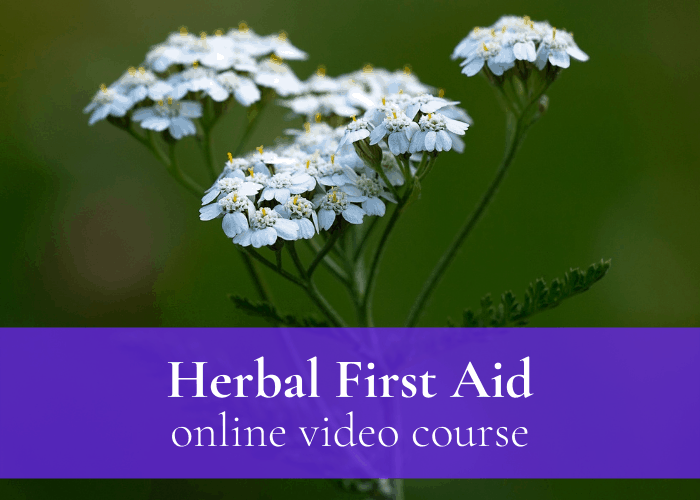
Like all our offerings, this self-paced online video course comes with free access to twice-weekly live Q&A sessions with us, lifetime access to current & future course material, open discussion threads integrated in each lesson, an active student community, study guides, quizzes & capstone assignments, and more!
If you have a moment, it would help us a lot if you could subscribe, rate, & review our podcast wherever you listen. This helps others find us more easily. Thank you!!
Our theme music is “Wings” by Nicolai Heidlas.
Episode Transcript
Katja (00:14):
Hi, I’m Katja.
Ryn (00:15):
And I’m Ryn.
Katja (00:16):
And we’re here at Commonwealth Holistic Herbalism in Boston, Massachusetts.
Ryn (00:20):
And on the internet everywhere, thanks to the power of the podcast.
Katja (00:23):
Woo hoo.
Ryn (00:24):
Yep. Well, we are continuing our series on first aid.
Katja (00:29):
Yes. We have been teaching first aid skills for honestly, a couple of decades now. And I…
Ryn (00:36):
Hey.
Katja (00:37):
What?
Ryn (00:38):
Hang on. Yeah, a couple decades.
Katja (00:40):
A couple decades now, babe.
Ryn (00:41):
You’re right about that, actually.
Katja (00:42):
You’re getting old, is what I’m trying to say.
Ryn (00:44):
Yes. We’re very old here. We’re so old together.
Katja (00:47):
I, you know, no. But you, babe, you’re getting old. Anyway, one thing that I have found consistently stresses students out is bandaging. It’s harder than any other topic in first aid. And the thing is that it’s not magic. There’s not a ton of stuff you have to memorize. You really can do it well, and it is worth doing well. So, in continuing this series, I really wanted to make one episode just be a giant encouragement and motivation extravaganza for you, because bandaging is important to know how to do. And you can do it, and it’s not hard. And so that’s what we’re going to talk about today.
Ryn (01:37):
Yeah. That is what we’re going to talk about today. But first we need to give you a reclaimer. That’s where we remind you that we’re not doctors. We’re herbalist and holistic health educators.
Katja (01:47):
The ideas discussed in this podcast do not constitute medical advice. No state or federal authority licenses herbalist in the United States. So, these discussions are for educational purposes only.
Ryn (01:59):
We want to remind you that good health doesn’t mean the same thing for everyone. Good health doesn’t exist as an objective standard. It’s influenced by your individual needs, experiences, and goals. So, keep in mind we’re not attempting to present a single, dogmatic right way that you should adhere to.
Katja (02:15):
Everyone’s body is different. So, the things that we’re talking about may or may not apply directly to you. But we hope that they’ll give you some new information to think about and some ideas to research and experiment with further.
Ryn (02:27):
Finding your way to better health is both your right and your own personal responsibility. This doesn’t mean that you’re alone on the journey, and it doesn’t mean that you’re to blame for your current state of health. But it does mean that the final decision, when you’re considering any course of action, whether it was discussed on the internet or prescribed by a physician, that’s always your choice to make. Yeah. We say it every time because we believe it.
Katja (02:49):
Also, you should get the Herbal First Aid course. It has more detail on everything that you need to know to take care of everything from sports injuries to more serious stuff: wounds, staph infections, burns, bites, stings, environmental heat stroke, and hypothermia, and that kind of stuff.
Ryn (03:13):
Panic, fear, overwhelm. Yeah.
Katja (03:15):
Yeah, yeah, yeah. So, these are all skills that you need. And if you’re thinking I really don’t like first aid classes because I don’t like to see gory bloody pictures, I got you. I specifically made sure that when we were building this course, the pictures that went into it are not gory, horror movie kind of pictures. So, if you want to work on this with your kids. If you just have a light stomach, and you don’t want to see that stuff, whatever. You can learn this stuff. And so I promise it’s not gross out. It is just the skills that you need to get the job done.
Ryn (03:54):
Yeah. And it’s a video course. So, as for the bandaging, there is a bunch of excellent video constructed by our lady here to show you exactly how the bandages go on, and how to wrap them, and how to cope with lumps. And how to make them nice and clean and flexible.
Katja (04:13):
And how to put them on your wiggly pets. There’s also a video of that. There is video of my lovely assistant husband who is holding very still for me so you can see everything in a perfect kind of environment. And then our lovely dog, Elsie, wiggling like crazy so that you can see bandaging in a very wiggly environment. And everything in between.
Ryn (04:42):
Yeah. So, we’ve also made you a special coupon code. It’s going to be active for the month of June. This is 2025 just for future reference. But if you pick up the First Aid course, and during checkout you enter the code: firstaid – all one word, no spaces – then you’ll get $25 off. It’s a great deal.
Katja (05:04):
It’s really important because everybody needs first aid skills, and now you can get them cheaper.
When Band-Aids Won’t Cut It, Bandages
Ryn (05:11):
All right. So, first thing that you wanted to point out in this discussion about bandaging is that yeah, Band-Aids are actually pretty good. They’re a classic for a reason, you know?
Katja (05:25):
Well, and they’re a modern classic. Because honestly, the idea of having like a bandage that is pre-ready, and all you have to do is slap it on. And it will just stick there and protect the wound. That is wicked new. That is not something that we should take for granted. If you’re listening to this, and well, okay. You know, I guess you’d have to be kind of older. So, if you’re listening to this and you’re my age or older, then you already know not to take Band-Aids for granted because, you know, whatever. But if you’re really young, maybe you think that Band-Aids were around forever. And you wouldn’t be weird for thinking that. But the thing is that they work. They’re actually a wicked cool invention. And so I just want to take a moment to marvel at the convenience and the ubiquity of a Band-Aid that you can just plop on any wound anywhere, so that we don’t take them for granted. It’s a big deal. Okay. But now that we’ve had our moment.
Ryn (06:31):
And I mean, there’s lots of places where you’ve got a blister, you’ve got a small bite, you’ve got a whatever. And the Band-Aid is big enough to cover the thing, you know?
Katja (06:38):
Yeah. Or you have a cut on your finger. It’s not really that deep. It’s not really that big, like whatever. Yeah, it’s handy. It’s cool. It is cool. But here’s the thing. A bandage is so versatile. It is so flexible. It is so breathable. And you can bandage anything. There’s a limit to what you can Band-Aid, but you can bandage anything. And you can tailor your bandage to the weird situation. Like oh, I have this jagged cut that goes between two fingers and down my hand or whatever. You’re not going to get a Band-Aid on that. So, we think about, I don’t know, that everybody just grabs a Band-Aid so frequently. But the reality is just that you’re going to need some bandages in your life. If you’re out there doing things in the world, you’re going to get cut in weird ways, and you’re going to need to know how to bandage. So, don’t be intimidated. Let’s just learn how to do it.
Ryn (07:40):
Yeah. I mean, especially any wound that’s really sensitive, or it’s going to hurt when you’re peeling the sticky bits off. Or you look forward with dread to the idea of I have now peeled it off, and now I’ve got sticky glue all around these edges. And I’m going to need to pull that away before I can clean it well and put on another one. There are situations where a Band-Aid is not your favorite option, and you want something that’s a little softer and gentler in terms of what’s actually touching the sensitive bits of your body. Yeah. So, that’s bandage time.
Katja (08:12):
All right. Well, some things that you should know about bandages really quick. They are super versatile, like we’ve been saying. You can bandage basically everything. Even things that you would normally put a Band-Aid on, you also can bandage those. They allow you to keep the wound clean, but they are a little more breathable than Band-Aids, although Band-Aid technology has been improving. They are more breathable. You can make your own bandages. Listen, buying them is so much more convenient. But if you were in a situation that was a disaster or an austere situation, you can make them yourself. You can make them out of bedsheets, you can make them out of anything basically. You’ve just got to make them clean. But it’s nice to know that nope, you can just make them yourself. And a bandage will give you a lot of flexibility in wound management. If you have a large wound that is not quite big enough to need stitches, but you want a little pressure on it to kind of help push the edges back together. You can do that with a bandage and maybe not so much with a Band-Aid. So, that kind of just a little extra compression. Or a wound that kind of won’t stop bleeding. And you get it to stop bleeding, but then you move a little, and it just starts bleeding again. A little extra pressure in that bandage can help. And the flip side of that is a little less pressure. If you have a wound in a place that’s going to be bending a lot, and it’s reasonable for you to bend, then you can actually build a little extra flexibility into the wound so that you still have some range of motion. I mean, into the bandage. You can’t build it into the wound. You can build it into the bandage so that you still have some range of motion if that’s actually available to you. So yeah, just that flexibility in being able to handle different kinds of situations. Yeah.
The Basics: Slow & Smooth
Ryn (10:15):
Yeah. But the most important thing, the number one thing here is that if you want to get good at bandaging, you just have to practice. You have to try it, you have to do it again. You have to repeat the process over and over again. It’s a skill. It’s something that you need to execute repeatedly in order to get good at it. It’s like tying knots, you know? You learn about a knot. And you’re like it goes under, and then there’s a rabbit somewhere, and I don’t know what happens next. And then there’s a knot, right? But after you’ve done it enough times, it’s motor memory. It’s something that you don’t need to really talk your way through or think your way through each time. You just do it, and now it’s all set. Bandaging is like that. And it’s like that even when it’s not a specific spot on the body or the exact kind of wound that you’ve already seen in the past. Once you get the basics down, the kind of principles and some skill about how you can manipulate and arrange your bandaging, and your gauze, and your pads, and all of that, then you develop a lot of flexibility, a lot of capability to respond to different circumstances. So, while there are some kind of conventional approaches. Like oh, you have a wound in the palm. Okay. The best way to wrap it is start at the wrist, go around a couple times. And then come up over the palm at this angle, and then around that way, and through here. There are some kind of replicable patterns that you’ll learn as you go along. But they’re guidelines, right? In the most general sense, you don’t need to be focused on the right way to do it, the exact way I saw in that awesome video on YouTube, or in the First Aid course, or wherever else, right? There’s not one only right way to do it. But again, once you get the basics down and some of the key things that we’re about to list out for you, then you’ll have a good handle on it.
Katja (12:04):
Which, you know, every wound is a little different. You could have five wounds across the palm of the hand, but they would all be different. They wouldn’t all be exactly the same. So, every time that you bandage, you’re facing a somewhat different situation. And I feel like that is the kind of place to build optimism and to build encouragement instead of feeling intimidated. To just be like everyone is different. So, I need to do a good job, but I don’t need to do the exact job that somebody else did, you know? So, let’s talk about doing a good job. A couple of like guidelines for how do you know that you’ve done a good job?
Ryn (12:48):
Right. One of the first is you’re doing as much as you can, and I put a little star on that. You’re doing as much as you can to make the way the bandage lays against the body smooth. Not lumpy, not uneven, not with a bunch of hangy bits coming out this way and that way but as smooth as possible, right? My asterisk was one of the key things you need to do in order to achieve that is to slow down. And don’t be afraid to wind back a couple of steps if you get to a spot, and you’re like I just can’t make it smooth. Everywhere I go there’s a lump, there’s a peel back, you know, whatever. Just slow down. A lot of times when you’re doing this, everybody’s amped up, right? Somebody’s in pain. Everybody else is agitated, or scared, or grossed out at the blood, or whatever it is, right? And so a lot of times it’s like ah, cover it up. Get the gauze on there and just wrap it around until I don’t have to look at that anymore, you know? But that doesn’t get you a great bandage.
Katja (13:48):
Yeah. You know, also you might feel like if you want to instill confidence in someone else, you need to somehow be fast at this.
Ryn (14:01):
One and done. I have perfect confidence in every movement I make as I bandage up your weird elbow problem. It’s not going to happen, you know?
Katja (14:10):
Right. And so I just want to encourage you instead to have confidence in being slow. And when you are caring for someone who is injured and in pain, slowness, your slow movement – deliberate, confident, slow movement – helps them actually to calm down. And so you don’t have to feel like oh, if I can’t do this fast, they’ll be afraid I’m doing it wrong, or that I don’t know what I’m doing. Nope, do it slow. It’s actually the right way to go. And that really allows you to see how is the bandage laying? And it’s okay. Like you said, it’s okay to backtrack a little and then try again. Anytime that you have a lump in the bandage, that’s going to cause irritation. And anytime that the person is moving around, they could get irritation from some pressure against their skin. But also that lump is creating a place where it’s more likely that the bandage could catch on whatever they are doing in the world as well. So, it’s kind of like bad on the inside and bad on the outside. So, it just really is confidently, slowly make everything smooth. You will get faster at it the more times you do it, but the goal here is not to do it fast. There is actual merit in doing it slow. And really, especially getting the lumps out, getting the gaps out. If you’re coming around a corner, and just one side of the bandage is tight, but the other side is just a little floppy. Oh, back that up and make it nice and smooth on both sides. Because anywhere that there are gaps, lumps, whatever, it could catch on something. And then that’s just not going to be awesome.
Ryn (16:19):
Yeah. You feel pain. You get crud in the wound. You loosen the bandage. It doesn’t sit right. Whatever you put underneath to actually heal the problem isn’t going to be in contact the right way,
Katja (16:30):
Or it’ll start slipping around.
Twisting & Taut But Not Tight
Ryn (16:31):
Oozing out. Yeah, yeah. As you’re going through that, you can be folding your bandage material. Or you can twist it around in order to get the curve, or the shape, or the lay against the body that you’re looking for trying to get it to lay flat each time, right? And this is going to be necessary – not just helpful, necessary – if you’re working on something like a hand where you might be going between fingers or even just going around the palm itself. It’s often like if you want it to work, and you want it to be smooth, you’re going to need to twist or turn the bandaging as you as you set it over.
Katja (17:09):
Yeah. And so by twisting, really think about you’re holding the roll of bandage in your hand. And you could even just do this without having anybody else around you. You could just unroll the bandage a little bit, and hold the loose end in one hand and the roll in the other hand, and just turn that roll 180 degrees. And now your bandage will look like a bow tie because it has a twist right in the middle. And so you can just practice doing that turn over and over again. It’s just a 180 degree turn of the roll. And then you think about okay, yeah, if I had to go up and in between fingers. Well, if I just went straight through, I would just get a big bunch of all of the bandage stuck in there. And then that’s going to create lumps on either side. But if you go right up to the finger, and then put that 180-degree twist in, and then over the other side. So, imagine you were going up the palm, put that 180-degree twist, and then down the back of the hand. Now yes, you do still have however much fabric in between the fingers, but it is neatly gathered up in that twist. And on either side of the gap between the fingers, you have nice, smooth, flat bandage. And take a minute to make sure that it really is smooth and flat before you go covering it up, you know? But yeah, that concept of just putting a twist in the bandage as you are unrolling can really help you get around weird corners. It makes a huge difference.
Ryn (18:54):
Yeah. Definitely. All right. Now as you’re doing all of this, you’re trying to make your bandages appropriately tight. You want it tight enough to stay tidy. For things to stay in place and not to just kind of fall off or come out, but not so tight that we reduce circulation, you know? If the bandage is loose, like we said before, it’s going to slide. It’s going to get caught on things as you’re moving around. You’re going to expose it to a risk of infection or other issues like that. So, we’re trying to keep it stable. But again, you can wrap too tight. Even if it’s not like an ACE bandage that has the elastic inside. Even if it’s just roller gauze, you can do it too tight. So, there are ways to check for that. Like if it’s something you’re banding around a wrist or around the hand, then okay. They can relax the hand, and you can push on the nails and see how long it takes for the color to come back. You push on the nails, and they kind of go white for a moment.
Katja (19:54):
Yeah. You can just do that right now with your own fingernails. Just pinch the tip of your finger and look at the fingernail. And for just one little moment there it’ll turn white. And then it’ll very quickly return to being pink. And that is just you squeezed the blood out of it while you were pinching it. And then when you let go, the blood came back in. Well, if that bandage is super tight, and you squeeze, and it turns white, it will turn pink again too slowly. And that’s just a good indication that the bandage is too tight. Remember I was talking about a wound that was kind of on the border of needing stitches? And so you wanted to make the bandage a little extra tight to help hold it together and to encourage it to stay together. Listen, there’s nothing wrong with doing that. But watch to make sure that yes, if we are going to tighten up the bandage… This is called capillary refill when you do that pinch test on the end of the fingers. Because it’s like how fast are the capillaries in your finger filling back up again with blood? And so yes, that’ll be a little slower than with no bandage at all. But in this moment, you want a little extra tightness. And so if you do that with a bandage, you might say I’m going to check this bandage every half hour. I’m going to check it every hour. And I’m just going to squeeze and make sure that there’s still circulation going through. I’m going to talk to this person and make sure that their hand isn’t falling asleep or whatever body part it is. But just for a little while while this is clotting up and holding together, I just want a little extra support. And there’s nothing wrong with that as long as you’re checking in and making sure that the hand is not falling asleep. But if that’s not what you’re trying to do. You’re just trying to put on a bandage, and it’s going to stay on for a day, or it’s going to stay on until you check it that night or whatever. Then you really do want it to be in that super goldilocks, comfy zone of taut enough to be neat, and tidy, and all very smooth but not tight, right? Yeah. That place between whoa, taut but not tight. Yeah.
Neat & Tidy & Maintaining Range of Motion
Ryn (22:16):
Yeah. Like that. All right. Cool. I think you got the idea on that one now. Okay, cool. So, other thoughts here. Bandages are fabric. You might have some skills about manipulating fabric from other practices in your life like folding your laundry, or being a dress maker, or making your bed, or whatever, right? When these things are loose, or wrinkly, or sloppy, it’s not ideal. It’s not very appealing. But a little attention to detail, a little tug in the right place and not too much of a rush to get it done and move on to the next thing. And then you can smooth out all the wrinkles. It can look really nice.
Katja (22:59):
You can think about every mummy movie ever. And here’s always some point where the mummy has the bandages that are kind of halfway falling off. And then somebody steps on the bandage, and then the mummy trips. And then like hooray, we defeated the mummy or whatever, right?
Ryn (23:14):
They unravel and there’s nothing inside.
Katja (23:15):
Right, right. Exactly. I don’t really know. I haven’t really watched that many mummy movies. But there are cartoons. You see that, right? And so, okay. It’s like a funny image in your head. But keep that funny image in your head when you are working with the fabric of a bandage. And be like well yeah, I don’t want somebody to just step on my mummy’s bandage. And now suddenly my mummy falls face first into the whatever. No, I want this to be a nice, neat… Okay, now think of your other pop culture references wherever you’ve seen medical shows, and the beds have hospital corners. You know, like a made bed, and it’s so made you could bounce a quarter off of it. And the corners are perfectly folded, and crisp, and whatever, and there’s no wrinkles anywhere. All right. So, that’s what you’re going for, not the mummy movie. Yeah.
Ryn (24:08):
Yeah. Nice. So, that’s what, that’s what makes the bandaging job neat and tidy. And here’s the thing though. If it hasn’t moved yet, you’re not positive how well this attempt went, okay? So, once you’ve got it wrapped up, that’s good. But now they want to move around a little bit. And if it’s something like a wrist, or a knee, or something like that. Then before they go away from your first aid tent or whatever, then have them move around in a bunch of different ways. Give it a few minutes to see if it holds, to see if things stay in place, and also what kind of range of motion they still retain, right? When you have an injury, you’re usually going to cut down your range of motion a little bit. But if it’s possible for them to dress themselves, or to manipulate objects, or to cook, or whatever with the wound and with the bandaging on top without it getting messy, without it coming out or getting caught on things or whatever, then great. We did a good job.
Katja (25:07):
Yeah. And that’s it. That’s actually it. You don’t have to memorize I’m going to do a basket weave. And then I’m going to do this and then I’m… Those things can be helpful in certain situations. But when we’re just talking about bandaging for wound care, every situation is different. You don’t have to memorize the exact way that someone else bandaged a wound. You just have to follow these guidelines, and make sure that it is neat and tidy, and that they retain whatever range of motion movement they have already. The wound will limit it. But whatever they have with the wound, we want to let them have that with the bandage as well. And if you do that, good job, you did it. You made a fantastic bandage. The only thing that you really need to do to get good at this is practice. You can watch videos if you want to. But I am telling you, the act of practicing what would I do if I had to bandage between two fingers? I don’t know. I guess I’m going to try it. I guess I should do that twist. Okay. Really the biggest trick of bandaging is twist the thing by 180 degrees. If you know that trick, you’re pretty much ready to go. And then just try it. Just come up with the craziest possible wounds that you can think of and just try it. But Katja, you say, if I just try it, I only have one hand because the other hand is getting bandaged. That’s a problem. So, we have a solution for that.
Mummy Practice Parties & Supplies
Ryn (26:52):
Yeah. It’s the mummy party, right? This is where we get a bunch of roller gauze and maybe some pads, and then we bandage our friends until we all look like mummies together. Yeah. You’ve got one on your head. You’ve got one on both arms all the way down.
Katja (27:09):
Here’s what you’re going to need for this. You’re going to need a box of non-sterile roller gauze. I like two-inch roller gauze for anything involving the hands. And then I also like to have four-inch roller guard roller gauze. Because if you have a big wound on the leg, or maybe the middle part of the arm, or the torso, or something like that, then the larger is better. But the thing is that for practice, get the cheapest box you can. And it does not have to be sterile because you are literally just practicing with this. And you can get it at a drugstore. You can get it at evil Amazon. You can get it at online medical supply places. But shop around to get the cheapest. If you buy them at the drugstore in your town, that will be the most expensive way. Okay, so grab those. And the thing is that a box will have 10 or 12 of them in there, and you can roll them back up again. They do tend to catch on things, and so you won’t be able to use them forever. But you’ll be able to use them a lot of times if you just carefully roll them back up again when you’re done.
Ryn (28:22):
Yeah. I mean, ultimately they’ll fray. But honestly, that little practice of rolling them back up together is helpful.
Katja (28:29):
It is helpful. It’s, it’s just a,
Ryn (28:31):
It’s just some more experience of manipulating the thing physically. Yeah. It’s going to come through. You might also want to grab some ACE wraps, the sports bandaging stuff with the elastic inside. Again, two-inch width, four-inch width, they’re both useful. It’s good to have both of them and to practice with both. These are more durable. That can be good if you want to practice a bunch of times. But they also behave differently than the roller gauze does because of that stretchiness. That’s going to change the way they lay against the body. It’s also going to add a degree of compression when you wrap all the way around. And so you’re going to need to be a little more careful or attentive to things like circulation and range of motion once you’ve got that on. But it is helpful to practice with both. And there’s plenty of times when you’re like okay, I’m going to get a gauze pad, roller gauze, and then an ACE bandage or something else to secure it and keep it really sturdy. Especially if it’s going to be a longer time between wound cleanings and changes of the bandaging. Then that’s a situation when we might want to keep something really, really stable for longer periods. Yeah.
Katja (29:40):
Now, you can also get other bandages. But in my experience of all of the first aid everything, you can pretty much do anything you need to do with two-inch and four-inch roller gauze. And you’re also going to get some gauze pads. They’re like the squares. And that’s what’s going to go directly on the wound. But in terms of okay, now I’m wrapping this up. Honestly, if you have two-inch and four-inch, you can really do anything. And it’s way more cost effective to buy in bulk a bunch of two- and four-inch roller gauze instead of having specialized sizes for every different kind of thing. Just get really good with those two sizes. And it’ll be more cost-effective, and you’ll basically be able to do anything. Yeah. But then those gauze pads, for this, for a practice situation, get the non-sterile kind. You should get them to practice with. Because when you put them on wherever the supposed wound is while you’re practicing, you’ll realize oh, it’s a little fiddly to kind of hold the gauze pad in place while I am wrapping the roller gauze around it to hold it in place. And so yes, it’s good to practice that part so that you get used to the fiddly nature of it. But for practice it doesn’t have to be sterile. And when they’re not sterile, they’re cheaper. For your first aid kit, get the sterile ones. Basically, I almost never get sterile roller gauze because the roller gauze is almost never going to come in contact with the wound itself.
Ryn (31:24):
Yeah. And I mean, the circumstances when you would need to do that is like oh, this wound is so deep. I need to take the entire roll and pack it inside of there. This is very advanced first aid work, right? Hopefully you never have to deal with that. If you do, that’s at the stage where your immediate concern is to stop the bleeding, right? And so we’re going to disinfect this wound later. It’s going to be a multi-day process. It’s going to go on and on. But in this moment, we are cramming stuff in there to stop the bleeding and save life, right? So, that’s another situation where you’re not like oh no, it has to be sterile. Let me get my other pack from down the road. We’re doing this fast, right? So anyway, for most situations you’re ever going to encounter, including real live wounds, you’re not going to need that roller gauze to be sterile. But the pads that touch the wound yeah, of course.
Katja (32:13):
And it’s not bad to get the sterile ones, it’s just that they cost a lot more. And if you’re trying to do this on a budget, then yes, get the sterile gauze pad that’s going to go against the wound. But the not sterile ones are still clean. They’re not contaminated. They are clean, they just aren’t sterilized. So, that’s fine.
Ryn (32:34):
Cool. All right. You’re also going to need a friend, or a kid, or maybe a pet, or somebody for you to bandage upon, right? And get some music, and some snacks, and some party hats, and whatever, right? Yeah. A few talismans to go with the mummy theme.
Katja (32:52):
Yeah. No, that’d be good. Maybe you have some mummy horror movies in the background just to really set the mood.
Ryn (32:59):
Abbott & Costello Meet the Mummy. That’s a pretty good one.
Katja (33:01):
Oh, okay. Sure. Yeah.
Ryn (33:03):
You know, for the kids.
Mummy Play: Unbandaging, Backtracking, & Trying Again
Katja (33:06):
I have not seen that, but for the kids is probably appropriate for me too. Yeah. Okay. So, what’s going to happen here is that whoever is volunteering to be the mummy for you, you are going to just ask them okay, pick a random place and say you’re wounded. And you can give them a Sharpie, or a pen, or whatever, and they can draw it on if they want to. And you could also use sticky notes, or a little piece of tape, or whatever. Or they could just point and say it’s here. But tell them maybe the first one make it easy. But tell them to be a little creative. Let them be a little obnoxious with it. Because the more challenging that you have to deal with in a fun situation where you have snacks, and music, and party hats – party hats? Party hats – the more confident that you are going to be when you’re doing this in the real world. So, yes. So, tell them to be really creative slash obnoxious. And just say great, I’m wounded here. Now you bandage it.
Ryn (34:17):
Yeah. And so then you grab your gauze pad. You put that over there. If it’s a real wound, right, this is going to be holding in your herbal dressing.
Katja (34:30):
Vinaigrette?
Ryn (34:34):
No. Your wound care dressing, right? So, this is maybe your monarda-infused honey. This is your pine resin salve. This is all of that good stuff that you’ve learned about with your herbal powers to heal the wound, and make sure it doesn’t get infected, and all that greatness, right?
Katja (34:50):
And there’s different… The appropriate dressing is different for different types of wounds. So, well, when in doubt you pretty much can’t go wrong with honey. But for different wounds you would choose different things. But whatever you’re choosing would go on the wound and be held in by the sterile pad. And also the sterile pad is going to give the nice buffer between the unsterile world and the wound.
Ryn (35:18):
Yeah, yeah. I wouldn’t waste honey in a practice environment here. But if you have some old salve that’s not really great anymore but isn’t horrifying when you sniff it. You could just be like well, just for the practice, just for the fact that it’s a little more slippery now, whatever, I can put that on to the unbroken, fake wound. And then my sterile or unsterile pad goes over that. And now my roller gauze gets wrapped around holding that in place, covering the wound area. A little space on either side, right? You don’t want to have it be just only over the actual bleeding spot.
Katja (35:56):
Right, right, right.
Ryn (35:57):
A little space on either side.
Katja (35:59):
You want to make sure basically that no part of the square, sterile or we’ll pretend it’s sterile for the purposes of practice gauze is sticking out from the bandage. The entire square should be covered completely. And even not just barely covered but a nice generous cover around the whole thing. Yeah.
Ryn (36:23):
Right. Okay. So, now they’re bandaged up. You’ve got to have it secured in place, you know, so you don’t just have a tail end of the gauze flapping around. We can tuck that in. There’s various ways to secure that.
Katja (36:35):
It’s okay to tape it, especially with that micropore tape. That’s really, really effective. And also one of my favorite ways to do this in a real situation is to put self-occlusive wrap over it. Because that gives you a semi-waterproof covering outside of the whole dressing. And it sticks to itself, but it doesn’t stick to you. So, that’s going to hold everything together really nicely.
Ryn (37:07):
Yeah. That’s really, really handy stuff. With the tape this isn’t like I have a wrap of the roller gauze, and then there’s a tail. And then I have a two-inch length of tape that attaches that to the rest of the roller gauze underneath, right? With the tape you’re going to want to wrap it around so the tape touches itself.
Katja (37:26):
Right. It sticks to itself better than anything else.
Ryn (37:30):
Yeah. And that’s a place where, again, you’ve got to be careful about the amount of pressure that you put on. Because maybe your bandage is perfectly just the right amount of pressure, just the right amount of compression and squeeze. And then you go to put the tape on, and now you squeeze it down real tight. And now the tape is holding it at that pressure level, right? So, with that one, again, you want to make it flat. You want to make it secure. You want to make it clean. But just be thoughtful about how much pressure you’re putting in.
Katja (37:57):
You know, also a thing to be thoughtful of is don’t put the tape directly over the wound itself. Of course there’s layers of gauze in between the tape and the wound. But put the tape above or below the wound but not on the wound, because if it’s on the wound, that could hurt. Yes.
Ryn (38:21):
When you try to get it off later. Okay. And so now they’ve got their wound dressed, covered, wrapped, secured. Now let them move around, right? Walk around, do some daily tasks, pick up some objects and move them from place to place.
Katja (38:39):
Put on a jacket. Take off a jacket.
Ryn (38:40):
Yeah. Nice. That’s a really good one, yeah. Just to see what happens to the wound, right, to the banding situation. Does it fray? Does it fall apart? Where? Can you see why that happened there? Can you see an alternative way to wrap it or secure it that would prevent that from happening? Cool. So, this is like the stress test for your bandaging effort.
Katja (39:01):
Yes. And then don’t forget to be proud of yourself. And just be like ah, yes. You put that jacket on, you took that jacket off, and it still looks great. All right. Pat yourself on the back. You did a good job. And now you’re just going to unbandage in reverse. You’re going to roll the gauze back up as you go so that you can use it again in your next round of practice.
Ryn (39:25):
It’s easier to do that than to take the whole thing off and then try to handle this coiled and long thing. Honestly, rolling it as you unwrap is easier.
Katja (39:35):
It is easier. It’s much easier. It’s not fast, but it’s not going to be fast no matter what. Like re-rolling it is just not going to be fast. So, do it while it’s still on the person, because that gives you a little resistance to it. It just helps you a lot to roll it back up again.
Ryn (39:52):
Nice. And as we said before, if you make an attempt, and it doesn’t go too well, you don’t have to go through the whole process before you start over. You can be like hang on. I’ve got to wind this back a few rolls and start over. I’ve got to resecure the gauze pad underneath. That’s all good. That’s helpful practice. That’s good learning.
Katja (40:11):
And it could happen anytime. It could happen if somebody has a wound in a weird place. It could happen to somebody who has a lot of experience bandaging. So, if that happens, you don’t need to feel like oh, I’m never going to be good at this. Or oh, nobody’s ever going to trust me or whatever. No. The reason to trust you is that you are paying attention, and that you are redoing whatever needs to be redone. It isn’t that I should trust you if you just do it automatically correct the first time with never making a mistake. Okay. But, you know, whatever, it’s great. But at some point you’re going to see something that you have never seen before, and you’re going to have to think about it a little bit. So, the trust is not oh, you can do that without even thinking. The trust is you cared enough to think. You noticed when it wasn’t right. And you backtracked and then fixed it. Yeah. So, that’s where your confidence is coming from.
Ryn (41:12):
Nice. Nice. We mentioned before, but this is a good thing to practice with kids, you know? Maybe this is older kids who might be out and about with the crowd, with the crew, and who knows what’s going to happen to them. So, probably you’re encouraging your kids to have a little first aid kit that they carry with them when they go out into the world, a little everyday carry situation, yeah? Well, they’ve got to know how to use that stuff, right?
Katja (41:39):
Yeah. You’re basically never too young to start learning this. But by the time that your kids are eight years old, especially 10 years old, really make sure they have these skills. And it’s okay to learn them together. You don’t have to know how to do this for your kids to learn how to do this with you. It’s okay to let your kids see you learn. In fact, it’s great to let your kids see you learn because you’re modeling continuing to learn even after you’re an adult. You are showing them that that learning is not one and done, and once you’re an adult you never have to learn anything again. Letting them see you learn is a gift to them. So, it can feel a little uncomfortable to be trying to work on something with your kids that you aren’t really comfortable doing. But just let go of that discomfort. And recognize that you’re actually modeling excellent behavior for your kids when you show them hey, yeah, I’m not good at this either. But we’re going to learn it together. And we’re just going to learn, and practice, and get better every time we do it. That helps them too.
Different Wounds Call For Different Herbal Actions
Ryn (42:59):
Yeah, absolutely. All right. Now you might be thinking hey, I listened to this podcast for the herbal stuff. And I really want to know more about the pine resin salve, and about the herbal-infused honeys, and all that kind of thing. Don’t worry. If you’re wondering what goes under the bandage, right? If you’re like well, I get about bandaging. That seems important. But I don’t know what to do instead of the I don’t even remember the names of the disinfectant creams that people put on.
Katja (43:24):
I think Neosporin.
Ryn (43:25):
That’s the one.
Katja (43:26):
Yeah. That’s what you’re thinking.
Ryn (43:27):
Right? All I’ve ever used is Neosporin. What can I put on that’s herbal? There are a lot of options actually. And the thing is that different wounds can need different types of herbal action, the effect that the herb has on that tissue. It could be a different stage of the wound’s development, right? Like I just got it a moment ago versus I’ve had this wound for a while. I didn’t take good care of it, and now it’s getting kind of green. That calls for a different approach, right? And so again, different wounds might need to be kept moist all the time. Some of them might need to be a little bit dry but not too dry, you know? Wounds can be very superficial but still really irritating. Like maybe there’s also a plant irritant. It’s a shallow cut, but it’s full of poison ivy somehow. Or it could be a really deep wound. And we’re like hey, that’s some weird looking tissue under there. What are we doing with this? So, these can all make a difference in what we’re going to choose on the herbal side to manage it.
Katja (44:30):
Right. It’s not like – I don’t know – if you go to the drugstore, and you go in the first aid aisle, it’s pretty much just Neosporin all the way down, I guess, and hydrogen peroxide. Those are the things. But it’s not a one-size-fits-all approach. And so while it is true that there are some things that I always want to have around because I work with them a lot, like honey, honey and pine resin salve. Or if you live in a place without pine trees, then a general calendula salve would be good. But you are not going to put those on every single thing. You’re going to put them on different things. Different wounds need different things. And so it’s not a super easy that we can just tell you in one sentence here, just have this, and you’ll always be all set. But don’t worry. Because the Herbal First Aid course has all the different types of situations and the order of okay, well, let’s start this wound out with honey. And then as it progresses, and it starts to have this kind of thing going on like getting dry around the edges and maybe a little itchy. Okay, then we’re going to change over to salve, and then we’re going to do this, and then we’re going to… The different stages of healing get supported by different herbs and different preparations of herbs. All of that is in the Herbal First Aid course.
Ryn (46:00):
And as we said up top, you can get $25 off when you use the code: firstaid, all one word, no spaces, during the checkout process. Don’t miss it, right? You’ve got to click the little thing that says I have a coupon code.
Katja (46:13):
But I made it all caps. I couldn’t make it bigger, and I couldn’t make it bold, but I at least did make it all caps. So, when you’re checking out, you will see if you have a coupon, put it here. Yep, yep, yep.
Ryn (46:24):
All right. And remember, that course has a lot more than wound management, right? When people think about first aid, they’re always thinking about a bleeding wound, or maybe a nail through your foot, or maybe a dog bite, right? But it’s always like something gory. Okay, yeah, a sprained ankle. Yeah, right? But first aid, it puts us in mind of those kinds of things. But as we mentioned in the previous episode, it’s way more likely that you’re going to encounter upset stomachs, and uncomfortable bowels, and agitated emotional states. Those are the most common first aid situations you’re going to run into. And we want to help you address those too.
Katja (47:01):
And there’s burn care, and there’s all the different sports injuries. And there’s broken bones, and sprains, and all that kind of stuff. And a complete materia medica so that you know which herbs are best for oh, this one’s a little infected. Oh, this one is just whatever. And skills to help you make sure that you know when it’s time to get more help. So, that you can say this is a little infected, but it’s still safe for me to work on this. Versus this is no longer safe for me to work on this, and I know why for sure, right? Yeah. That gives you a lot of confidence.
Ryn (47:42):
It does. Let me say one quick thing though about the materia medica. The way that we teach, like if you haven’t taken a course with us already, the way that we teach is based on some foundational ideas that we refer to as herbal energetics, right? And that comes along as a direct connection to herbal actions. What can the herb do in the body? When we combine the energetics, like is this a very hot fiery herb or a cooling one, with the actions. Like this herb can kill bacterial infections. This herb can circulate lymph in the tissues in a wound. That helps us to understand how that herb is doing what it does. And it also helps us to see where other plants could fill that role. So, it may be that you live somewhere where you don’t have pine trees around. And as you’re going through the course, you’re going to hear us mention pine resin salve over and over again. But we’re also going to explain why we find this particular preparation to be so helpful. And that can guide you to say okay, well, I don’t have pine. But I have this other resin producing, antimicrobial, vulnerary plant available to me. Maybe it’s gumweed, maybe it’s some other thing like that, right? If nothing else, you can grow calendula, like you said before, you know? And so this isn’t a situation where what you have to do is learn the best first aid herbs. It’s I need to learn the qualities and the actions of an herb that make it helpful for first aid kind of situations,
Katja (49:05):
Which is important because if you’re in a disaster situation, I mean, I’m just thinking about North Carolina last year. And so many herbalists’ homes were flooded. And so maybe their home didn’t wash away. But all their herbs were flooded, and now they couldn’t work with any of them. But not every plant in the surrounding area was washed away. And so you could still go out. If you know what you need, and what different plants have those qualities, then you can still go out and find what you need, even if it isn’t your favorite version of that. Maybe you would rather work with pine, or maybe you would rather work with calendula, or whatever. But okay, that’s all right. I know other plants that have those actions too. Yeah.
Ryn (49:53):
Right, cool. So, we think it’s pretty good, and we think you might enjoy it., And we encourage you to go and check it out. So, you’ll find a link in the show notes. You can also just jump right over to online.commonwealthherbs.com to find our Herbal First Aid course and all of the other courses we offer. There’s quite a few of them.
Katja (50:11):
I should probably know the number off the top of my head. And I don’t because the number is large.
Ryn (50:16):
Yeah, it’s a bunch. So, we’d love to teach you. Yeah, that’s what we like. So, that’s going to be it for this episode of the Holistic Herbalism podcast. We’ll be back soon with some more material. Until then, take care of yourselves. Take care of each other. Drink some tea.
Katja (50:36):
Drink some tea.
Ryn (50:37):
And have a Mummy party.
Katja (50:39):
They’re fun. They’re really fun. Yeah.
Ryn (50:41):
We’ll see you later.
Katja (50:42):
Bye-bye.
Join our newsletter for more herby goodness!
Get our newsletter delivered right to your inbox. You'll be first to hear about free mini-courses, podcast episodes, and other goodies about holistic herbalism.