
Podcast 263: Herbal Care Kits for Fall, for All!
If you haven’t made herbal cold/flu/COVID care kits for your household yet, now is the time! Herbal care kits are one of our very favorite things. Here’s the premise: when you’re sick, it’s hard to think, no matter how good an herbalist you are. So get the stuff you’re going to need ready ahead of time! It’s like taking care of your future self.
Plus, it’s likely that you’re the herbalist in your household – so you’re going to need to take care of everyone else too! But life doesn’t stop just because someone gets sick, so if you make care kits for everyone, then even if they get sick at the most inconvenient time – no problem. You’re already ready!
There’s two steps to this process. First, think about each person in your household, and how they tend to get sick. Then, plan your kits based on that.
For us it goes like this: Ryn tends to get a sore throat and a cough, or a stomach ache, whereas Katja always starts with an earache or headache. Even if we have the same bug, that’s where things tend to settle in our bodies. So in our kit, we’ll put some generally-applicable items – like herbs to steam with – but we’ll also put things in for headache and earache/ear infection, as well as items for sore throat, cough, and stomach ache.
Today’s episode is all about how we make our care kits, so that you can make yours more easily!
The natural next question is, what are the things we should put in our herbal care kits, for ear infections and sore throats and coughs and and and…?
We’ve got you! We made the Cold & Flu mini-course for exactly this reason! It’s got everything you need both to prepare your body to stay strong when folks are getting sick, and to deal with all the symptoms if you do get sick. It even has a simple reference chapter that goes through each kind of symptom individually, so you can mix and match your strategies to meet each person’s specific situation.
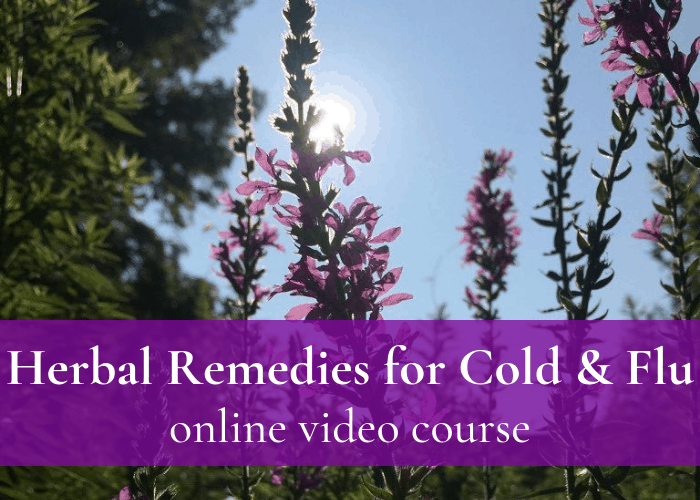
Like all our offerings, this self-paced online video course comes with free access to twice-weekly live Q&A sessions with us, lifetime access to current & future course material, open discussion threads integrated in each lesson, an active student community, study guides, quizzes & capstone assignments, and more!
If you have a moment, it would help us a lot if you could subscribe, rate, & review our podcast wherever you listen. This helps others find us more easily. Thank you!!
Our theme music is “Wings” by Nicolai Heidlas.
Episode Transcript
Katja (00:13):
Hi, I’m Katja. And I’m here at Commonwealth Holistic Herbalism in Boston, Massachusetts. Today Ryn is working on some worksheets for our Clinical Nutrition course. We are updating that course with all kinds of new information. I’m really excited about it. And while he’s doing that, I wanted to show you about our herbal care kits because I think these could really help you. This is just a way to take everything that you need for your own body and get it ready before you get sick. Because once you get sick, your brain doesn’t work well. It’s not going to be really easy to think through which herbs do I need right now. But people tend to get sick with the same type of patterns each time. So, if you think ahead and plan out the stuff that you’re likely going to need, okay, you might not get it perfect. But you’re going to end up with a kit full of stuff ready to use right there so that you can use it, or your family can do it for you. It’s going to make it so much easier to take care of yourself or to take care of your family members when you’re feeling sick.
Katja (01:19):
So, before we get started on that, I just want to do our reclaimer. Normally we do this together, but I’ll do it all by myself today. And I will tell you that we are not doctors. We are herbalist and holistic health educators. The ideas discussed in this podcast do not constitute medical advice. No state or federal authority licenses herbalists in the United States. So, these discussions are for educational purposes only. We want to remind you that good health doesn’t mean the same thing for everyone, and it doesn’t exist as an objective standard. It’s influenced by your individual needs, your experiences, and your goals. So, keep in mind that we are not trying to present a single, dogmatic right way that everyone should adhere to. Everyone’s body is different, so the things that we’re talking about may or may not apply directly to you. But we hope that they’ll give you some good information to think about, to research, and to experiment with further. Finding your way to better health is both your right and your own personal responsibility. But this doesn’t mean you’re alone on the journey, and it also doesn’t mean that you’re to blame for your current state of health. It just means that the final decision when you’re considering any course of action, whether it’s discussed on the internet or prescribed by a physician, is always yours to make.
Katja (02:38):
Okay, now that we’ve got that out of the way, let’s talk about herbal care kits. And specifically this is our fall and winter herbal care kit. We have a different set of stuff that we’re going to put into the kit in the spring and summer that would be around allergies, and injuries, and stuff like that. But this is for colds, and flu, and whatever else is coming down the pike for fall and winter health. Today I was getting out everything that I’m going to put into the care kit for Ryn and I. Yeah, we have a whole apothecary. We have all these things right at our fingertips in our home. But when you feel sick, it doesn’t matter how long you’ve been doing this. You just don’t want to think. You don’t want to try to figure stuff out in your brain. So, we put all this together ahead of time, and we just have a box here. It doesn’t matter. You could use any kind of box. But this is one that I had, and it works. And so we just keep using it over and over again. If you have multiple members of your family, you might want more than one box. You might do it in bags, or bins, or whatever. But I do really encourage you to actually tangibly put the stuff aside. It is important for multiple reasons. First of all, because when I was gathering this stuff up, I realized that we’re almost out of pulmonaria, which I’m going to talk about in a minute, and that we are getting low on thyme. These are two really important herbs for us through the winter. And so this was just a really good exercise to help me realize oh, I need to make an herb order for some of these things. But also if you really do have it set aside, then you know that it is available for you when you need it. And also family members can help you with it as well.
Our Herbal Care Kit: Broth & Herbs to Steam
Katja (04:35):
The very first step is to think about how you get sick and the members of your household, how do they get sick? So, in our household it’s just Ryn and I. And when we are getting sick, even if we have the same bug, we get sick in different ways. He tends to get sick with a sore throat, with a cough, and also with a lot of stomach upset. And I tend to get sick with earaches or an ear infection, headaches, a lot of sinus pressure. And we both are likely to run a fever. So, there’s some similarities there. But those are the way that our symptoms usually express. Sure, I’ll cough sometimes depending on what kind of illness it is. But usually what’s going on for me is up in the head, ears, sinus, that kind of stuff. And so as a result we need different stuff in our care kits. So, the first thing that we write down or that we think about in our planning is how do we get sick, and what kinds of things do we need to deal with that, to support it. Your answers for these questions are not necessarily going to be the same as our answers. But as an example I thought that I would just show you everything that’s going into our kit, and that will help you as you are thinking about your kit.
Katja (06:03):
All right. The first thing here that we can get out of the way the easiest is broth. So, if you make broth regularly, then I recommend that you freeze some and set it aside for emergencies, right? You don’t know when you’re going to get sick. And what if you didn’t have any broth ready that day? Broth is really important when you’re sick. It’s hard to eat when you don’t feel good, especially if there’s a fever involved or a sore throat. But broth gives you the minerals, it gives you the electrolytes, and it does give you proteins, a little bit of fat. It gives you basically everything that you need to kind of sustain yourself through the whole sickness. And so instead of freezing broth, I put some packets of broth in our box. Brodo is… I mean I’m not affiliated with the company. I just like their broth. But it’s a little bit more expensive of the pre-made broths, but it’s also really, really good. It will gel up when it gets cool, and the box broths don’t usually do that. So, it is more expensive. You don’t need to use it every single time that you’re having broth. But I do like to have a few packs for when we’re sick. Because when we’re sick then I really want the good stuff. Into that broth I can put seaweed, I can put mushrooms, I can put rice or vegetables or whatever else that I feel up to at that time. But at least I have some packets of broth in here that if I really feel so terrible that I can’t even think about anything, I know that there are some in here waiting for me and available.
Katja (07:45):
And already, this is bringing up a little maintenance point here. If you don’t use all of the stuff in your care kit this year, then return it to your apothecary and make it fresh next year. So, if we don’t go through all of this stuff, that’s okay. Because when I transition this box to be the spring and summer care kit, I’ll take everything out of it. I’ll put all new stuff into it. And that just helps make sure that this broth doesn’t stay in here for three years, right? It’s going to stay in here for a couple months. If I don’t use it, it’s going to go back into the kitchen for me to use whenever is the right time.
Katja (08:25):
All right. And then we have some general things that we’ll put in herbally. One of them is some thyme, or oregano, monarda, even sage would do it for steams. Now when you’re putting stuff into your kit, it doesn’t have to be super fancy. So, here I filled the jar with the thyme. And I’m just taking the leftover still in the bag that it was shipped in, and I’m just going to put that whole thing right into the kit. It doesn’t have to be everything… I mean if you want to make it fancy because that’s fun, go right ahead, but it doesn’t have to be. Just get the stuff set aside so that it’s there for when you need it. So the thyme is in there so that we can do steams. That clears out the sinuses. That also gets down into the respiratory tract to fight whatever virus, or bacteria, or fungal thing is going on. And even can be really helpful if you are the kind of person who gets a stye when you have a cold. A thyme steam is really helpful for that. It can be helpful for ears as well. And that is kind of a personal preference thing. I don’t really like to get any kind of moisture in my ears. So, I don’t feel comfortable putting my ear over a hot steam, but Ryn really does. That feels very good for him. That’s okay. We don’t all have to feel the same way about everything.
Fire Cider & Elderberry/Boneset-Infused Honey
Katja (09:47):
All right, and then we have here some fire cider. This fire cider is a pretty stripped-down version. It’s really just horseradish and ginger, onion and garlic. And that is all that’s in here. Oh, there’s a little bit of turmeric in here. And again, your fire cider recipe can be as fancy or as basic as you want it to be. It could literally just be garlic and vinegar. That would also be fine. But the purpose of the fire cider is to clear out those sinuses. I’ve got to tell you, I just get pasty stuck crud in my sinuses. And in between doing a thyme steam – you can do one of those maybe in the morning, one at night – but then I’ll still get stuffy through the day. So, fire cider works really well throughout the day just to help keep everything clear. For that purpose you don’t have to take a ton of it. You know, sometimes you’ll see people doing shots of fire cider or taking a large quantity of it. That’s not really necessary if you’re trying to get the sinus relief. You really just need a spoonful of it. And if you’re feeling a little nauseous, you actually don’t even have to put it in your mouth. You could just smell it. All of that garlicy, horseradishy, pungent, spicy kind of aroma going up into the sinuses, that alone actually is enough to start to get things moving. So, even if you feel like you can’t swallow it into your stomach because your stomach is a little nauseous, it still can be really helpful. Now, this is not the jar that I’m going to put it in to get into this kit because it doesn’t fit in my box. But that’s okay. I will put it into a smaller jar. So, for now I’m just going to leave it out so that I don’t forget to do that.
Katja (11:49):
All right. Also in the realm of things that I should not forget to, to do is this here is a honey infused with elderberries and boneset, but it’s not quite done yet. I set it up kind of at the beginning of fall, and I think that it should probably infuse a little bit longer. And so this also I’m going to leave out right beside the kit, just so that I don’t forget to put it in there when I strain it out. When I do strain it out I will mash the elderberries so that every last bit of the juice gets in there. Elderberry and boneset is a great mix for us. For me in particular boneset is particularly helpful. When I get sick it is just everybody kind of has their own herbs that click with their body really well. And for me boneset is one of those. Boneset is a plant that you don’t need to take a lot of. A very small dose will get the job done. And that’s good because it does have pyrrolizidine alkaloids. And although it’s not as concentrated as comfrey, it is the kind of herb that you don’t want to be taking large doses for a long period of time. But small doses just over a short period of time is not a problem. And then of course elderberry in here is really sort of helping you get your immune action going. And also everybody thinks about elderberry in that regard. It inhibits the viral replication, which it does, but that test was done in a Petri dish. And so it’s unclear how that translates to in the bloodstream, right? But we do know that elderberry has that particular ability, but it’s doing so much more. And a lot of the more is actually in the color of the elderberry. That deep purple pigment is a very anti-inflammatory compound. They’re called bioflavonoids. And that anti-inflammatory action is going to help keep things in check in your body. Inflammation is a necessary part of illness because it is calling the immune system to wake up and do the work that needs to be done. But we want the Goldilocks amount. So, getting some of those anti-inflammatory mechanisms in during a time when we do need to have some inflammatory action is going to help us sort of keep that whole system modulated so that nothing gets spun out of balance. All right, so these are the two things that later I will still have to put into another jar to get into our kit here. That’s okay.
Elecampane & A Tasty Chai-Like Tea Blend
Katja (14:46):
All right, so a couple more general things that are going to work for both of us and that are really important. One of them is elecampane. And I really am going to put this whole bag right into the kit. Elecampane is my favorite herb when you get deep, wet, gurgly lung infections, so that when you cough you hear the phlegm kind of rattling around. Both of us when we get a cough that does tend to get deep in there. Ryn often will get that high cough if it is sort of just a cold or whatever. But if we really get sick, it gets down into the lungs. Elecampane is one of those kind of all-purpose expectorant herbs. It’s warming up the lungs. It is strengthening the lungs and helping you so that when you cough, that cough is actually doing something. It’s productive, which ultimately reduces how much you need to cough. The purpose of coughing is to get stuff out, like to get crud, phlegm out of your lungs. And if it is pasty, if it is stuck in there, or if your cough doesn’t have much strength behind it, then nothing will come up, and that is sort of wasted effort. Elecampane is really going to help make sure that all of the effort of coughing yields a result so that ultimately you don’t need to cough as much. It’s not a cough suppressant, but the end result is that you cough less, right? So, in the end it kind of looks like a cough suppressant, even though that’s not the way that it is actually working.
Katja (16:38):
Now, elecampane doesn’t taste very good. There are some people who are lucky and they just love the flavor, but it tastes like peppery mud. And so if somebody has weak lungs, and they’re just prone to always getting sick. Maybe every winter they get pneumonia, that sort of a situation. Then regular elecampane is a very good idea, but the flavor is hard to manage. So, it is totally fine to take that just as a tincture. And I do have a tincture of it here. Because if we really were in a situation where there was a lot of feeling of nausea, and you’re trying to take elecampane, taking it as a decoction is a little bit challenging. So, we do have the tincture here as well. But I find the decoction to be more effective. The tincture is not bad, but the decoction is so much better. And so what we normally do is we’ll make a decoction, and every hour we’ll take one shot glass full of it. Don’t try to drink a whole cup because it’s just not going to taste good. Just take one whole shot glass and then drink something tasty. And if you do that every hour, then you’re getting a good, strong dose, especially if you make a strong decoction. That’s why there’s a whole bag in here. So that even if we were sick for a week or a couple of weeks, we would have plenty of elecampane in here to make a really strong decoction. And that way one ounce of it every hour is still going to be very, very effective.
Katja (18:16):
All right, speaking of drinking something that tastes good afterwards, I have specifically a blend here that is for that purpose. This blend is sort of a chai kind of blend. It has ginger and fennel, cinnamon and tulsi, cardamom and rose. Now, you don’t have to have a blend like this. Anything that tastes good to you would be great to follow up that elecampane. But what I was going for here was these are all very warming, especially in the respiratory tract. And so that’s going to heat things up and make life very uncomfortable for whatever pathogen has gotten in there. That’s why we have a fever by the way. Because most pathogens like a slightly cooler temperature. And so when we warm up the body, then it’s a very uncomfortable place for them. In fact, it becomes a place where it’s hard for pathogens to survive. So, when you have a respiratory thing, and you can bring warmth into that formula, that’s actually really helping you.
Katja (19:26):
Here also we’ve got herbs that are settling the stomach. Because again, this is a general thing for both Ryn and I, and he tends to get an upset stomach. So, I want herbs in here that are comforting and supportive for him when he’s feeling woogie in the guts. There’s also tulsi and rose, which are mood boosting herbs. And you know, when you’re feeling sick and gross, and then you’re thinking about oh, there’s so much stuff I’m not getting done. And it’s hard to stay in bed. You want to get up and work anyway, or whatever it is you have to do. Having some herbs that help with the mood and make you feel a little bit more positive, for me at any rate makes it a lot easier to stay in bed and just go ahead and get better. So, this is a blend that I would have going at the same time as that elecampane decoction. And that way we’ve got the elecampane. It doesn’t taste good. But then we have this chai-like blend that has a pretty strong flavor but a good flavor, and it’s going to offset the unpleasantness of the elecampane. Okay, now if you’re one of those magical people who thinks elecampane is delicious, you could just have a second tea just for fun. Or you could go ahead and just drink quarts of elecampane all day. That would be completely fine.
Our General Tea Blend & Winter Elixir
Katja (20:47):
All right. Let’s talk about this other tea blend that I have here. First of all, in order to put this, these jars, they go on the shelf, right? When I’m sick I don’t want to try to formulate. I’m going to formulate ahead of time. But these jars aren’t going to fit in the box. And also I need them on the shelf. So, I’m going to put something smaller in the box. And you can just reuse containers that you already have. You know, like a tea container of some other kind of tea, that’s fine. Just refill it with the tea that you’re blending. Or if you have these kinds of little brown bags, that’s great too, but you don’t need to buy something separate. Honestly, you could even use a Ziploc bag. It would be okay. But I like to reuse tea containers or other jars that I have around just because it’s not something extra that I have to buy. So okay, into these I will put a tea blend that also this tea blend is going to work for both of us. So, for starters we’ve got ginger, and chamomile, and catnip. And in our house if we don’t know what to put into tea, these are the three herbs that are always good. Chamomile and ginger are really helpful for me, and catnip and ginger are really helpful for him. For me the chamomile and ginger are a lot about reducing tension, a lot about relaxing, a lot about reducing discomfort in the lower digestive tract, not so much in the stomach but a little lower down. And also ginger and chamomile are my favorite two herbs for headache. Now, there are different kinds of headaches, and they respond to different herbs. So, ginger and chamomile is not necessarily going to be the best blend for every headache everywhere. But for the type of headache that I get, especially when I’m sick, it’s very, very effective. And then for Ryn we’ve got the catnip that has that upper digestive support, right? There is your stomach support and even your esophageal support. And catnip also is really important for reducing tension but a little different kind of tension. All three of these actually are relaxants and antispasmodics, but they’re targeting a little bit different parts of the body. So, right here even though it’s only three herbs, we actually have a really broad span of actions represented.
Katja (23:22):
And then we’re going to add to that a little bit of sage – I’ll put that here – and some pulmonaria. So, the sage and the pulmonaria are both working about the respiratory tract. The pulmonaria is moistening, and soothing, and strengthening the lung capacity in similar ways to elecampane, but it’s moistening instead of drying. And the sage is also bringing that warmth, really that heat into the lungs, that antimicrobial action into the lungs. So, this is going to be a tea that you can pour out and sort of huddle over and breathe in the steam because the steam is going to have that action topically in the respiratory tract. And then you can drink it and get the actions for the whole rest of the body. So, this is going to be a really supportive blend across a variety of symptoms that the two of us frequently get. Which means that although it might not be perfect for every single illness out there, it is likely to be helpful for any kind of illness that we would get in the fall or winter.
Katja (24:37):
All right, and now let’s talk about the tinctures that I have added in here. Like I said, we have elecampane tincture for when you get tired of drinking elecampane decoction. We have here a winter elixir. Now, our winter elixir is a little different every year, but there are some things that are always in it. And you will find a video of exactly how we make this in the Cold & Flu course, which is really going to help you make decisions about which herbs you should put in your kit if you don’t already have that kind of knowledge. It’s really set up in a very convenient way so that you can just say well okay, these are the symptoms I tend to get. And then each one of those symptoms has its own video with different herbal strategies to address it. And so you can pick the thing that appeals to you most. That course has 17 hours of videos, lots of quick guides, all sorts of stuff, and it’s $25. But I won’t even make you wait. The coupon code is fall2025, and that’ll give it to you for 20 bucks. So, it’s a pretty good deal, and it’s going to help you know exactly what to put in your kit. And there is a video with the full blend, the full recipe for the winter elixir. But let me tell you a couple of things that are always in it. We always start it off with elderberries, first infused in honey, and then infused in vodka so that we have a double infusion of the honey and the vodka together. And that sets the base for the elixir.
Katja (26:18):
Then there’s always sumac leaf and berry. There’s always some boneset, some goldenrod, and usually there’s a little bit of blue vervain. That’s for me because blue vervain helps you to kind of let go of all the things you feel like you need to control and allows me to relax, and rest, and get well. And there’s always some catnip. That one’s for Ryn again because trying to help that upset belly part in the whole mix. There is usually Japanese knotweed flowers. And then there’s often other things, like whatever is either looking really good that year, or if we are feeling a particular need for some kind of plant. Maybe it’s been a rough year for my ears, and so we put some extra ground ivy in there. But you will find the whole video that shows when I made this particular batch with all the different plants laid out, and their proportions, and exactly how I put it all together. Again, that is in the Cold & Flu course. Use code fall2025, get it for 20 bucks. No, I think it’s really important because setting up a kit like this is really going to make the whole fall and winter so much easier for you when somebody gets sick. I really, really want you to do it. So, I want to make it easy and more accessible for you to do that. Okay, but we’re still talking about herbs ready?
Two Honeys, Two Tinctures
Katja (27:47):
Okay, so now we have here two honeys: a ginger honey and a catnip honey. These are really important for coughing. Honestly, it’s basically like having a throat lozenge, a cough drop. But there’s no sugar. There’s no weird corn syrup or any other thing in it. It is just fresh ginger in honey, and then we strain the ginger out so that it’s just the honey leftover. And this is just fresh catnip in honey and then have the plant strained out afterwards. So okay, yeah, there is sugar in honey. But I mean there’s just no other ingredients in there. It is just the herbs and the honey, nothing else. This is so helpful with a sore throat, with a hacking cough, especially the kind of cough that makes your throat hurt. Like it feels like it’s scratching your throat as the cough is happening. Any kind of herb-infused honey is just going to feel so, so soothing. Now, you may need to take it regularly just the same as a cough drop, right? If you have a sore throat, you kind of just always have a cough drop going on. The same thing here. Maybe every half an hour, every hour you take a little spoonful. But it really just is a lovely, lovely, soothing relief kind of thing in the throat.
Katja (29:13):
All right. Then lastly we have a couple extra tinctures in here for me. The first one is ground ivy. I cannot say enough about ground ivy. I could do a whole 10-hour series just about ground ivy because I love it so much, but I’m going to keep it short. So, first of all ground ivy is in here because, like I said, I get ear infections really quickly. Or if not a full-on ear infection then all that congestion and pain in the ears. And ground ivy knocks that out. The way that it does it is ground ivy is helping move the lymphatic fluid in the head, in the whole ear, nose, and throat area. And that’s what’s going on when you feel like your ears are clogged or congested. Often that goes along with sinus congestion as well, and there’s sort of some connections going in between here. So, you get that sinus pressure and the pressure in your ears. That’s all fluid that needs to be moving, and ground ivy is so good at it. Also, I tend to get a headache that goes along with that fluid pressure. So, either I’ll get the sinuses clogged and then the headache kind of emanating from the sinuses, right? Or occasionally I will get a headache that doesn’t have the clogged sinuses but does still have that fluid pressure kind of feeling. And again, this is a place where ground ivy is so helpful because it is moving that fluid out, letting it drain down into the lymph nodes, and getting that pressure out of your ears, out of your sinuses, out of your head.
Katja (30:58):
Okay, but a couple other things about ground ivy. Maybe one of my favorite things lately about ground ivy, is that when I feel like my brain is full in a way that prevents me from focusing on what I need to think about. And so it sort of feels like there’s just molasses in my brain, and I can’t get through it to think about the thing that I actually need to focus on. It’s kind of not exactly brain fog. It’s like heavier than brain fog, right? And when I’m feeling that way, I find ground ivy again so helpful. And this is really on one hand this is an emotional aspect, like an emotional support aspect of ground ivy. But when you think about it, when we talk about that feeling, also that lymphatic action has a parallel even if it’s maybe metaphorical. So yeah, I just really, really appreciate ground ivy. And I feel like also when you’re sick, often you get that feeling, that molasses feeling in your head. Like everything is just slow motion and a little dizzy. And again, for me ground ivy really, really relieves those feelings.
Katja (32:18):
And then a tincture of boneset. Now yes, I did put boneset in this elderberry infusion here. It is – I don’t know – 80% elderberry and 20%, it might even be like 10%, 10 to 20% boneset and all the rest elderberry. But maybe I didn’t take that. Maybe we run out of it. Maybe I just wasn’t feeling the elderberry for whatever particular thing. So, I just wanted to have the boneset as tincture in here as well. Boneset, again, this is a real not necessarily across-the-board kind of herb. This is not really… Like Ryn doesn’t love boneset as much as I do. But I find it so helpful to keep the lymph moving and to keep my immune system… I don’t want to say that it is an immune stimulant because it’s not, but it prevents the slowdown or the bog down of the immune system. That’s not a scientific term at all. I’m really describing how it feels in my body when I get sick, and I feel like… You know, you start off kind of sick. You’re like no, I can fight this. It’s going to be okay. But then you kind of hit a wall, and nothing is moving anymore. And you’re just like nope, now I’m sick. I’m not going to beat this. It’s kind of that feeling that your resistance is kind of grinding to a halt. And that is the thing that boneset gets going again. So, it’s not a stimulant in terms of you were here, and you just skyrocketed your immune system. But more like your immune system sort of slowed down till it was almost stopped, and then you kind of got it revved up again, going again. Now, I don’t want to say even revved up because again that sounds like stimulation. More it’s like bringing it back to that baseline state.
Adding Instructions & Tailoring to Your Needs
Katja (34:22):
All right. Now there’s one more thing for your herbal care box, especially if you are the only herbalist in your household, and that is to put some notes inside the box. They should be simple enough so that the other folks in your household can understand them. So, for example, you could right here on the bag of elecampane, in fact you even could put a sticker right on it. But you can also just do it with no cards, whichever is easier for you. But somehow you would label that elecampane is when you have a wet, heavy cough, and that you’re going to make a decoction. Four tablespoons of elecampane with one quart of water, boil it for 15-20 minutes, and then take an ounce every hour. If you just put that much, that’s what your non-herbal family members will need to take care of you, right? Or simple instructions for a thyme steam or simple instructions for one of these syrups. You might say half a shot glass full every hour, and you could just put that right on the label, or you could put it on a note card. But either way, if you live with other people, put some notes inside the box. Because if you are helping them, well that’s fine. You’re the herbalist. You know how to do it. But if they’re trying to help you. And they’re looking at all this stuff, and they don’t feel very familiar with it. They’re not really exactly sure how to do it. Then they’re not really going to help you very well. So, give them the tools to help you so that you can stay in bed and let them take care of you.
Katja (36:07):
All right, so this is what’s going in our box, but this might not be what goes in your box. Some of these things as I’ve described them might have resonated with you. You might have said ooh, that is exactly the sort of thing that I need. But probably not every single thing here exactly resonates for you. And that is okay. We all have different bodies, we all experience an illness a little bit differently, even if it’s the same illness. We could all have the same bug. But it’s just going to be a little different in each of our bodies because of our baseline state, because of areas where we already have weakness, stuff like that. So, jump on over to online.commonwealthherbs.com. Use the code fall2025 to get 20% off the Cold & Flu course. You’re going to pick that up for only 20 bucks. You could listen to it over the course of this week. Just listen to it while you are running errands, making dinner, doing the stuff you need to do. And when you hear oh yes, that’s exactly how I get sick, then pause it. And make a couple notes for yourself as you build the list of things that you want to put into your box. And then by the time that you’ve listened to the whole thing, you have your list complete. All you have to do is get the stuff, put it in the box, and you are ready for the whole fall and winter. It is going to make your life so much easier. So okay, we’ll wrap it up there today. And we will see you again soon on the Holistic Herbalism podcast. This is the part of the podcast where Ryn would say take care of yourself. Take care of each other. Drink some tea. And make yourself an herbal care kit. Bye-Bye.
Join our newsletter for more herby goodness!
Get our newsletter delivered right to your inbox. You'll be first to hear about free mini-courses, podcast episodes, and other goodies about holistic herbalism.