
Podcast 276: Herbalists’ Views on the Top-Selling Herbs (Part 13): Bacopa, Senna, Rhodiola
At number 35, 36, and 37 on the list of top-selling herbal supplements we find bacopa, senna, and rhodiola.
Bacopa is also known as brahmi, and this name is just as often given to gotu kola (Centella asiatica) as well. This is because both are known by that name in Ayurvedic herbalism, where they originate. Both are able to improve mental clarity and cognitive function, and have the same type of energetics as well as growth habits. For practical purposes they are nearly identical, but their chemistry does differ, so the best extraction method may not be the same for both, and this could be relevant in the context of a commercial extract capsule.
Senna is one of the cathartic stimulant laxatives. It is possible to become dependent on senna – not after one dose, but if taken for several days running. A person may then find it difficult to move the bowels without taking it every day. Better not to get into that situation! In the commercial context, note that this herb is often included in ‘detox’ and ‘weight loss’ supplements… although it does not truly serve either of those functions in a root-cause or restorative manner.
Rhodiola is a very stimulating adaptogen, and so it’s no wonder people talk about it as an ‘herb of happiness’ or even an ‘herbal antidepressant’! But that is a misleading way to think of the root, and it can lead to some bad choices. This one is particularly drying, so unless your constitution (or local environment) are very damp, it’s best to include demulcents in your protocol whenever taking rhodiola.
35. Bacopa – Bacopa monnieri
- Bacopa at ITM Online
- Adulteration of Bacopa Botanical Adulterants Prevention Bulletin, BAPP
- Brahmi at Herbal Reality
36. Senna – Senna alexandrina
- Senna at Herbal Reality
- HHP 242: Herbal Detox? Heed the Don’t Ox!
37. Rhodiola – Rhodiola rosea
- HHP 208: Herbs A-Z: Rhodiola & Rhus
- HHP 174: Interview with Shawn Donnille of Mountain Rose Herbs – includes discussion of why rhodiola is so expensive, and why it absolutely should be.
- Rhodiola at Herbal Reality
- Roseroot – Herb of the North by Anna Rósa
As you’ve heard in today’s episode, one of the ways we can understand these herbs is by attention to their chemistry. Which constituents contribute to their effects? What synergy exists between the many different chemicals a plant contains? Which constituents are shared between herbs with similar actions? If these questions pique your interest, you’re in luck! Our Basic Phytochemistry course for herbalists is a low-pressure introduction to the practical aspects of plant chemistry, the ones which are most relevant to the practice of herbalism.
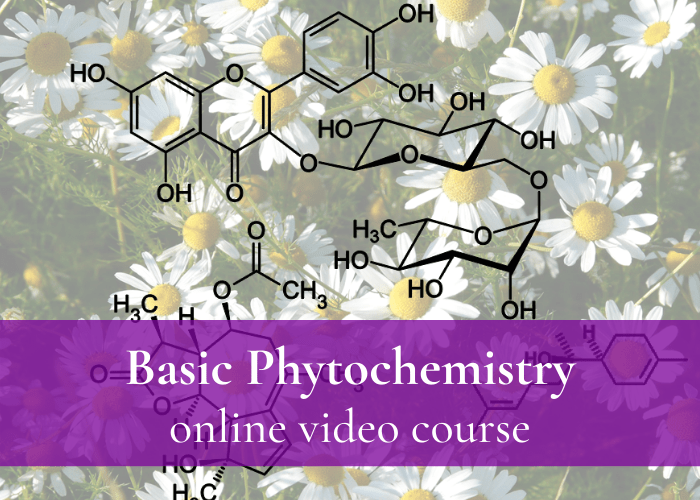
Like all our offerings, this is a self-paced online video course, which comes with free access to twice-weekly live Q&A sessions, lifetime access to current & future course material, twice-weekly live Q&A sessions with us, open discussion threads integrated in each lesson, an active student community, study guides, quizzes & capstone assignments, and more!
Previous episodes in this series:
- 1: Psyllium, Elderberry, Turmeric, Ashwagandha
- 2: Apple Cider Vinegar, Cranberry
- 3: Wheatgrass, Beet Root, Ginger
- 4: Green Tea, Fenugreek, Ivy Leaf
- 5: Ginkgo, Guarana, Maca
- 6: Saw Palmetto, Cinnamon, Echinacea
- 7: Tribulus, Pycnogenol, Garlic
- 8: Milk Thistle, Black Cohosh
- 9: Aloe, Flax (plus new market data!)
- 10: Valerian, Pumpkin, Goji, Red Yeast Rice
- 11: Yohimbe & Horny Goat Weed
- 12: CBD, Fennel, Oats
If you have a moment, it would help us a lot if you could subscribe, rate, & review our podcast wherever you listen. This helps others find us more easily. Thank you!!
Our theme music is “Wings” by Nicolai Heidlas.
Episode Transcript
Ryn (00:00):
Hi, I’m Ryn. And I’m here at Commonwealth Holistic Herbalism in Boston, Massachusetts. And on the internet everywhere, thanks to the power of the podcast. All right, so I’m going to dispense with the long introductory stuff today. If you’ve been following along, you know what this series is all about. If not, then you may have noticed that this is part 13 in a series talking about the herbalists’ views on some of the top-selling herbs. We are taking a look at a listing of the bestselling herbs and telling you what herbalists think about them. Pretty simple, actually. I think you’ve got the gist of it already. So, I’m going to give you my little reclaimer and then dive right into today’s topics, which is going to be bacopa, senna, and rhodiola.
Ryn (00:56):
All right, so first, let me just remind you that I’m not a doctor. I’m an herbalist, and I’m a holistic health educator. So, the ideas discussed in this podcast do not constitute medical advice. Remember that no state or federal authority licenses herbalists in the United States anyway, so these discussions are for educational purposes only. Those are pretty good purposes though, right? Okay. So, I want to remind you that good health doesn’t mean the same thing for everyone. Good health doesn’t exist as one objective standard. Instead, it’s influenced for each person by their individual needs, experiences, and goals. So, we’re not attempting to present here a single, dogmatic, right way to do herbalism or to think about herbs that you should adhere to. Everyone’s body is different. So, the things that I’m talking about may or may not apply directly to you. But my hope is that they’re going to give you some new information to think about, some new ideas to kick around, to play with, and some things to research and to experiment with further in your own life and in your own body. Finding your way to better health is both your own right and your own personal responsibility. And that doesn’t mean that you’re alone on your journey, but it does mean that – sorry – it does mean that the final decision when you’re considering any course of action, whether it was discussed on the internet or prescribed by a physician, is always your choice to make.
#35 Bacopa: A Tradition of Cognitive Support
Ryn (02:15):
All right, so we are talking today about rhodiola, about senna, but first about bacopa. So, in the botanical we’re talking about Bacopa monnieri. This one had a good peak in sales in the year that we’re looking at the data from. It increased by 72%, which is a pretty good, pretty solid increase for sales for a given particular plant. Primarily that was because of an increased interest in quote-unquote cognitive support. And this is tied or at least loosely connected to the COVID epidemic. And then the impacts of that that many people have been feeling, and you may still be experiencing even today. Where a lot of people experienced cognitive difficulties after a round of COVID infection or after multiple rounds. And those things are pretty well documented now that they can occur. This is something to be aware of. This is something that we can take steps to prevent when we get exposed to COVID. Some things that we can do to try to resolve or to recover from after we’ve already been exposed and dealt with that. But it’s a real factor with the virus. And of course it’s also a factor for a lot of people anyway. Whether that’s simply because of an aging population. Whether that’s because of the impacts of a life of chronic stress, or not particularly fantastic nutrition, or other facets that can contribute to this kind of an issue. And so, you know, a lot of people are looking for this kind of herb. They’re looking at ginkgo. They’re looking at tulsi. They’re looking at bacopa as well and saying can this help me to think better, right?
Ryn (03:53):
So, this is an herb that does have a long history, and particularly that history is going to be tied to Ayurveda. So, the traditional medicine system of India and the subcontinent. And in that system this is a plant that has been long regarded as being particularly helpful for a variety of different mental and psychological issues. These would also in some circumstances be described as spiritual concerns as well. So, whether today we might use labels like psychosis, or schizophrenia, or anxiety, and we might place all of those into different categories of severity. In the past these would be all regarded as there is a problem with your mind. And this is an herb that can operate on that problem in a beneficial way, usually regarded in the context of clarification, first and foremost, right? In traditional ways of people working with this plant, those would include tea. Also just squeezing the juice out of the plant or making what you might call a succus, okay? In more modern times, once the development of distilled alcohol comes around, we have worked with tinctures and alcohol preparations. But another traditional method from the Ayurvedic tradition would be to work with ghee as a menstruum essentially. To infuse or to cook the herb into the ghee. And that seems to work particularly well because there are some fat-soluble compounds in here that are going to come through and be well represented in that way.
Ryn (05:27):
In modern times though, you’re going to see a lot of capsules, a lot of tablets, a lot of things that you put in your mouth and swallow for bacopa. As we’ve seen over and over again in this series when looking at the most popular forms of herbs in the modern world, we’re talking about mass market stuff here. That’s what people tend to be expecting, and that’s what they tend to get. So, capsules of this particular plant may be just the straight-up powder, although you’re seeing that less and less often as time goes by. More often now you’re going to see them containing some kind of an extract. And for bacopa, there is a standardization process that is often used. Remember previous comments on standardization, that it’s not everybody is using the same standard in order to make their product. It’s that each company says all right, we’re going to make it in this particular predictable, repeatable way. And we’re going to do some analysis on what we’ve produced each time to make sure that it has a particular concentration of specific constituents that we’re interested in. In the case of bacopa, these are usually called bacosides or sometimes bacopa saponins. Those are synonyms. They are talking about the same group of constituents, right? There’s a few members, they’re a little bit different from each other, but they’re all in the same group together. Bacosides or bacopa saponins, right?
Ryn (06:46):
When we look at products, like if you go to Amazon and look at a number of standardized bacopa extract products, you’re going to see that generally they’re targeting 20% or higher of the bacopa saponins. And setting that as like their floor for if we make an extract and it doesn’t have at least that much, then eh, that’s not going to be good enough for us. We’re going to try to get 20% or higher. There have been some investigations, including some scientific studies on bacopa extracts, which have used a higher concentration of bacosides. Those have been like 50%, 55%, or even more than that. So, there may be some differences in performance between commercially available common products there, and the results that we see in some of these studies. But in both cases, we are talking about a similar group of constituents as being primarily important or responsible for the activity that we’re getting from it.
Saponins, Adaptogen Herbs, & Nootropic Activity
Ryn (07:35):
Yeah, I would note though, these are saponins. And in fact, this is a plant where you can take it. And if you have the dried material, or I’ve heard even more so the fresh material, put it into the water, and shake it all around, you might see some bubbles forming. Those are indeed soapy kinds of bubbles. That’s what saponin means. That’s what we can observe with a number of plants that have high saponin content, including jiaogulan, including the ginsengs, including eleuthero, all of these adaptogen herbs. Now, that does give us a bit of a phytochemical connection here, right? Most of our adaptogens have some amount of saponin content. Saponins can interface with our hormonal system and often with our nervous system as well. And so that can be part of how they exert their effects on our endocrine function, on our responses to stress, and the coordination communication between our hormonal organs. And bacopa as an herb with high saponin content is also often considered to either be an outright adaptogen or to be like adaptogen-adjacent or an adjunct to adaptogens, right? And that has also manifested where this herb has this very strong again, tradition and well-deserved reputation as being an herb that operates on the nervous system, and on your brain, and on your cognitive function. And so that’s put it into that category of nootropic. And so now what we have here is a nervine, trophorestorative, nootropic, adaptogen, right? And so that’s a lot of words that are saying this herb may be able to improve your capacity to think clearly, to focus, to have good memory, to be attentive, to have clear thinking. And these are all the kinds of language and the kinds of activity for which bacopa is promoted, and which I think explains its really good sales record, okay, not just in recent years, but for a decent amount of time now.
Ryn (09:47):
All right, so there are some aspects about what it can accomplish and how people are thinking of it, marketing it, purchasing it, working with it, okay. I did mention trophorestorative in terms of nerve function, but we could also say protective to nerve function. So, neuroprotective activity is another thing that modern studies have identified as something that bacopa can accomplish or contribute to our lives, the herb and its extract both. That does seem, as usual, largely through protecting the nerves and especially those in your brain from oxidative stress and damage. So, this is essentially a targeted antioxidant effect, which can pass through the blood-brain barrier and get to a site of tissue in the body that it’s not always very easy to access. So, that’s particularly valuable. And that probably explains or is a major factor, let’s say instead, for how this herb can make those improvements in cognitive function, and memory, and other facets like that. Your brain is like any other organ. When it’s more inflamed, when it’s under more stress in the form of oxidative damage, then it’s not going to function as well, just the same way that your liver or your heart wouldn’t. When we can improve that, when we can reduce inflammation. When we can make it easier for the body to clear the residues of inflammation away, then we think better. We feel better. We’re more focused. We’re more attentive. Things are smoother, right?
Ryn (11:20):
Some people do talk about this herb as being helpful for anxiety, and agitation, and so on. But I would say that less in the form of like relaxing you, less in the form of calming your mind down. And really much more on this side of removing that kind of inflammatory stress and therefore allowing better function to take place. That also means, I would put forward here, that this herb could be a little more appropriate for people when it was combined with gentle nervine relaxants, maybe even mild nervine sedatives as well, particularly for people who are overextended, over agitated, and overstimulated, right? Maybe bacopa all by itself isn’t the most appropriate element there or the most appropriate herb. But it could be playing a really nice role in a broader nerve formula. Yeah. All right.
Brahmi: Bacopa vs. Gotu Kola
Ryn (12:17):
So like I’m saying, this is a somewhat stimulating herb. I would put it on a similar level as ginkgo, to which bacopa is often compared, or in some cases even confused. Like they’re talking about bacopa. They’re talking about ginkgo. They’re kind of saying things about the two of them. But that happens much more with yet another plant. Most often bacopa is going to be compared with or even conflated with gotu kola. And there’s a very good reason for that. Which is that both of these plants are known in Ayurvedic herbalism by their Sanskrit name, which is the same for both of them. They’re called brahmi. And this basically is not an unusual feature of traditional medicine or folk medicine, where there could be more than one plant according to current botanical taxonomy, right, different species names. And yet traditionally people would work with them in similar ways. Especially when those plants have similar growing habits. Maybe they even look pretty similar to each other. Gotu kola and bacopa, they’re both plants that like to grow in or near water. They’re leaves you can differentiate between them, but they have some similarities. And so you can see why somebody in the distant past would be like oh, here’s an herb that grows in a watery environment and that you can harvest the leaves of. And you can eat them, or make tea, or take them in different ways, and it helps you to think more clearly. So, that’s brahmi, and I’ve got it. I’m solid, right?
Ryn (13:53):
And then later the taxonomists come by and the botanists with their hand lenses and their microscope. And they’re like no, these are different species actually. But in general they’re considered to be either very similar or even fully identical. I would note that you’ll see a couple of comments here and there from people who might say things like well, they’re both brahmi, but gotu kola is not as potent as bacopa. So, there can be some I wouldn’t call it argument, but some differing of opinion about that element of things, right? And that may have relevance in the modern world as well in the context of supplements, in the context of mass market products, and particularly here looking at what we would call adulteration. So, the Botanical Adulterants Prevention Program, which I’ve, I’ve referred to previously in this series, they put out a bulletin last year, almost a year ago now, talking about bacopa in particular. And about the commonality of products being sold as bacopa or being sold as brahmi and claiming to contain one species but containing both or containing the other one. And again, it’s simply because they have that shared Sanskrit name, brahmi. And also because in the Ayurvedic literature and tradition there, they acknowledge them as legitimate substitutes for each other whenever they’re going to be taken.
Ryn (15:27):
So, they do have basically all the same kinds of actions, essentially all the same qualities, affinities, all that kind of thing. So, you know, I think that that’s a totally legitimate substitution opportunity, but their chemistry is a little bit different. I think in one context it could be relevant that there might be differences in extraction between the bacopa saponins on the one hand, and then some of the constituents in gotu kola that may not be optimally extracted by the exact same process for both herbs. And so if somebody gets a shipment of plant material to their supplement-making factory. And they’re told that it’s brahmi, and they interpret that to mean bacopa. Maybe they run it through a process that’s focused on getting those saponins. Whereas if it’s gotu kola, maybe there’s different constituent groups, or there’s more complex groups of constituents in there more than just that focus on the saponins that they might want to plan for and run their method for. So in any case, the BAPP folks are just pointing out that mislabeling of bacopa or gotu kola material is regularly reported. That it happens with no degree of rarity, right?
Ryn (16:44):
As a consumer, ways that you can try to manage that. When you are buying organic, or when you’re buying products made with organically-sourced material, there is much greater degree of tracking and record keeping that is required to maintain certification. And so you’re basically just a lot more certain that you have the species you think you have. And that is the very first-line thing to do. Beyond that, it’s as always knowing your supplier, knowing their practices, knowing their habits around plant identification and assessment of the plant material for purity, for contamination, for efficacy. When people are doing those standardizations in their product, as long as they’re testing their batches regularly, that should also make it very clear if there was a batch of plant material that was mislabeled or something like that. So, that could be another way to try to guarantee that you’re getting what you think you’re getting with your bacopa.
#36 Senna: A Strong Stimulant Laxative
Ryn (17:40):
Okay, let’s move on. Number 36 on the top seller list here is senna. Senna alexandrina in the botanical. So senna, you may have heard of this one already. Senna is a fairly popular herb and has been for a very, very long time, even back into antiquity. And there we’re talking like ancient Egypt, ancient Greece, ancient Rome, ancient Persia, that period of time. This was a very, very well-known herb, and it has been all the way up through to the modern day. Senna is an herb that you cannot miss its effects. This is not a plant where you take it, and you’re like oh, maybe I feel a little bit different. Maybe I’ve got a little more liver activity. Maybe my mind is a little clearer. No, this herb is a stimulant laxative. It will send you to the bathroom. Yeah. And if you take a lot of it, and if you’re particularly sensitive to this effect, it might send you there on the run. So, what does it do? It induces intestinal peristalsis. Peristalsis is the wavelike movement of the muscles in your intestines and other tubes in your body. But in this case, that is how your body is going to move the feces along so that you can get them out of you. And this will trigger that movement. It will trigger that muscular contraction. Hmm, okay.
Ryn (19:00):
Chemically we’ve identified that this is primarily due to the action of a group of constituents called sennosides. These are anthraquinone glycosides, which is a long phrase. But it may be a term that you’re familiar with if you’ve been studying herbalism a bit and looking into these kinds of herbs. Because those compounds turn up in a number of other herbs, which also have laxative effects. And many of them have that at a strong degree, and they’re very, very stimulating. Or they’re in this group of herbs called cathartics. Now, catharsis, when we use that term in the modern era, we usually mean I went to this movie, and it was cathartic. And it brought all my emotions out. And it purged me of this heavy feeling I’d been carrying around. And ahh, I came out of it feeling good. Okay. That’s a metaphorical application of the term. Catharsis originally or medically speaking does mean that the bowels open up and eliminate all of their contents in a quite rapid fashion. Yeah. Okay. So, cathartic herbs include Cascara sagrada, rhubarb, the buckthorns, and the latex of aloe, which we discussed in a much earlier episode in this series. Those are cathartic, stimulant laxatives. They have strong, strong representation of these constituents and of the more powerful ones in that group together. And so they have that kind of an impact.
Ryn (20:30):
There’s also, to a much lesser extent, anthraquinone glycosides found in a much more common herb for me to work with, which is called yellow dock, Rumex crispus and also Rumex obtusifolius. And if you’ve listened to us before talk about this issue, you probably heard us say senna, you can have some issues with. There can be cautions. I’ll come to those in a moment. But yellow dock is much safer, much more reliable, a much better first-line choice. Because it does have some anthraquinones in it, enough to get things moving along. But not so much that you’re likely to get dependent on it. So, that’s a much safer choice. It’s a much better choice in most circumstances. Now, those constituents, the sennosides, they have been again, extracted, and characterized, and isolated from this plant for a very long time as far as chemistry goes. And so they’re also employed in a number of over-the-counter products. So, on this particular listing of top-selling herbal supplements, over-the-counter quote drugs that are made with isolated sennosides are excluded from the list. They’re excluded from the calculation of its place. If they were, this would be not at number 36 but somewhere much closer to one. Because those products are very familiar. You may have heard of things like Ex-Lax or Senokot. Those are purified representations of the sennosides from senna. And so again, they’re not part of the calculation of top seller-ness here, but I thought that they merit a mention anyway.
The Danger of Dependence with Senna
Ryn (22:04):
Okay So, I keep raising this specter of dependence, right? We want to be cautious about that. It is possible for anybody taking a stimulant laxative, especially one of the cathartic group, if they’re taking it in a sufficient dose and for a long enough period of time, it could become the case that that person needs that dose in order to have a bowel movement at all or to have a bowel movement with any degree of ease, right? And so you could imagine a case where somebody goes traveling. And like a lot of people when they travel, they start to get constipated. And so maybe they take the Ex-Lax, or maybe they take a senna tincture from an herbalist, or capsules with senna, right? And they take them, and they can have a bowel movement, and they feel some relief. And now they make a habit of it, and they do it every day on their two-week vacation. And then they get home, and they’re like I’m home again. I’m eating my normal food. I should be fine. They stop taking the senna, but then they become constipated. And they don’t have an easy time in the bathroom. And they’re like oh, what’s going on? And so then they take the senna again. And now they’re on this treadmill with it, where they’re likely to continue to be dependent on it for a while unless we make some kind of an intervention.
Ryn (23:23):
There’s also an element of a problem here of simply the way that these function. Like I say, they’re going to stimulate that intestinal peristalsis. They also tend to draw fluid into the intestine. And so these factors can together contribute to diarrhea, and they contribute to an accelerated rate of loss of electrolytes. Electrolytes are involved in nerve firing, and muscle contraction, and a number of other important functions. And so if somebody is taking high doses of senna long term, having ongoing diarrhea essentially but also requiring it in order to have any bowel movements at all. Then they could begin to get depleted of their electrolytes, which is going to have consequences for muscle function, including the heart, nerve function, organ function beyond that. And so it could become a more complex problem if it goes on long enough, and if we’re not correcting for that with diet and intake.
Ryn (24:23):
Yeah. Okay. So, we’ve got to watch out for that, right? Now in a case where somebody has become dependent on a stimulant laxative, it is possible to walk it back and to free the person of their dependence on them. But that might take a while to accomplish. That might take several months to fully wean them off of that requirement and reduce that. So, the method is basically that we’re going to gradually reduce their exposure to the stimulant laxative herb. We’re going to support that work and eventually replace that strong stimulant or that cathartic laxative plant with a milder one. So, this is a place where if I can get somebody to reduce their dose of senna for a while, and then we can introduce yellow dock. And then we can kind of increase the dose of yellow dock while we eliminate the senna, for instance, right? And then from there we can start to reduce from the yellow dock dose all the way down to zero. That can be a helpful way to proceed through it. And again, that might span over the course of a month, or two months, or three. It’s going to depend on where they started from and how severe the problem is. And at the same time, we’re going to be doing all this foundational work with hydration. Making sure that there’s a good intake of fats that they can digest well along with fibers. We’re going to support that also with herbal bitters, and carminatives, and relaxants, and maybe some other digestive herbs as needed for the individual. And so, you know, it’s a whole approach, a whole protocol we’re going to work through for that. But it is possible. It’s a routine sort of a job for an herbalist to be in a good position to do and to help people with.
Ryn (26:04):
Okay. All right. So in general though, it is better to only take senna when the need is pretty severe, right? Like I’m severely constipated. I’ve tried yellow dock for a while. I’ve tried significant doses of yellow dock, and it didn’t quite get me what I was hoping for. Okay. I take a dose of senna. I take two, right, over the span of a day or two. And that does it, that gets things moving again. And maybe now I can take yellow dock for the next few days, and then fade out of that, and I can be back to normal again. That kind of pattern is very safe and very fine. I don’t want to give anybody the impression that one dose of senna is going to make you a senna addict, right? That’s not what we’re talking about here. But being aware of that concern from the beginning is a much better way to proceed.
Ryn (26:53):
Okay. So, one other note on senna. Because of this laxative effect, because of this strong laxative effect, you’re going to see it frequently turnup as a component of a detoxification formula or a kit. So, that could be like one formula that says we’re going to detox all of you. And it’s going to combine some herbs for the liver, and some herbs for the kidneys, and some stimulant laxatives for the bowels, right? And it’s all this focus on elimination processes in your body. And the kit, it’s more likely that there’s going to be like a sequence of things that you’re supposed to do. Like you’re going to gradually reduce your food intake, or you’re going to limit the types of foods you consume. You’re going to take some strong laxatives for a while, and that’s where the senna would come in. You’re going to take high doses of fiber. You’re going to do various things like that. So, that’s the context it might turn up in like one of these detox kits that you can encounter out there in the world. Remember that those kinds of products are very, very popular. Those are some of the top sellers. Those are some things that keep the department humming along with their budget and everything. And so these are again, the role for senna in such a circumstance is that it’s going to clean you out, quote-unquote, by causing this cathartic elimination of your bowel contents.
Ryn (28:11):
So, my opinion here is that this is not always appropriate. That this is not always the best way to help somebody who’s feeling heavy, or sluggish, or weighed down, or brain fogged, or fatigued, or other things that make people seek out a detox kit in the modern environment.
Better Ways to Support “Detox” or Weight Loss
Ryn (28:33):
That there are better ways to support that person. If we identify something lacking in their diet. If we identify something in their food that they’re sensitive to and is causing problems for them. If we identify something in their sleep habits that’s really deficient, and we could find a way to get better sleep for them. That might be a better route to improving the symptoms they’re experiencing than just sending them to the bathroom for a weekend, right? Also doing that kind of a detox, a flush, a cleanse, that kind of thing, that is not going to cause lasting change in a person’s health if they don’t change anything else about their habits, about their diet, about their sleep, about their movement, about the way they cope with stress. Just doing a cleanse doesn’t alter the conditions of your body in a permanent way. And this is why a lot of people are going to get into this cycle where they feel bad, they feel ugh. And then they take a cleanse, and they’re like ah, okay, that kind of energized me. I’m feeling lighter now. I’m feeling better. This is good. But then in two weeks, or in a month, or whatever, all of the same feelings have come back along again, right? So, it’s not a root cause resolution that we’re seeing when people go through a cleanse pattern like that.
Ryn (29:53):
Okay. So that’s about detox issues, and detox products, and that kind of thing there. Oh, yeah. And then senna will also turn up for a similar reason in weight loss products. Ooh. And in this context, this isn’t great, okay? This is really not helping in the way that people want or think that it’s going to. This is not a good approach, right? So, senna or some other cathartic, it might cause a person to lose some weight in the form of water in the form of diarrhea. But that’s it, okay? This is not real weight loss in any way. This is not a change in your body composition. This is not an improvement in your metabolic function or your basal metabolic rate. This is none of those things. This is just yeah, you might see a lower number on the scale after you eliminate a bunch of stuff into the potty. So, I don’t think it really belongs in such a product. Of course, I don’t make or sell them, and I don’t run the supplement world, so they’re probably going to continue to be out there. But I would say when somebody mentions that they’re taking a weight loss product or a weight loss herbal formula, look at it. And if you see senna on there, explain to them these cautions that I’ve raised for you about that category of herb, the effects it can have, the issue of dependence, the issue of electrolyte loss and other factors that go along with it. As well as saying this isn’t doing what you hope it’s doing, right? And let’s talk about other ways that we can make you more metabolically healthy, more metabolically flexible. And let that be the primary thing that we try to improve, rather than just looking at the number on the scale. Because that can be very, very misleading as this example demonstrates.
Ryn (31:41):
Okay? And on a similar note actually, if people are asking about detox, right? Like if you want to enhance your body’s capacity to cope with metabolic wastes, with the leftover elements from your metabolism and your digestion of food, and from your own exposures to whatever toxins you may encounter in the course of your life, or your work, or your home environment, or the kind of water you’ve got access to. Those are all things that we can accomplish. But they’re often best accomplished through nutritive strategies first, through restorative strategies more broadly. So, that’s not just about food being restorative to you, but good sleep, healthy movement, things like that, right? Those are generally better ways to get the feeling people are looking for of a clearer mind, better attention, less pain, an easier feeling inside of their guts and belly. Those are things that we can accomplish in a lot of different herbal ways. And only framing the approach there as detox is not particularly helpful. So, in this regard, in the show notes I’ve linked to an earlier episode of our podcast where we talked about herbal detox in a little more detail. And outlined some other approaches to a situation like that that we find to be much more effective and much more appropriate for the goal.
#37 Rhodiola: An Adaptogen of Endurance
Ryn (33:09):
Okay. So, next up we’re going to talk about rhodiola, number 37 on the bestseller list here. Rhodiola, rhodiola. So, you may have heard of this one already because it’s gotten very popular in the past decade or so. Rhodiola is a stimulating adaptogen. It’s one of the more stimulating adaptogens that we’ve encountered, right? And this is, I think for understandable reasons, this is the most popular kind of adaptogen out there on the market today, right? The very gentle, restorative adaptogens, the immune-building adaptogens like your astragalus or your jiaogulan. These are less exciting for a supplement maker or a supplement consumer. So, when we encounter an adaptogen like rhodiola, well, what do we find? We find this herb is promoted as an herb of happiness. Or some people would even go so far as to say it’s an herbal antidepressant. And you probably know how I feel about that. But this is a misleading way to talk about any plant, whether it’s St John’s wort, or tulsi, or vanilla, or rhodiola, right, to call it an herbal antidepressant. Because It conjures in the pharmaceutical category in a totally inappropriate way, right? But listen, when we’re talking about a plant that can make you feel energetic. And it can also make you feel like you’re coping with stress better. Then you can see why people would interpret that as an herb of happiness or an antidepressant in plant form, right? We can understand the tendency to do that. Okay. Fair enough, fair enough.
Ryn (34:50):
Now, when we look at rhodiola supplements in the modern marketplace, we find that many of them are standardized, in this case, for rosavins and salidroside. We often see this as a 3:1 ratio. So, it might be 3% rosavins and 1% salidroside, or something in that regard. It’s usually not going to be so much higher than that. Like you’re not going to see 30% plus 10% or something like this. Usually the 3%, 1% is about where they’re going to be set. And again, as almost always is the case with standardization, that is a concentration above naturally-occurring levels in the root itself. But it’s not like a 50x concentrate, or a 20x concentrate, or something like that. It’s just a little bump to get a little higher up, right? So, rhodiola supplements, again, they’re going to be sold with claims about enhancing energy levels, about enhancing or improving mental performance, and improving endurance as well. Both athletic or physical endurance as well as cognitive and mental endurance, right? So, whether it is I need to go and get a hoe and go into the garden. And I have three acres of gardens that I need to chop the ground up today. And I’m going to go out, I’m going to do it all right now, all at once. Or if it’s I need to study for the next five hours because I have a really important exam tomorrow. I have to be focused, I have to be attentive, I have to get this all into my head. I’m not saying this is the best way to study – just as a little parenthetical here – but a lot of people do it, right? So in either case, rhodiola can be very helpful. It can stimulate you and give you enough energy to stay focused on what’s directly in front of you. So, pretty attractive, right?
Ryn (36:46):
And I also would like to say this is one of those herbs that we have for some people found to make a pretty effective substitute for medications that they’ve chosen not to work with any longer. I phrase that very carefully. I am not saying that I have sat here and said hey you. Stop taking your Ritalin and start taking rhodiola. I have never referred to rhodiola as herbal Ritalin, and I never will. There are people out there on the internet who are doing exactly that. And they’ll say that about a bunch of different herbs, right? They’ll say that about anything stimulating. I wouldn’t want to present it that way. But what I can say is that sometimes people will say I don’t want to take Ritalin, or Concerta, or whatever because it has side effects that I don’t like. I’m looking for something kind of like that. What could you point me to? And I could say well, it’s not a drug. But this herb is very stimulating to your brain, to your mind. It often does really help with focus and attention. Especially when it’s hard to maintain that because of fatigue, because of mental exhaustion or mental overwhelm. I wouldn’t though suggest somebody who is only having trouble focusing because of energetic distraction. Like they’re agitated, and they can’t really stay focused on one thing at a time, and they’re all over. That’s not the person that I would say try rhodiola as a substitute, right? Because for them it might simply exacerbate that overstimulation even further, okay? But for somebody who tried Ritalin or Concerta, and they found it helpful for their focus and their attention, but they didn’t like some of the other effects they got from it. They could try rhodiola and see what kind of effects they get. And again, it may not be exactly the same. You’re going to need to figure out the proper dose for your particular body. And that’s going to depend on which product are you taking, and how concentrated is that, and what format is it in, and what’s your baseline constitution and some other elements as well. But this is something that we’ve seen frequently enough that I feel comfortable discussing it in this way.
Rose Root & Fresh Rhodiola
Ryn (38:58):
All right. So, I mentioned constitution, and there is a pretty important element of that here. This herb is very drying. It’s very drying. When you taste it directly, it’s very, very astringent, right? And it’s the root of the plant that’s worked with for this regard. And it’s sometimes referred to as rose root. And I think in terms of the astringency power, rose root, literal rosa root and rhodiola root, they’re on a level. They’re on a level with each other. Very, very astringent, very locally drying. If we’re taking it consistently, we are going to get whole-body drying effects. And like any adaptogen, you would expect to be taking this consistently over an extended period of time. And so that’s one way in which that nickname rose root really does make sense for rhodiola. Very, very astringent, okay, lots of tannin content. The other way though, is the smell. So, if you have a freshly dug or freshly cut fresh root – not dried, but fresh – cut open, and you smell it. It does smell like rose. It’s really beautiful. It’s really delightful actually. And that element actually, the scent, the aromatic element of it is not very much there. It’s lacking if we only have dried rhodiola root, or we have a supplement that was made from dried root. I suspect that those aromatic elements that come through in the smell of the fresh root when it’s cut and opened, that they’re pretty effective, and pretty potent, and would be something we would like to include whenever possible.
Ryn (40:42):
Now we do work with dried rhodiola here. We find it to be very helpful. We’ve made tinctures out of it. We’ve thrown it into decoctions. It works great. I’m not saying that only fresh rhodiola root is good. But I do think that fresh rhodiola root is a little bit better and probably a more diverse and complex medicine than the dried. Okay. But in any case, however you take your rhodiola root, it is going to be very, very drying. Okay. Now, I haven’t gotten to play with fresh rhodiola root very many times. In fact, only a couple of times. And the one that stands out the most is when Katja and I went on our honeymoon to Iceland. And when we went there, we spent a bit of time with the Icelandic herbalist, Anna Rósa. And she was actually filming a little video for another herb school at the time, and she wanted to do a little segment on rhodiola. So, she took us to somewhere, it was actually a neighbor’s garden. And she was like hey, can I dig up one of your rhodiola roots? And so she did that and chopped it open. And we all sniffed it and went woo on the little video. And then since she had dug up the root, she also had the leaf material, right, the aerial parts.
Ryn (42:02):
And we were going to depart from her at that point and go on a little tour of some of the spots in Iceland just by ourselves, like driving around ourselves. And she was like here, take this with you. You can eat this like salad. And so that was how we got introduced to this part of rhodiola that you’re pretty much never going to find in commerce, which is the leaves. And I’ve got to tell you, they taste amazing. They were like crispy. A little bit astringent, not too bad though. Not so much that you wouldn’t want to eat several of them. But they’re plump and almost succulent in the way that they grow. Lots of moisture content inside. But with that astringency it kind of clicks through it just a little bit. And so when we were driving around the island, and this was like in the middle of summer, like right at summer solstice, so it was endless days, basically. We would chew or eat little bits of the leaf every day for several days. And that, along with the long, long hours of sunshine, were very energizing. We were in very, very good moods, and very happy, and very energetic for that whole time, I think for the obvious reasons of being on honeymoon. But also, you know, this little exposure to rhodiola was sustaining us in that way as well. Yeah, really good stuff.
Ryn (43:24):
You won’t be able to grow rhodiola for yourself unless you live pretty far north. We have tried it here at Boston latitudes. The plants kind of survived for a few years, but they were really struggling. They want to have a year cycle that includes time where there are long hours of daylight. They’re going to really grow better if they can have that. So, it does grow across the entire northern rim of the world. You can grow it in Canada. You can grow it in Alaska. You can grow it in Iceland, in Northern Europe, in Russia, Siberia, northern China, right? So, you can grow it in many places, but it’s got to be pretty far north. I mean maybe pretty far south would do it too. I’m not sure if they have the right terrain. But in any case, it does have that kind of growth habit. So, this means that its natural range is somewhat restricted in comparison to something like a mint family plant, which can grow in a vast array of different latitudes, and it’ll be just fine, right? That means that this is not a universally abundant herb to work with. Yeah. All right.
When Rhodiola Makes Sense
Ryn (44:34):
But before I talk too much more about sustainability, I did want to mention one other image I want to share with you. So, this is Katja’s favorite image for when is it appropriate to take rhodiola, or when would it make most sense to take rhodiola in comparison to some other adaptogen, right? So, she would say if you imagine a bunch of Vikings in a long ship rowing across the North Atlantic in winter, right? So, what have we got? We’ve got long days of physical labor, unrelenting. We’re in a cold, wet environment, and the sun’s light is weak if it even rises above the horizon at all. So, dark, cold, damp, physical marathon plus, plus, plus kind of situation, that’s when rhodiola makes the most sense, right? That’s the circumstance that this herb is best suited to address. So, it doesn’t mean that you have to literally be doing that in order to earn the right to take rhodiola. But the more your environment and the more your situation is like that image, the more sense it makes. If on the other hand, you’re somebody who’s feeling very agitated, but you have to stay sitting for a long period of time. Like you have a job that’s very demanding and very stressful, but you’re at a computer locked in for long stretches of time. And also, if you’re in a dry environment, maybe even also a hot environment. Like you live in Arizona, and this is what’s going on for you. Then all those things would steer me away from rhodiola. I might be trying to encourage you to work with American ginseng or jiaogulan instead. Or even codonopsis, something like that rather than this particular herb, right?
Ryn (46:18):
But then also in terms of constitution. So, if somebody’s body is very dry, very tense, or very hot, then I wouldn’t be thinking of rhodiola right out of the gate. Or at the very least we would be like you can take rhodiola, but we’re going to also get you linden. And you’re going to drink a quart or two quarts of linden every single day as long as you’re going to be taking rhodiola. To compensate for the drying, stimulating, and tonifying effects of the rhodiola with the cooling, moistening, and relaxing effects of linden or whatever herbs you put together to do a similar job, okay? So, constitutionally, you do want to be thoughtful about it because this is an herb that people are going to take for long periods of time. And that’s where constitutional and energetic assessment of our plants and our bodies is going to be the most important. Okay.
Ryn (47:12):
Now, I had raised some things about Iceland, and Anna Rósa has a book called Icelandic Herbs, a really cool book worth checking out. In there she quotes from some old Icelandic texts. And so in one from 1830, they were writing about Rose root or burnirót, which is my closest approximation of an Icelandic word. And saying that for this one, the decoction of the rose root will warm, dry, and constrict. Heating, drying, tonifying, right, it’s literally there. Okay. So, they also say it can heal sore mouth, or sores in the mouth might be what that means also. It can clean the kidneys of sand and what would become gravel, right? We’re talking there about nascent kidney stone formation basically. It stops diarrhea. There’s the astringent thing again. It heals headaches. I would say some headaches but not all of them. So, particularly if there’s a laxity-type headache, this is going to tighten it up, and that might help that, okay. And strengthens the head and also hair growth if the head is washed with it. Hmm. Topical application of rhodiola, interesting. The root is good to place over bad sores. That’s going to be the astringent element again. Chopped, bruised, and mixed with butter it reduces swelling, eases back ache, joint ache, and other ailments, especially if it is warm when it is applied. It’s considered healthy for leprous people. So, I just wanted to quote from that because that outlines some of the older perspectives on this plant before anybody had the word adaptogen to throw around, okay? And also looking at this not only as a mental stimulant or a metabolic stimulant, but we’re talking here about diuretic effects. We’re talking about direct topical astringency and some related actions like that. Okay. So again, thinking about this in a broader context, the way that ancient peoples would do.
Sustainably Sourcing Rhodiola
Ryn (49:12):
All right. One final note on rhodiola. This herb is critically endangered in the wild. That is according to the CITES, C-I-T-E-S, organization and their standards. So, this is an herb that is not abundant out there in the wild, right? When it is cultivated, and it is to varying degrees of quality, that’s not always done in a restorative or what we might call a regenerative manner, okay? In some countries which have taken up the cultivation of rhodiola because of identifying it as a popular herb and one that can be sold for a decent amount of money. In some places the issue of environmental contamination is very, very serious, all right? And so for these reasons, if we’re going to buy rhodiola, sourcing organically-cultivated rhodiola. Or any product made with rhodiola, only buying it if it says a hundred percent of the rhodiola in this product was organically cultivated. That’s very, very important. You can make a little aside here. If there is a small-scale product put together by somebody who lives in Alaska and cultivates a bunch of rhodiola on their own organic farm or in their own backyard. And maybe they’re not even organic certified, but you know exactly where it came from. Okay, that’s a small exception to what I’m describing here. But if we’re looking at stuff on Amazon, we’re looking at products at the herb fair, the market, whatever, then you want to be looking for organically-cultivated, regeneratively-grown rhodiola. It should also be mature material, and that generally means at least five years old.
Ryn (51:07):
So, all those things put together means that the price for rhodiola is quite high. When we go to say, Mountain Rose Herbs, for instance, we might find organically-cultivated, regeneratively-grown, small-scale cultivated rhodiola for $120 per pound. That is a totally reasonable price. That is a completely rational amount worth for that particular root. And for the amount of time and investment that went into it on the part of the small-scale farmers. And the investment in making good quality stuff and doing it the right way. So, that also might mean that for many people, rhodiola isn’t necessarily the right herb because they might not be able to afford it long term. And so that’s where looking at less expensive herbs to achieve the goals you have in mind might be a very helpful thing to do or some advice that you can give a client, or a friend, or somebody who’s asking you for your herbal advice. If they found rhodiola really helpful for them, what could we work with instead? Remember, when you’re doing this kind of substitution, you don’t start by saying what herb is most similar to rhodiola. Because maybe that points you towards red ginseng. Maybe that points you towards highly concentrated eleuthero extract. And okay, we can start with that.
Ryn (52:36):
But if the person was specifically taking rhodiola to help lift their mood in the wintertime, well, we could experiment with dandelion flower. We could experiment with tulsi, vanilla. We could experiment with bacopa. We could experiment with ginkgo in some circumstances, right? There’s a lot of different ways that we could come at the problem. And just saying what’s the adaptogen that’s most similar to rhodiola is not always the most nuanced and organized way to accomplish that for someone. So, trying to find substitutes for more expensive plants is a matter of saying what are the particular actions that I’m calling on from this herb not just in general, but in the application or for the person that I have in mind. That can guide you to say okay, what other less expensive, more common, more available herbs have similar actions? And that can tell you where to start. Okay.
Ryn (53:36):
All right, good. We got our three for today. That’s going to be it for this episode of the Holistic Herbalism podcast. I just want to remind all of our listeners here that we do run a school, right? And we are really enthusiastic about having you join us. So, we have a number of free courses that you can take to get a sense of how our platform works and what our teaching style is like. If you listen to the podcast more than once, then you’ve also got a pretty good sense of what our teaching style is like. And if it seems to resonate for you, then come and check out some of our stuff. We have a lot of classes, a lot of courses on all kinds of different material. We do have organized programs for those of you who want to make herbalism a big part of your life or even a career. You can start out with family herbalism. You can learn your Materia Medica. You can learn your Medicine Making methods. You can progress to the Community Herbalist program and learn all the different systems of the body and how herbs interface with them. Get a deeper dive into Herbal Energetics, into Phytochemistry, into Formulation, and other elements like that. And then you can move on into Clinical Herbalism. And you can be learning about Herb-Drug Interactions and Herb Safety. You can be learning about Clinical Skills, like how do you actually talk to somebody and conduct a good consultation in order to learn enough about them that you can make good, targeted advice for their symptoms, and their constitution, and their taste preferences, and all the other elements that go into a good recommendation like that. And you can learn all of this at our school online. That’s online.commonwealthherbs.com, and I hope that you do it. Okay. So, that’s it for this episode. We’ll be back soon with some more Holistic Herbalism podcasts. Until then take care of yourselves. Take care of each other. Drink some tea. And if you’re rowing through the endless night, keep rowing. All right, goodbye.
Join our newsletter for more herby goodness!
Get our newsletter delivered right to your inbox. You'll be first to hear about free mini-courses, podcast episodes, and other goodies about holistic herbalism.