Podcast 282: Uncertainty versus Imposter Syndrome for Herbalists
Today we’re sharing some thoughts about uncertainty versus imposter syndrome, and learning herbalism. Recently, we did a 20 Questions video for the folks at HerbRally – it ran nearly four hours long! 😲 Two of the questions we were asked wove a theme together, and we wanted to share them here.
The first question was “how do you deal with uncertainty as an herbalist?” The person asking this may have been expecting some kind of study trick that would help them to feel confident enough in their skills that they didn’t feel uncertainty in their practice – like an antidote to imposter syndrome!
But we have this sign in our apothecary that says “there’s only the hard way” (and if you know, you know!) and that applies here: the way of herbalism is uncertain. Accepting the presence of uncertainty is the first step toward navigating it confidently.
Now, we’re not talking about under-training: the first thing to do is to get trained, of course. But once you have trained for years and years, and even once you’ve been in practice for years, you are still on a journey with uncertainty. Which sounds a little zen, perhaps – and actually, a little bit, it is! Training the mind to accept uncertainty, while still finding the truth of the moment, is as important a skill for an herbalist as it is for a monk.
Next, someone asked us about mistakes new herbalists make, and how long it takes to “feel like you know what you’re doing.” (Do you see a theme here?) They want to know if it’s going to take years to feel confident, or if there’s some way to accelerate the development of that confidence. Yes.
These questions come up for lots of herbalists. Especially because a lot of us are practicing alone in our communities. Sure, there are herbal friends online, but maybe you’re the only herbalist in your town, and you’re feeling the weight of that solitude. A lot of folks don’t have elders or mentors available, and that makes it harder to practice.
One solution to that problem is online clinical herbalism mentorship – and we’ve got that for you!
Did you know that you can book a one-on-one Zoom session with Katja to talk through your goals, your challenges, and how to get you where you want to be in your herbal practice? You can! It’s open to anyone, and the easiest way to book one is to go to enroll in any free course – they’re at the top of the list. (They’re truly free: you don’t even need a credit card.) That will set up a student dashboard for you, and right there on the menu on the left you’ll see, about halfway down, Quick Help Sessions – click that link and it’ll take you right to the scheduling calendar!
If this episode caught your attention, then our Clinical Skills course is for you! Learn to practice legally, safely, collaboratively, and effectively. Get all your client forms & scheduling systems sorted. Cultivate consultation interview skills, and explore methods for planning personalized protocols. Everything you need to be a top-notch herbalist!
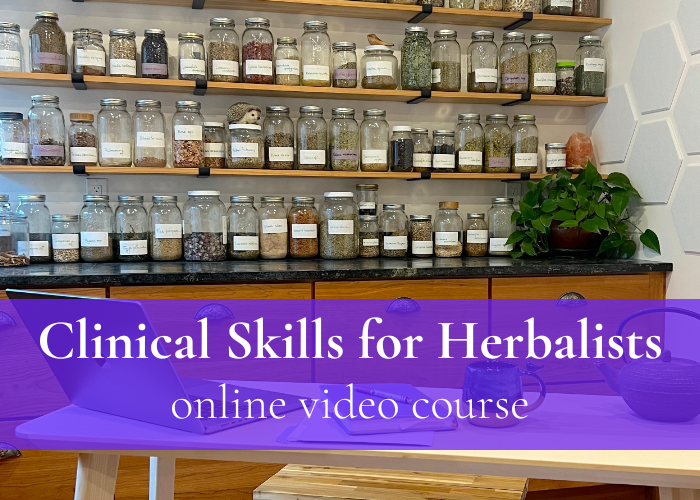
Like all our offerings, this self-paced online video course comes with free access to twice-weekly live Q&A sessions with us, lifetime access to current & future course material, open discussion threads integrated in each lesson, an active student community, study guides, quizzes & capstone assignments, and more!
If you enjoyed the episode, it helps us a lot if you subscribe, rate, & review our podcast wherever you listen. This helps others find us more easily. Thank you!
Our theme music is “Wings” by Nicolai Heidlas.
Episode Transcript
Katja (00:14):
Hi, I’m Katja. And I’m here at Commonwealth Holistic Herbalism in Boston, Massachusetts. Today, I’m really excited to share some thoughts about uncertainty, imposter syndrome, and learning herbalism. So, recently we did an interview, and two of the questions that we were asked wove a theme together. And that’s what I want to share. The first question was how do you deal with uncertainty as an herbalist? And I think that the person asking it was probably expecting some kind of study trick that would help them feel confident enough in their skills that they would not feel uncertainty as an herbalist, kind of like an antidote to imposter syndrome. But we have this sign in our apothecary, and it says there’s only the hard way. If you know, you know. And I think that applies here. The way of herbalism is uncertain.
(01:18):
And I’m not talking about under training. Obviously, of course, get trained. Get trained really well. But once you’ve trained for years, and even once you’ve been in practice for years, we’re all still on a journey with uncertainty every single day of our practice. Which sounds kind of a little Zen, and actually a little bit I think it is. Okay. So, that was the first half of this. And then the second question in this theme, someone asked about mistakes that new herbalists make and how long it takes you to feel like you know what you’re doing, right? Okay. So, do you see this theme here? I think that these questions come up for lots of herbalists, especially because a lot of us are practicing alone in our communities. Maybe you have herbal friends online, but you might be the only herbalist in your town. And you might feel the weight of that solitude, and responsibility, and lack of peer network.
(02:29):
A lot of folks practicing herbalism don’t have elders or mentors available locally, and that makes it harder to practice. Of course, a solution is online mentorship, and we’ve got that for you. In our Mentorship program we meet every week. We work in clinic together. We walk through all the challenges that people have with all different kinds of cases. We build supports where you need them. We even push on those to help you start to really feel confident about the work that you’re doing. And you can learn all about that at our website, commonwealthherbs.com. Or you can just send us an email. It’s info@commonwealthherbs.com. So, if you want to know more about that. But for now let’s think through these two issues. And hopefully it’ll give you encouragement and support for wherever you are right now in your herbal journey.
How to Deal With Uncertainty: Interventions as Experiments
Ryn (03:30):
So, this first one came in from Caden, and they asked how do you deal with uncertainty as an herbalist? And my immediate response was endlessly all the time. And also enthusiastically because you have to be enthusiastic about uncertainty to be a good herbalist in my opinion. And you do it with curiosity, right? Because uncertainty isn’t bad news. Uncertainty means that there’s more information to be gathered before you can proceed.
Katja (04:00):
I think that’s the key. Honestly, I think as an herbalist there is only uncertainty. Literally. There is never certainty. If I ever am in a situation where I am encountering certainty, then I know there’s actually a problem.
Ryn (04:16):
We don’t mean on the level of bitters stimulate digestive secretions. Okay. We can be certain about that. We’re talking about more involved, more nuanced questions.
Katja (04:24):
Like when you’re working with somebody. And the reason that this is, is because every body is different. And so no matter how many times a very strong infusion of chamomile has helped people you know with menstrual cramping, you don’t know for sure that it’s going to help the next person because their menstrual cramping might be different. What’s going on in their body might be different. And so everything that we do is uncertain. Everything that we do is an experiment. And so we take all of our education and all of our experience, and we direct it at the problem. And we come up with a solution that we think is going to work based on the person that we’re working with and the experience and the education that we have. But then we also acknowledge this is an experiment, and we’re going to now do the experiment. And if it doesn’t work, that’s not bad. That’s data, which is a theme I think we’re going to come back to a few times throughout this. That’s data. And that just means no problem. We just need to make adjustments so that it works right based on the information that we got back.
Ryn (05:39):
Right, right. We frame our interventions as experiments. And I mean that both for myself if I’m like oh, I want to try a different herb and see if that feels similar to fennel or feels similar to ginger in my body when my stomach is upset or whatever. But also when we’re sitting down with a client, and we’re saying I think that this blend of herbs is going to be helpful for you for these reasons based on what you’ve been describing and telling me about and other information that we’ve gathered. This is what I think will help, and this is why. This is an experiment. You’re going to go, and you’re going to try this for a while, and you’re going to see what kind of results you get. And when something is set up as an experiment, that includes the expectation that some adjustments are going to be made as we go along.
(06:23):
Sometimes you nail it right away. You’re like okay, you’ve got this kind of digestive sluggishness and slow down. We’re going to try something that’s primarily based on ginger. We’re going to see if that warms you up and gets things moving. And then it does. And you’re like well, that’s what I thought would happen. Yeah. But other times it doesn’t work the way you expected. And the way it doesn’t work is also information. That’s just as helpful as the name of the problem or the particular type of discomfort feeling that they get and that they describe to you. The success or failure or partial success or partial failure of whatever you try is more information. And oftentimes that’s what helps you get to the answer. The next experiment is what it really gets you to.
Katja (07:08):
Right. Until you find the thing that actually works.
Ryn (07:11):
Yeah.
Katja (07:12):
Yeah.
Ryn (07:12):
Yeah. So the goal of the work isn’t only we’re going to solve the problem. We’re going to make you feel better. Even if something works, that’s also good data. That can also tell you what else might be helpful or what else you can try if say there was an herb that was really handy for you and did the trick. But what if it’s an expensive herb? What if it’s an herb that’s hard to come by? What if it’s an herb that is available now, and then suddenly it becomes more often out of stock at all the herb suppliers? Anybody who used to buy violet every month from Mountain Rose 10 years ago probably knows what I’m talking about. That’s not as easy as it used to be. And so things may change on you, but gathering the data from the experiment helps you to know what you can expect to work next time.
Katja (07:57):
There’s one other thing that I want to add here, which is that when we expect uncertainty, when we choose uncertainty as a mode of practice, that protects us, and it protects our clients or our community members. Because when we approach a situation with certainty, then we are removing power from the client. We are walking in and saying this you must do because I said so, because I am certain. And that does not serve the client because now they’re just doing what we said. Do they know why? Like what if it didn’t work, but they don’t feel empowered to tell us that and whatever else. If we approach every situation with uncertainty and curiosity. Not uncertainty like oh no, I’m scared to do this. Don’t think of it that way. It’s the curiosity. It is the yeah, I’m not certain. I think this is going to work, and we’re going to try it. If you approach every situation that way, then you are always on equal footing with the person you’re working with. You are in collaboration with that person instead of trying to have authority over that person. And knowing that you are collaborating on an experiment, that you’re expecting feedback from them. That you are not just expecting it but empowering them to give you feedback, to let you know. Did they like it? Did they not like it? Did it work, but they didn’t like it? That’s possible. Was something weird happening? When you are approaching everything as an experiment, then they feel free and open to be able to tell you things. But when you approach something with certainty, then they’re going to feel like oh, maybe I just did it wrong. I can’t.
Ryn (09:52):
Maybe they don’t talk to you ever again.
Katja (09:54):
Yeah, exactly. Exactly.
Ryn (09:55):
Yeah. Which doesn’t serve them, and it doesn’t serve you either. We need to get feedback. We need to get follow-up with clients to really know if what we’re suggesting even makes a difference.
Katja (10:03):
So uncertainty, we love it.
Biggest Mistakes New Herbalists Make: Learning Only in Your Head
Ryn (10:05):
Yeah. All right. Next question from Natalie here. What’s one of the biggest mistakes that new herbalists do? And then how long does it take herbalists to feel like they actually know what they’re doing in your experience? I love this question. I love both of them, and I love that they fit together. So, here’s some mistakes. One, trying to learn herbalism only from books and lessons. Trying to learn herbalism entirely within your skull.
Katja (10:36):
Yeah, yeah, yeah.
Ryn (10:37):
Well, I guess your skull has your tongue and your nose in it, so…
Katja (10:40):
Trying to learn herbalism only in your head.
Ryn (10:45):
Only in your brain. Yeah, yeah. So you can read a lot of information about plants, and it can be really informative and exciting, and it can open your eyes to new possibilities.
Katja (10:55):
And hopefully you’re reading it in one of the books that is not the 82% of books that are AI slop.
Ryn (10:59):
Yes. One hopes. One hopes, yes. But if you never ever taste an herb, then no matter how many times you’ve read about the effects of bitters to stimulate your digestive secretions from saliva to stomach acid to bile to pancreatic fluid and all the way through. If you’re only reading about that, and you’ve never experienced it, you’re missing something. If you’ve never experienced what it’s like to take a squirt of cayenne tincture onto your tongue, you’re missing something. And that can make a really big difference in how well you’re able to share this knowledge to other people.
Katja (11:30):
Yeah. Plus if you are only learning it in your head, then you are completely trusting whoever it is that’s teaching you. And if they’re wrong, you don’t have any way to find that out. So, it’s important to try it because that’s the verification. Okay, now all bodies are different, and it’s possible that you can learn something that just doesn’t apply to your body. That is true. But that’s a little different than you know that actually just wasn’t even a thing. You’ve got to try it in your body.
Ryn (12:06):
And without having that kind of experience, then when you run into contradictory claims about an herb, you won’t have any way to pick a side. It will remain in the fog of unknowing, and you won’t be able to navigate out of there again. Yeah.
Katja (12:20):
Plus, if you are only learning in your brain, then you’re putting a ton of pressure on your brain to remember every single thing that you learned. But let me tell you, where do you hold the memory of the flavor of an apple? It’s not in your brain. It’s in your mouth. If I ask you what does watermelon taste like? You know that in your mouth. You don’t have to check your brain for that. You don’t have to go to your flashcard with the information about what apple tastes like. And so the more that you are trying these things in your body, the more that you are holding the knowledge of herbalism in your guts, in your joints, in your nerve cells, in your whatever, because that’s where your experience is. Now okay, yes, of course your brain is involved in whatever, but it’s different than straight up memorization.
Ryn (13:17):
Right.
Katja (13:18):
Yeah.
Ryn (13:19):
And directly connected to this is another common mistake, which is to try to create a spreadsheet or a database that’s going to have all the herbal info in it. And again, the problem is the excessive focus on collecting information and collating it into a legible format without living it, without doing things with that information. Without experiencing it yourself, and figuring out, and finding the places where the statement on paper gets a little fuzzy in the real world. Or the places where that does apply, and the places where there’s exceptions to it, or things that change the way it functions, or things like that. So, the temptation is if I have it all written down, and I have it all on a database, then I’ll be able to go look it up again later. But it’s better to have the lived experience, to understand the limits of your own personal lived experience and how that’s going to be different for other people, and that will allow you to generalize and also to respond to new and unexpected circumstances.
Katja (14:26):
Did you ever hear the phrase it’s more important to understand the math than to memorize the math, or get the right answer, or whatever? And I think that is – I don’t know – I think that’s kind of an obtuse statement because I think a lot of people don’t like math very much. But it is the key here. It is more important for you to understand the system, understand the full context. Because if you just memorize every herb, what are you going to do when you find a new herb, and there’s no book about it? I don’t know, right? If you understand herbal actions, and you understand how do you determine what the actions of an herb are. And then how do you apply those actions and where are they relevant in the body? If you understand the system, then it’s really easy to insert new herbs into the system or to insert new bodies into the system that break down in different, new, exciting ways.
Ryn (15:31):
To do things with the herb that you have never seen written down.
Katja (15:33):
Yeah.
Trying to Be an Expert ASAP & Do Everything All at Once
Ryn (15:34):
Which doesn’t mean that nobody’s ever done that before. But it’s not among the first 10 things that somebody wants to include in their book, and their editor has a certain page count in mind. Other factors like that really go into what’s available out there in terms of the information that’s accessible to you. Yeah. All right. Here’s another big mistake. I think we’ve kind of covered it already, but to try to get certified as a master herbalist as soon as possible. That’s a mistake. That is a mistake. It’s a philosophical mistake because learning fast isn’t the way to learn deep. And it’s a practical mistake because you are going to get frustrated if you just try to cram in as much information as possible. It’s also going to lead you to skim reading stuff and believing that you’ve now learned it. But not taking the time to go and prepare the remedy and make three different versions of tincture from that same plant material. Or to get two different batches of plant material from different suppliers, and prepare them in the same way, and taste the differences, and try to figure out why they’re there. All those kinds of experiments that really deepen your knowledge and make it real, and persistent, and flexible. Okay.
Katja (16:44):
The thing is that our society kind of pressures people to become overnight experts. You can’t do that in herbalism. It cannot be done. So, your friends are asking you these complicated health questions. And you’re like hi, I’ve only been studying this for a while. And I don’t actually know the answer to that question. And so I think that the corollary to this or like the parallel to this is give yourself permission to take a long time. Don’t put that pressure on yourself because it will just lead to imposter syndrome. It will just lead to poor skills. And it will lead to you feeling bad about the work that you do. Society is not going to say oh, it took you 10 years to become an herbalist/ Good job. They’re going to be like How come you didn’t do it in one year? But all the herbalists are going to be like good job. You gave yourself 10 years. You gave yourself 20 years. Whatever. Take permission for yourself. Demand that permission because you deserve however much time it takes you to develop the skills that you want to develop. And even if the whole world thinks you can be an expert in a weekend or whatever, they’re wrong. They’re just wrong. And you don’t have to put that pressure on yourself.
Ryn (18:17):
Right. And you don’t have to put the pressure on yourself to get outside of your scope of practice, comfort, capability. Which is another thing that happens when people are like I have to be a full-fledged, complete herbalist who can do anything as soon as possible. Well, you’re not going to be. And then that means that you’re going to start finding yourself trying to do things that you’re not really ready for, or able to do safely, or to think through carefully. So, we don’t like that. That makes us worried.
Katja (18:44):
The wise woman at the edge of the woods, she’s not young. She’s never young, right? You don’t have to learn this fast. It’s impossible to learn this fast. So, if you feel like you have to, you’re literally torturing yourself. Don’t do that to yourself.
Ryn (19:04):
And a really similar thing is to try to do all of the kinds of herbalism at the highest and most professional degree all at once. So, another common mistake for people starting out with herbalism is like I’m going to build a clinical practice, and an herb shop, and a product line, and an herb farm. And I’m going to do all of those things in the next year. No, you’re not.
Katja (19:25):
You’re not going to do all those things at all.
Ryn (19:27):
You’re not going to do any of those things. Yeah, because those are all really big undertakings that are going to have a multi-year plan to fully grow out. And any one of them is at least a single human’s entire focus and energy budget. Oftentimes more than one human.
Katja (19:47):
I mean, also it’s not legal. So, there is that. There is that. But there’s not a lot of regulation on herbalism, but there is some. And if you want to sell products, you are not actually allowed to do teaching or clinical work. There are maybe some gray areas there with clinical work but okay, it’s the law. It’s the regulation. On the other hand, in this case a lot of people think that this is a bummer. They get mad about this regulation. But I think it’s hysterically great because the reality is they made a regulation that just reflects reality because actually you cannot do all those things at the professional level. Now, you can certainly grow some herbs. And you should, you can certainly make some medicines. You can certainly whatever. But if you run an herb shop, you can make a bunch of medicines to sell in your herb shop, sure. If you’re a clinical herbalist, of course you can make a bunch of medicines and whatever. But at a professional level that is going to burn you out so hard, and then you’re not going to be healthy. And also you’re going to hate your job. And also you’re just not going to be able to maintain it for very long. And there’s so many examples of that happening. So, it’s kind of funny that the regulation actually is completely aligned with what’s actually healthy in a holistic way for humans because it doesn’t always happen like that. Yeah. But yeah, it doesn’t mean that you can’t live on a homestead, and small -cale farm a bunch of herbs, and then also be a clinical herbalist. But just don’t try to make all of those things a job because it’ll just hurt you. It’s too much for one person.
How Long Before Feeling Like You Know What You’re Doing as an Herbalist
Ryn (21:41):
Yeah. So, the other part of Natalie’s question there was how long does it take herbalists to feel like they actually know what they’re doing? And that’s a good thought. Does anybody feel like they know what they’re doing? Well, not 100% of the time.
Katja (21:59):
I think that’s where #adulting comes in.
Ryn (22:01):
It’s also where the uncertainty discussion comes in. I can go into a consult, and I can say I know what I’m doing because I know how to navigate uncertainty. Which is different from I am completely familiar with all of the medical diagnoses and rare diseases that this person says that they’ve got in their history. Those are two different things.
Katja (22:21):
Yeah. I think the number one thing that every single mentorship student says when they really start working in clinic. And they start working in clinic after several years learning all the beginning and intermediate material, right? The thing that happens for every single student is they say oh my God, I really don’t know anything at all. But not in a despairing way. It’s almost like a rite of passage because it literally happens to every single one. And so we’ll be in round table, and somebody will be like and this is when I realized I actually don’t know anything. And again, they’re not realizing that in like what have I been doing with my life? I don’t know anything. I’m so depressed. They’re realizing it in that way of everything that you studied to get to this point was just the vocabulary. It was just the beginning. And then now we’re going to write poetry, but metaphorically. And so it’s like a whole new world when you start working with people, and you really start seeing that every single person is totally different. And knowing all the herbs is one thing. But like oh boy, now how am I going to present that to this person? And how am I going to make it fit for them? And how am I going to engage them? And this person’s really quiet and shy, and I want them to collaborate. And how do I draw them out? All these places where now it is about sharing it with somebody in a way that’s going to be profound and change their lives. That’s hard stuff.
(23:59):
And so when students say this, every time I feel like it’s a huge party. I’m like yeah, you’re in the club. But the thing is that they also seem to feel that way too. Kind of like when you get to a certain level, you just give up all those ideas around certainty and around knowing things, and you just realize that every single situation is different. And there’s something freeing about that. Yeah, back to that idea of uncertainty. There is something freeing about realizing that you’re not actually certain. And that doesn’t actually impair your ability to do the work. In fact, it invites the people you’re working with closer into collaboration with you. And of course you can always say I need to look that up, or I need to talk to my mentor about that or whatever. And then other things you’ll be like well, I have six ideas in my head. I’m just not certain which one is going to work for you. Oh, okay. Well, that’s an invitation to collaboration, right?
Ryn (24:57):
Yeah. For sure.
Katja (24:59):
Yeah.
Ryn (25:01):
Once upon a time, Paul Bergner taught some classes at some herbal conferences, and they were titled How to Become a Master Herbalist in 30 Years or More. And that one, I’m pretty sure everybody who’s ever heard that, it really sticks with you. And definitely true for me, for us.
Katja (25:19):
Yeah. I think I want that as a poster on the wall. We’ve never done it, but…
Ryn (25:22):
It’s fantastic, right? Because it’s just basically saying you’re not going to do this fast. You don’t want to try. But slow and steady practices like opening up a materia medica book every day, tasting several herbs every day, doing blind experiments that you develop your senses and your capacity, doing formulation experiences like we were talking about before, or ways to re-imagine a case and multiply the experience you get from it each time. These kind of things are what helps you to get to that place of confidence within uncertainty. That’s what we like. That’s what we like.
Learning to Practice in Uncertainty
Katja (25:57):
I think that’s a really different kind of confidence than beginner’s confidence. Where you’re fresh out of taking your exam for Community herbalist, or intermediate herbalist, or whatever. And you’re like ah, I know stuff. I’m ready. And that kind of confidence is really different than the confidence in uncertainty. Because that first kind of confidence is where we always have to remind students like hey listen, you’re going to be sitting with a client, and everything is going to fly out of your head, and that’s okay. That doesn’t mean you’re not a good herbalist. It just means that right now everything flew out of your head. It’ll come back. Don’t worry. And the first time that happens to a beginning herbalist, or you just pass the exam, and you’re beginning to move forward. Then it shakes you. And now people are talking about imposter syndrome. It’s like no, no, no. You’re just coming into this place of learning to practice in uncertainty, and that’s a different experience. Yeah. All right. Well, if you listened to all of that, and that sounded great. But now you feel like you need to make a training plan, I can help with that. I don’t know if you knew, but you can book a Zoom session with me. These are free sessions, and we will talk through your goals, your challenges, how to get you right now to where you want to be in your herbal practice. These are open to anyone. The easiest way to book one is if you go to online.commonwealthherbs.com and enroll in any course. The free courses are fine. They’re right at the top of the list, just grab one. You don’t need a credit card if it’s a free course. All you need to do is make a username and password. That will set up a student dashboard for you, and it’ll put your course right on it.
(27:46):
We have multiple free courses. Actually, grab them all. They’re great. And you should always test out the free stuff that people give you from their school before you commit to any school because that helps you know if that school is really right for you or not. So grab one free course, grab all the free courses, whatever. But when you do, you will have a student dashboard set up. And on the left-hand side of that dashboard there’s a menu. Or if you’re on your phone, you know the little menu stack at the top. And about halfway down that menu it says quick help sessions. If you click that link, it’ll take you right to the scheduling calendar so that you can book a session with me personally. Hi, Katja. I will talk to you about this. And we can figure out whatever you need to get where you want to be. So, grab that. And if all those instructions were like you’re driving, and it’s too hard to remember it or whatever. Then when you get to a place where you can, just email us at info@commonwealthherbs.com and ask anything you want. We are here to help. So, next week we’re going to be talking about how to know whether herbal information is trustworthy or not so that you can learn with more confidence. And until then, this is where Ryn would say take care of yourselves. Take care of each other. Drink some tea. And get curious about uncertainty. Bye-bye.
Join our newsletter for more herby goodness!
Get our newsletter delivered right to your inbox. You'll be first to hear about free mini-courses, podcast episodes, and other goodies about holistic herbalism.