
Podcast 252: Herbal First Aid Kit Maintenance
Just like checking your stock of remedies in the apothecary, herbal first aid kit maintenance is one of those things you need to carve out time for – at least once a year! It’s June, which is the kick-off to summer adventure and here on the east coast, also hurricane season. In other regions, wildfire season is already started, and even without a disaster, summer means more bumps & bruises – so it’s the perfect time for us to be focusing on first aid and updating your kit.
Your kit might need updates if your health needs change, or if different people enter your circle of care. Sometimes old remedies need replacing, or you find a better system to organize everything. Your first aid kit is like a garden – it needs tending to be at its best.
This month we’ll be sharing lots of first aid information on the podcast. Let’s start off with your first aid kit. If you have one, it needs maintenance. If you don’t have one, this is the time to build one! This episode has everything you need to do both.
Use the discount code FIRSTAID during checkout for $25 off of our Herbal First Aid course for the month of June (2025)!
Our Herbal First Aid course teaches you all the fundamentals of working with herbs for acute care. Wounds, burns, sprains, bites & stings, and emotional first aid needs can all be addressed with herbs!
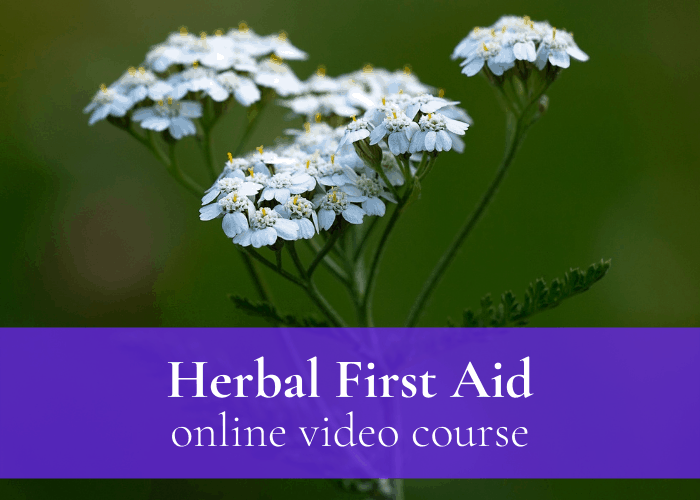
Like all our offerings, this self-paced online video course comes with free access to twice-weekly live Q&A sessions with us, lifetime access to current & future course material, open discussion threads integrated in each lesson, an active student community, study guides, quizzes & capstone assignments, and more!
If you have a moment, it would help us a lot if you could subscribe, rate, & review our podcast wherever you listen. This helps others find us more easily. Thank you!!
Our theme music is “Wings” by Nicolai Heidlas.
Episode Transcript
Katja (00:00):
Hi, I’m Katja.
Ryn (00:15):
And I’m Ryn.
Katja (00:16):
And we’re at Commonwealth Holistic Herbalism in Boston, Massachusetts.
Ryn (00:20):
And on the internet everywhere, thanks to the power of the podcast. All right. So, it’s June, and it’s time to talk about first aid kits.
Katja (00:29):
Yeah. June is like the kickoff to summer adventure season. But also here on the East Coast, it is the kickoff of hurricane season. And it’s not the kickoff of wildfire season. That happened actually quite some time ago.
Ryn (00:43):
It was a while ago.
Katja (00:44):
Yeah. I think the boat has sailed on that one. But whether you are thinking about summer in terms of going out, and having fun, and climbing mountains, or doing whatever, playing Little League – I don’t know – all the different things. And the potential for hey, getting hurt sometimes while you’re having fun. Or whether you’re planning for weather events or whatever else that could be coming your way. And making sure that you’re prepared for whatever not fun kinds of things could happen during that time. No matter what is on your mind, first aid is important.
Ryn (01:20):
First aid is important. It’s first.
Katja (01:23):
It’s first.
Ryn (01:26):
So, this month we’re going to be sharing a bunch of information about first aid, and we’re going to start off today with your first aid kit. So, if you already have a first aid kit around, it’s not something that you set and forget forever, right? It’s going to need some maintenance. And if you don’t have a first aid kit to brush up and update, but instead you need to start fresh, then this is a great time to do it.
Katja (01:51):
Yeah. You know, when we think about first aid kit, that might be a bag that you have that you bought so that you could put it in your car. But it’s not what you have in your bathroom, or your kitchen, or your whatever. Or it might be. There’s so many different ways to think about what even is a first aid kit. But bottom line, the most important thing is that whichever kind you have, whatever kind of philosophy of being prepared you have, it requires care and feeding. Because sometimes you have to swap things out. You have to just check and make sure everything is still good in there. All that stuff is what we want to look at today.
Ryn (02:36):
Yeah. So, we’re going to cover both today. But first we want to give you our reclaimer. And that’s where we remind you that we are not doctors. We are herbalist and holistic health educators.
Katja (02:47):
The ideas discussed in this podcast do not constitute medical advice. No state or federal authority licenses herbalists in the United States. So, these discussions are for educational purposes only.
Ryn (02:58):
We want to remind you that good health doesn’t mean the same thing for everyone. Good health doesn’t exist as an objective standard. It’s influenced by your individual needs, experiences, and goals. So, keep in mind we’re not attempting to present some kind of single, dogmatic right way that you must adhere to.
Katja (03:16):
Everyone’s body is different. So, the things that we’re talking about may or may not apply directly to you. But we hope that they’ll give you some new information to think about and some ideas to research and experiment with further.
Ryn (03:28):
Finding your way to better health is both your right and your own personal responsibility. This doesn’t mean you’re alone on the journey, and it doesn’t mean that you’re to blame for your current state of health. But it does mean that the final decision when you’re considering any course of action – discussed on the internet, prescribed by a physician, whatever – that’s always your choice to make. All right. And also we just want to make a quick plug here for our Herbal First Aid course, because there’s a lot of herbal first aid info in there. You might be surprised. Yeah. You can find a lot more information in there about getting your kits together, all the stuff you’re going to need, all of the herbs that you’re going to want to include, and how to take care of all the different sorts of accidents that take place in the course of any person’s life.
Katja (04:14):
You can find that and all of our courses at online.commonwealthherbs.com. And as you might already know if you’re a frequent listener of the pod, of course, all of our courses come with live Q&A sessions twice a week. Lots of ways to get in touch with us directly. Us personally, me and Ryn, and also Kenton and Emmy who work as mentors. We will personally answer your questions anytime you have them, as many as you have them. We really want you to learn this stuff. We don’t just want you to buy the course. We want you to actually learn it and be able to do this in your life. So, we really want to make sure that every single question you have gets answered. Plus, our student community that is pretty awesome. And just lots of other really great stuff that comes with all of our courses. Oh. And also lifetime access and full updates into the future and everything else. Yes.
Ryn (05:13):
Yeah. All that good stuff. And also because we’re going to really focus on first aid this month, we made you a coupon for the Herbal First Aid course. If you use the code FIRSTAID when you’re checking out to purchase that course, then you’ll get $25 off.
Katja (05:31):
And FIRSTAID is all one word. No space in between, just FIRSTAID altogether.
First Aid Kit Inventory & Shelf Life
Ryn (05:37):
Thanks. Good. All right, so let’s get to the kit. And the first thing here to do is to inventory what you’ve got and where you’ve got it. Yes. We want to bring them together.
Katja (05:50):
Yeah. That second part is really important because most people, just like in real life, don’t actually keep everything in a first aid kit in a kit.
Ryn (06:03):
Right, centralized.
Katja (06:04):
Yeah. Most people have their Band-Aids in the bathroom, and something in the kitchen, and something here, and something there. And when you need it, you kind of just know where you keep the things in your house. And so you get all the different things. But for most people – I don’t know – if you’re anything like how I grew up, it’s not all in the same place. A lot of it was in the linen closet in my mom’s bathroom, but not all of it. A bunch was also in the cabinet over the knife drawer in the kitchen. And then there was whatever.
Ryn (06:34):
Right. And then when you bring herbs into it too, you may be like oh, I’m bleeding. Okay. I stop the bleeding over here. And then I go over there to get the wound cleaner. And oh yeah, my herbal wound wash is in my other room. And I go and grab that, and now there’s blood all over the floor. Little trails as you’re going from place to place, you know? Yeah. Right. So, it’s not ideal, honestly.
Katja (06:54):
Yeah. But it also just sort of develops organically., No shade, right? This just happens. This is how my house was. It’s probably how your house was. It’s how all my friends’ houses were. It’s just kind of the way it goes. And so, as you are right now, as you’re going through all of your herbal first aid supplies, and regular first aid supplies, and over-the-counter first aid supplies, and all that stuff. And you’re realizing oh, I have all these things in different places. This is the perfect time to just look at your house and find a place that makes sense to be the centralized location for all the stuff. And that’s probably going to be either in the kitchen or in a bathroom. Because when you are wounded, you also need the sink to wash stuff out. So, it kind of makes the most sense for it to be in one of those two places. But in terms of just making life easier for you. And then also planning ahead for what if you needed to gather all your first aid supplies very quickly and go to where there was a problem. If you have to run all the around the house, you’re going to forget something. But if you have everything in one place, even if it’s not in the kit. It’s in a drawer or a cabinet because that’s convenient for everyday life. No problem. But yes, a centralized location is key.
Ryn (08:21):
It’s more scoopable.
Katja (08:22):
It’s more scoopable.
Ryn (08:24):
Sometimes you’ve got to just scoop everything up and then walk away with it, you know?
Katja (08:28):
Yeah.
Ryn (08:29):
Right. So, yeah. Make a plan for that. Figure out what the best option is going to be for you and where you’re living right now. And you know, move some items. And as you’re doing that, as you’re going through your first aid supplies and all that stuff, you want to be checking to make sure that each of those items is still good. Some things are supposed to stick. Are they still sticky? Some things are not supposed to stick together. Have they fused because there was weird moisture that you didn’t notice? And now it’s a glom of unusable objects? Like okay, that happens. It’s not the end of the world, but you need to know before you get hurt, ideally. If you’re an herbalist, you’ve probably got tincture bottles. And you probably have a lot of your tinctures in the dropper tops because it’s easy to grab it and take a squirt. But those tops do wear out over time just from the alcohol fumes and everything in the tincture itself. So, check all your dropper tops at least once a year. Are any of them cracked? Are they crumbling? The first sign is kind of like a grayish sheen over the black rubber. Yeah.
Katja (09:30):
Yeah. And then the next thing is you might not notice them cracking because it tends to happen in the little join in the neck where the screw part of the top and the rubber squeezer part of the top come together. That you get little cracks in there, and it’s not always super easy to see. So, actually look a little bit closer as you’re doing it. Because first off, that’s a place where it could leak if you have it in a bag or something. But more importantly, if it’s degrading like that, you’re getting bits of the rubbery material in the tincture. And that’s not actually awesome.
Ryn (10:12):
Not fantastic. Yeah. Not great. You know, another herbal-specific issue here is if you have infused oils or salves. They do have a shelf life. They will go bad eventually, right? The herb chemistry that gets extracted in there preserves that shelf life pretty significantly, but it’s not forever, you know? So, if you have some oils or salves around as you’re moving them into your new first aid location spot, then open ’em up. Take a sniff. See what’s going on inside and make sure that they’re all still good to go.
Katja (10:47):
Yeah. And this is also a once-a-year minimum thing. A lot of people are well, how will I know if it’s still good? And with salves and oils, that’s a little easier than other situations because you can smell rancid oil. If you’ve never smelled rancid oil… Is that…? Like at some point in your life you have. Yeah, you have. But really, if you have a salve that has a lot of essential oil in it, it might be a little harder to smell. But I have had salves with essential oil in them, and still eventually they will go rancid, and you can smell it. So, really open it up. Have a good strong sniff. And then the other thing to be looking for is mold. So, you know, if you have a salve, it’s in a tin or something like that. And realistically it’s your salve in your home. You probably use your finger in the salve, right? That’s not gross. Yes, if that was something that somebody was selling to you, then it would be gross. But it’s your stuff. That’s not gross. But every time that you do that, there is the potential for crud to get in there that could cause mold. And so I’m not saying that you need to have a rubber glove to get the salve out of your own tin in your own house, or like the back of a spoon, or whatever. You certainly can do that, but it’s not necessary. But it is good just once a year to just take a peek and make sure nobody’s molding. Nothing is weird in there. No bits of water got in. And if you keep lotions in your kit, then lotions are like bonus complexity. Because they can go rancid on the oil side. Because lotions is oil and water mixed together, right? So, the oil parts of a lotion can go rancid. Or the water parts of the lotion could cause mold. So, we’re looking for both factors there. Yeah.
Ryn (12:49):
Yeah. All right. And you know, we’re not herb-only purists around here. And you may not be either. So, your first aid kit might contain some over-the-counter drugs, or it might contain some prescription drugs. If you have a medical condition, and you need a steady access to your pharmaceuticals, then you want to include that in your first aid kit plan and in your go bag if you’re going to have such a thing. So, those need to get checked as well. Are they still within their use by date? Are they still good? That’s really important. Yeah. All right, cool.
Katja (13:26):
You know, one other thing that wasn’t on our little checklist of stuff to remember to say but did just pop into my mind and is kind of a good transition into our next topic, actually. And that is honey. If you have honey in your first aid kit, then just check in there too. Has it crystallized, which is not necessarily a problem. But when you’re working with wound care, if your honey gets too crystallized, then that can become a source of discomfort for a wound. You kind of want your honey in a Goldilocks zone of gently liquid, but not so liquid that it’s going to run.
Ryn (14:08):
More like a paste consistency really.
Katja (14:11):
Yeah. Like flowy. Yeah, liquid is not actually the best word I wanted.
Ryn (14:16):
Because I want to be able to put it here, and it pretty much stays. It will slowly ooze if I was just to leave it, but it should mostly stay.
Katja (14:22):
So, without any crystals in it. But the last stage that doesn’t have crystals in it, that’s the most ideal. Because it won’t drip out of whatever you’re trying, your Band-Aid or whatever you’re trying to do. And so just check if you have herb-infused honey, that tends to be liquidier. And so that also can ferment or it can, it’s possible, mold. Check that. And if you have just straight honey with nothing infused in it, then the issue that you’re looking for there is did it crystallize into a place where it’s not really practical to use on a wound anymore. And if it did that, that honey is not bad. You can put it on toast or whatever. Put it into tea, whatever you like your honey.
Ryn (15:08):
Sometimes just warm it up again, and it will settle down.
All The Things We Need
Katja (15:12):
But either way, maybe you replace that with a more flowy kind of… Not too flowy. A perfect Goldilocks flowy amount of honey. Yes. Okay. And so my point there with transitioning into the next topic was the contents of your first aid kit or your first aid location, your first aid station in your house, do you actually have all of the stuff that you need? And when your first aid stuff is kind of scattered through the house, then it’s not always easy to know if you have what you need. Because oh, I didn’t have any honey in my kit, but now something has happened that requires honey. Well, I have honey in my house. I can go get it. But it wasn’t really with your first aid stuff. So, if you were going to take your first aid stuff somewhere, you would not have thought to take the honey with you. So, even though you may have all the things that you need for caring for your family anytime, or your household anytime there’s injuries, you might not actually be thinking about all those things as first aid kit contents. And so it’s good to just make sure: do we have all the things that we actually need to take care of all the things that could happen.
Ryn (16:31):
Yeah. And this is also a time to check in on kind of again, the inventory, right? So oh, I’m sure we’ve got some nitrile gloves around here somewhere. We bought a few while back, and we’ve got a set around. Yeah. Except then somebody wanted to stain a bunch of pieces of wood for a construction project, and they were wearing them while they did that. And they’ve gone through your whole stash, and now there aren’t any left. So yeah.
Katja (16:54):
Yeah. That’s a constant thing in our house. I’m always like no, we can’t use the gloves for that project because then we won’t have them for the first aid kit. You can get more gloves. It’s okay. You can have gloves for both. But just check and make sure that as you’re going through, because if you’re in a big DIY phase, that’s cool. But then just make sure that you don’t run out of the gloves.
Ryn (17:17):
Yeah. But at this stage you’re like okay, do I have the stuff that I thought I had? Do I have the stuff that I already knew that I wanted in my first aid station area? And I had already planned it there, and it was there. All right. Is it all still good? Do I need to replace anything? Did I run out of stuff? Okay, there’s that. But then there’s also have my needs changed, or have I realized that there’s something else that I do want to include? Because your needs might change over time. You maybe start a new habby. A new habby? A new hobby. And you want to make sure that you have whatever you need for what keeps happening. I don’t know. I took up archery, and I don’t have a good wrist guard. And I keep getting these scrapes on this inside of my wrist on my left hand. And I need some nice salve to apply there regularly. I don’t know.
Katja (18:07):
Maybe your kids are getting older, and they started Little League, or they started gymnastics, or they started whatever. Maybe you started a new DIY kind of hobby, which I fully support. But most DIY hobbies come with some bonus first aid requirements, like potential requirements.
Ryn (18:29):
The occasional smashed fingernail, you know,
Katja (18:31):
Hopefully not the occasional finger in the saw. But definitely the occasional flying splinter. And please do wear your eye goggles, but sometimes. Sometimes, right?
Ryn (18:48):
Oh, I’m just doing this real quick. Okay. That’s not great.
Katja (18:52):
Put on the goggles. Yeah. And so even if it’s just like you’re just sanding. And you’re like well, there’s not going to… I’m just sanding. Yeah. But sawdust in your eye really hurts. And so do you actually have one of those little cups that you put the saline solution in to rinse out your eye gently or not? And so just sort of all those kinds of things that may have changed about your own activities throughout the year might change the needs for the first aid kit.
Ryn (19:25):
Yeah. But maybe you or somebody else in your household has had a change in their health status. There’s a new or a newly understood disease state or health problem going on for them. And there’s something that they’re definitely going to need. And you’re going to want to include that in your kit, especially if it turns into a go bag, or something like that occurs, right? So, basically this is a reminder that the first aid kit isn’t only about cuts and scrapes and bumps and bruises. It’s about all the different things that somebody could need help with. It could be that somebody’s allergies just got real bad all of a sudden. And they’re like I don’t know what’s different this year, but it’s really intense. Okay. You’re going to want to have that on hand, and have it somewhere easy to get to, and centralized, and all of that.
Herbal Care Considerations
Katja (20:10):
Yeah. This is bringing up for me a tiny tangent. I swear I’m going to make it really short. But this is a concept that I think about a lot. And I have a lot of resources for this in different places in our courses. But I call them herbal care kits, because it’s not exactly a first aid kit, but it’s also not just random things on a shelf. It is like if there’s something that happens that isn’t first aid, like seasonal allergies. It’s not exactly first aid, but it’s also a thing that happens every year. It’s very predictable. You know how it happens. You know when it happens. And so if you just have your herbs, and your whatever, and your things in all the different places that they are. Then when you’re feeling miserable because allergies happen, it’s really hard to think about what do I even have that could help me with allergies in my herbal apothecary, or in my here, or in my there. Like in all the different places I keep things. And if you just make yourself a kit, just put it in a shoebox. Put it in whatever. It doesn’t have to be anything fancy. But if you just assemble the things you need for the sorts of situations that aren’t necessarily first aid. We think of first aid as an unexpected injury sort of situation. It doesn’t really have to be limited to that, but we kind of think of a first aid kid as those sorts of things. And so this is not exactly that. It’s a situation that’s kind of expected. But still the same concept of a kit of putting all the stuff you need in one place so that when you’re feeling miserable, you don’t have to also use your brain. So I call these herbal care kits. And it’s, I think, a great idea to at the start of every season, just make sure that you have the stuff you need for that season of the way that you tend to get sick in that time, or your household tends to as well. And so you can be kind of extending your concept of a first aid kit to sort of include that herbal care kit as well.
Ryn (22:15):
Yeah. And one – I don’t know – circumstance to put into your mind when you’re considering an herbal care kit that you’d want to have around could be that there has been some kind of a disaster in our area. There’s hurricanes, there’s flooding, there’s fires, there’s tornadoes, there’s landslides, there’s all kinds of things that can happen. And it may happen that you live somewhere where this occurs. And you either need to shelter in place, or you need to evacuate, right? It may be that it’s like all right, well, we’re just here with whatever we’ve got in the house for we’re not really sure how long. We hope it’s not too long, but we don’t really know, right? Or we’ve got to go somewhere. We’ve got to go to a to a shelter center, right, someplace where people are staying. And so that’s a particular situation that might occur. And you want to be planning and thinking like what would we need, not just if we get cut or if we get hurt. But what would help us to get through such a circumstance, and maybe even what would make us a little more comfortable, right? So, that can start with saying all right, well, we know that there are these illnesses amongst the people that we’re caring for here. They’re going to need this medication, or they’re going to need this reliable access to this herbal remedy. We want to make sure that we have those ready to go if we need to leave. This is kind of moving in the direction of a go bag or something along those lines.
Katja (23:45):
We keep saying that. And so I just want you guys to know that that’s actually planned for the next week’s topic. So, we are going to talk bigger about go bags specifically, go or stay bags, whatever. So, we do keep kind of mentioning it, but don’t worry. A big thing about that is coming. Yeah.
Ryn (24:04):
Yeah, right.
Katja (24:05):
But like you were talking about. What if also in those sorts of situations you know that you or someone in your family always gets diarrhea. Like you just have kind of a touchy digestive system. And if the water changes, or if your stress level changes, or whatever, you know that’s just a factor. Okay, well, that’s not a cut, or a bruise, or a scrape, or whatever. But it’s still a thing that needs to be taken care of, especially in a first aid situation. And so yeah. Make sure you’ve got the blackberry root in the first aid kit, right? Just because it’s not a bandage doesn’t mean it doesn’t have a home in the first aid kit.
Ryn (24:45):
Yeah. Maybe you might’ve lived through a similar problem before, right? You’re like okay, yeah, last year there was this big wildfire, and there was a shelter-in-place order. And we were putting up the stuff on the windows to try to reduce the particulates coming through and whatever. And I got really bad migraines every day for that whole week. Okay. Maybe by the end of that week you were able to find some herbs that helped you out. Maybe since that time you started to learn herbalism, and you’re trying to anticipate that need in the future. Then you’re definitely going to want to include your effective migraine remedy into your kit. Yeah, for sure. So, just be thinking about those kinds of things in terms of what goes into your kit or your first aid station.
Katja (25:28):
Yeah. And you may have people, like you have your household, whoever you live with. But you may also have people who you spend a lot of time with. Maybe they come to cookouts at your house really often. Or maybe your family and their family go to the lake a lot or whatever. Hey, they’re fair game. You can plan ahead for things for them as well in your kit. A first aid kit is not just about you alone. Every single part of being a human is about community. And sometimes we don’t like that very much. Sometimes we want no, I just want to be myself. I want everything to be my way right now all the time. And it’s just not like that. We live with people. We are social animals. And so when you’re thinking about being prepared for whatever might happen, be prepared for the people that you frequently hang out with too. That is a way of expressing your love for them. And also just a way of making sure that you’re prepared for a situation that they might be with you in. Yeah.
Scoopability & A Bit About Bags
Ryn (26:39):
Yeah. Okay. So, we’ve kind of brought up the idea of portability or potential portability.
Katja (26:47):
Scoopability. I really like that. That was spontaneous in the moment there, but I really like it. I like that concept.
Ryn (26:54):
Yeah. So, we brought that up. But just to say that you want your first aid stuff to be able to become portable in a hurry if you have to, right? That doesn’t mean that you need to keep everything in a bag all the time. That might not be the most convenient. Sometimes it’s easier to open a drawer or a cabinet and just grab a box of Band-Aids. Rather than I unzip the bag, I take out this compartment, I open this Ziploc. Now I have my Band-Aid box. There’s just a little more steps to it when you have everything all packed in, you know? I will say though, it is an option. It is an option. And we do encourage all of our students in our first aid course and just in general when they’re studying to at least try. Just take all of your first aid stuff, put it into a first aid kit, however big it needs to be, to contain everything you want to include into there. And just let that be where it lives. And at least do that for a little while. One big reason is you want to get super familiar with your first aid kit. And the same thing if we’re going to talk about a go bag, right, and whatever version of this we’re describing. You want to be able to think of an item and know exactly where it is and how you would get to it. Like what do I have to open, what do I have to separate, what do I have to tear, whatever it is, to get to the thing that I want. You don’t want to be like oh, I know somewhere in here there’s a pair of really fine tweezers. Is it in this bag? Is it in that compartment? I don’t know. Now I have to pour everything out and dump it all over the floor so I can find the item I’m actually looking for, right?
Katja (28:28):
Right. And this is not a concept that is unique to first aid kits. There’s a whole industry built around making little bags that will organize your suitcase for you.
Ryn (28:41):
Your toiletries, your makeup, your whatever. Yeah.
Katja (28:43):
Right, exactly. And just make it easier to pack your suitcase. So, it’s the same sort of concept. And you know, pro tip here. Whether you keep your stuff in your first aid kit all the time. Or whether you just keep the bag, box, whatever handy for if you needed to scoop it all. Either way, there are lots of fancy first aid kit bags on the market out there. And they have like a billion little pockets and like all this stuff. And they’re cute or tacticool depending on how you look at things. But tacticool, yeah. But I just want to tell you that first off, they’re usually quite expensive. And also they should be. If you are going to go that route, buy the good one. The cheapy ones, they tear.
Ryn (29:43):
Yeah, they fall apart.
Katja (29:45):
The pockets really fall apart. The zippers get jammed and whatever. So, if you’re going to go this route, spend the money on a good one. But I just want to advocate for a plain old duffle bag with a lot of gallon-sized Ziploc bags in it. And here’s why. All those fancy little pockets get kind of constraining. A very well-designed kit that is also uniquely tailored to the kind of work you’re doing, then all those little pockets can be great. Yeah. But when you’re looking for a generalized idea of a kit, and you’re purchasing one that has been made in a generalized kind of way. Then all those little pockets don’t always line up with what your needs are. And sometimes they’re very fiddly, and it’s hard to get things in and out of them. And they’re maybe not as big as what you need the thing to be. And so, I just want to normalize a plain old duffle bag. And inside of the plain old duffle bag, definitely have organization. Have gallon-sized Ziploc bags or some of those organize your suitcase bags, whatever. We’ve done all kinds. We have literally everything. We have a lot of different kinds of first aid kits for different reasons. Some of them are absolutely tacticool. Some of them are Home Depot toolboxes, no joke.
Ryn (31:17):
Oh yeah. Yeah.
Katja (31:18):
In fact, two of them I’m staring at right now are. One is a giant plastic, like see-through Tupperware bin where we keep stuff for a larger camp sort of situation. And then some really are just trashy duffle bags with a lot of smaller bags inside of them. Having some waterproof, whether it’s Ziploc or some of those suitcase organizer bags inside, is very helpful. Because you don’t want just everything rolling around inside. And also it keeps everything clean. And if it was raining or whatever else, that’s really, really good. Or if you are reaching inside, and you had gloves on. Like ideally if you have gloves or blood on your hands, then… Wait. Blood on your hands or blood on your gloves. There we go. That’s what I was trying to say. Then ideally somebody else would reach into the first aid kit for you. But sometimes you are by yourself, and it’s you that you’re taking care of. And so you are reaching into the kit. And so if everything is in a Ziploc bag. And okay, this Ziploc has all the Band-Aids. And this Ziploc has all the roller gauze. And this Ziploc has the tweezers, and the scissors, and all the pointy sharp things. Like the needle I use for getting out the whatever, the splinters and stuff, all that. You know, whatever. Then at least when you contaminate your first aid kit, it is in a way that is still protecting the actual first aid items inside. And that’s better.
Ryn (32:47):
Much better.
Katja (32:50):
But so yeah. I just really, apparently, I want to say a lot of words about this. But I do just want to say literally it is fine to use whatever bag your kids outgrew from school, whatever duffel bag is not going to the gym with you anymore, whatever. You don’t have to go out and buy fancy stuff. Save that money for good, quality Band-Aids and whatever else you’re going to put inside your kit. That’s what I have to say about that. Yeah.
Weight, Durability, & Customization
Ryn (33:23):
Well, another element that I would bring up here would be weight. Especially for times when you’re going to carry this with you, or you’re going to be taking it you’re not sure where. You’re not sure for how long. To the extent possible, you would want to avoid putting your glass bottles into your kit because they’re heavy, and they’re breakable. And you can try to buffer them, and protect them, and all of that kind of stuff. But it’s a real risk. So there are fortunately some non-reactive plastic bottles that we can pour our tinctures, and our wound care oils, and our whatever into. And there are ones that are very, very watertight. And you can throw them across the room, and they’ll just bounce.
Katja (34:04):
Yeah. It’s those Nalgene ones that are the safest of the plastics and the least likely to have any kind of reactivity and whatever. And yeah, plastic’s not ideal. But broken glass inside your first aid kit also not ideal.
Ryn (34:19):
Not ideal. Not ideal. Right. So yeah. So, that saves you hassle in terms of breakability. And it’s lighter, easier to carry around.
Katja (34:29):
Yeah. It’s one thing if you’re going to toss something in the car and take it to the local emergency shelter or whatever. Okay. But if you are.. Well, this is a good example actually. So, Ryn loves to climb trees in the woods. And so I made a special first aid kit that… I mean, he does not fall out of trees, you guys, whatever. But I don’t know what if? What if something happened? He also likes to run through the woods, and what if there was a root? And he’s never tripped on one yet. But what if someday he does, and he sprains his ankle in the woods? And he yells, and I’m like oh. Okay, well I don’t want to carry a big honkin’ huge whatever as I run out there and make sure he’s okay. And so I have a smaller bag that just has the stuff that he might need if he got hurt immediately right here in the woods, that would make it easier for me to get stuff stabilized, and then for us to come back to the house to take care of the problem. So, the idea of having something super portable that is also specifically tailored to what you need it to be. So, maybe you have a huge first aid kit that’s your home first aid kit because you have a large household, or you always have lots of friends over, or whatever. There’s no problem with that. Your entire kit doesn’t have to be ounce counting, low weight, always ready to run.
Ryn (35:55):
To go hike the Appalachian trail and whatever, you know?
Katja (35:57):
Right, right, right. Exactly. You can have sort of multiple bags that you use. And some can be pre-packed, and some can be not pre-packed. But if you just sort of have a stash of the different sorts of situations. So yeah, I have a run out into the woods in case something happens to Ryn or Elsie, because they run through the woods together, our dog, Elsie. But it doesn’t have every single thing in it. It just has the stuff I would need for that kind of a situation.
Ryn (36:28):
Yeah. All right. So, thinking along those lines, that can be really helpful.
Katja (36:33):
Or another sort of situation that is a really good one to think about is any kind of DIY activities. Having a specific first aid kit that is like a stop the bleed first aid kit either right there in wherever your tools are for your DIY stuff or right by the sink. Because maybe in your setup that’s where you would go. But you know my brother has a wood shop, and I’m pretty sure he has a first aid kit in it. Now that I think about it, I’m sure he has a first aid kit in his wood shop.
Ryn (37:12):
I thought you brought him one.
Katja (37:14):
No, I think my mom did. I think my mom did. But you know, if you have people in your household who go out to the garage, and work the table saw, and whatever else. Do you have what you need to stop bleeding? Because you might need to do that. And even if you’re going to go to the hospital. And you’re like well, I’m not going to take care of that at home. Of course we’re going to hospital. Yeah, but you stop the bleeding before you go or at least on the way, you know? So, having that kind of a thing really specifically tailored to what could happen using a jigsaw because that’s a thing I do these days now or whatever. Or what could happen at the sporting event that is a thing we do now or whatever. Having that as a subset kit and then having it lightweight and easy to take with you is important.
Limitations of Ready-Made Kits & Quality Concerns
Ryn (38:04):
Yeah. So, we’ve mentioned several times this idea of taking a moment and thinking about what you would actually need and the people around you would actually need. What are the kind of ways that they’re likely to get hurt or to feel bad, like in the belly, in the sinuses, or wherever else in their body, right? And trying to make this tailored to the needs you can predict. So, that is kind of opposed to the idea of oh, I’m going to go and buy a ready-made, generalized, do anything kind of a first aid kit. The problems with such a thing are that most of them are too small to actually be capable of addressing everything. And the ones that could address quote-unquote everything are too big to be useful, and they’re kind of unwieldy. It’s really hard to find a Goldilocks zone unless you make it yourself.
Katja (38:55):
Plus, when you buy the pre-made kits, the contents are not awesome. It’s the generic Band-Aids that don’t stick very well. The scissors in there won’t really be very sharp, or they won’t be strong enough to cut through the stuff that you need to cut through. It’s just when you buy those pre-made kits, it’s just nothing in there is really exactly what you actually need. Or if it is the thing you need, it’s not the quality that you need.
Ryn (39:25):
We are speaking in general terms. I mean, I know some folks who make some really great quality first aid kits. They do exist, but…
Katja (39:33):
Well, they make tailored, specialized… Right. Yeah. So, it really is better to think about what you need and then get the individual items specifically so that you’re getting good quality. And now we’re to the pro tip again. And that is really don’t skimp on the Band-Aids. Find Band-Aids that you like that stick really well. For me it is the CVS brand of the flexible fabric, but not the tough strips. Because those stick really, really good. But they stick almost too good because when you peel them off, they kind of pull at the wound a little. So, for me I don’t love those. And I like the CVS brand instead of the Band-Aid brand because they have a tiny bit of adhesive around the sides so that you don’t get the paddy part bubbling up. Bubbling up. Like, okay, I clearly have some very specific preferences here. But you should have those. You should try a bunch of different things. Like Ryn’s favorite is… Like if we ever run out of those knuckle bandages…
Ryn (40:47):
I like them for everything.
Katja (40:49):
He loves them for everything.
Ryn (40:50):
They’re going to stay where I put them. They’re just way better, you know? So, yeah.
Katja (40:54):
And the thing is that in a first aid situation, maybe you’re just around your house, and you could replace that Band-Aid anytime. But you don’t know. Maybe you are out somewhere, and you are not going to be able to replace that Band-Aid, or the Band-Aid’s going to get wet, or whatever else. And so first off, just the luxury of having bandages that can stick onto you in any location, that is kind of amazing actually. And so have some in all the sizes. Definitely the extra-large size, but also sometimes the small size is what you need. And then really try the different brands to see what you like best. And to see what’s tough and is tough enough to stand up to most things, but not so tough that it hurts you when you take it off.
Ryn (41:49):
Peel you down to the dermis when you pull it off of you. Yeah.
Katja (41:53):
Yeah. But so my point here is spend the extra money on those. Spend the extra money on a really good pair of scissors, a really good pair of tweezers.
Ryn (42:06):
Really good tweezers.
Katja (42:07):
But the flip side of it is not everything has to be the most expensive. So, if you’re buying roller gauze, which I highly recommend. I love roller gauze. You can bandage just nearly anything with it.
Ryn (42:18):
Gotta have it.
Katja (42:19):
Gotta have it. But it does not have to be the individually wrapped, sterilized roller gauze. There are some times when that is useful, so like maybe get a couple. But generally you can buy the less expensive box of roller gauze that each one is not individually wrapped, but they’re all…
Ryn (42:39):
Yeah. They’re just all lying next to each other. And it’s rare that we’re going to be like yeah, the gauze itself is going to go straight onto that wound.
Katja (42:45):
Right, right, right. There’s usually going to be some other sterile pad that would go in that place instead. And the gauze is actually just holding that on. So, you don’t actually need to buy the more expensive gauze. Or like self-occlusive wrap is really helpful. That is a kind of mostly waterproof – I guess maybe water resistant is the better word – wrap that sticks to itself but not to you. And you put it over whatever bandage you have going on to protect it from okay, but now I’m going back out to weed-whack again. And a roller gauze is not enough to actually keep this whole thing clean.
Ryn (43:28):
Yeah. So, it might be sterile pad, roller gauze, the vet wrap on top. That’s pretty stable.
Katja (43:33):
Right. Vet wrap, you might know that as vet wrap. Like if you have pets, you might know that self-occlusive wrap from that situation. Well, that’s actually the thing. If you do not have a latex allergy, buy vet wrap. It’s the same stuff that they use for animals that we use for humans. But it does have latex in it. So, if you buy the stuff that’s specifically for humans, it’s more expensive. And then if you buy the stuff that’s latex-free, it’s more expensive. And you should have at least one or two in your kit that are latex-free because you might be helping someone else who has an allergy. But if you don’t have an allergy, and nobody in your household has that latex allergy, then just buy vet wrap. It’s cheaper. So, not every single thing in your kit has to be the most expensive. But the things that really matter to you, make sure that they work right. Spend the money on those because it will matter when you’re in an actual emergency situation.
Top-Notch Herbal Adds
Ryn (44:36):
Yeah. And top-quality herbs
Katja (44:39):
Yes.
Ryn (44:41):
Yeah. You want to include the things in your first aid kit that you feel are fantastic. Our pine resin salve is always going to end up in the first aid kit. And when I’m separating out, like if I have a bunch of different batches that we’ve made. And I find one, and I’m like ah, this is like super rich, and really, really pine-scented, and effective, and has that beautiful red color to it. Then I’m like yeah, this is the good stuff. This is the one for the serious wounds. This is for everything, right? This other one, it came out okay. It’s a little mild, you know, whatever. I’ll use that when it’s like – I don’t know – some irritated skin, or a light scrape, or something like that. Yeah. But you’re going to want some herb stuff in there. And I’m sure as you’re thinking of this and listening to us talk, you’re like oh yeah. I want to make sure I have this tincture blend, and that thing really helps. And those kind of things around, honey hydrosols, all that kind of good stuff.
Katja (45:36):
Yeah. I was actually just going to go through a really quick, little, super quick list. Now listen, in the Herbal First Aid course we have enormous lists of all of our different kits, all the different sizes, what the kit is for and exactly what we have in it, why it’s in there, how many we have in there, all that kind of stuff.
Ryn (45:56):
I’m just going to take one quick moment to remind everybody that we do not sell products. We are not going to sell you a first aid kit. We are going to teach you how to make one for yourself.
Katja (46:04):
Right, yes. Good job. But I do want to just do a little rundown of some categories of things that you need to have. And so one is yeah, pine resin salve. Or so you could just think of it in terms of a wound salve, sort of like a broad-spectrum wound salve. And for that we love pine resin, but it could also be like a green salve or a calendula salve.
Ryn (46:31):
Or maybe yours is like – I don’t know – gumweed and chaparral or something like that.
Katja (46:34):
Yeah, that would be nice. Yeah, yeah, yeah. And then so, okay, so something there. A wound wash. For that we really like hydrosols. Rosewater, or witch hazel extract that doesn’t have alcohol in it, or any other hydrosol at all is our favorite. But that also could be if you were going to make a kit that was sort of for a more extended period of time. Then maybe you would include some dry herbs in there that you could make tea that would be a wound wash. And then I would want something in the mint family or yarrow, something that had a lot of antiseptic action. All right. And then also something for burns. And so for us that’s honey and rosewater. And then the honey is going to double for wound care as well. So, that’s really handy.
Ryn (47:36):
She didn’t mean like mixed together.
Katja (47:38):
Oh right, that’s true. Yeah. Rosewater to spray on it, to cool it down, and wash it. And then after that honey to dress it and wrap it up with. Yeah, yeah, yeah. But yeah, that honey is also going to help in terms of wound care, and it’s really helpful to be thinking about that. Like how can I consolidate? I could carry less if I say I am going to have this honey for burns and for wounds or whatever, instead of having two different things. Some something to help with pain. So, that might be tinctures. That might be that you have made little herbal pills or pastilles or whatever. Herbal lozenges of powdered pain-relieving herbs. It might be like different sort of situations. Whatever is appropriate for your family. And maybe you prefer a tincture, maybe you prefer not a tincture. Maybe you’re working in a place where you can’t take alcohol, so okay. But something to deal with pain, something to create calm. And that goes both ways. Creating calm in the person who’s injured and creating calm in the people caring for the people who are injured.
Ryn (48:53):
It is always worth the weight to put nervine formulas into your first aid kits, your go bags, your street medic kits, all that stuff.
Katja (49:01):
Yes.
Ryn (49:02):
Most likely to be needed. Even if nobody cuts their skin open. It’s more likely that they’re going to need some nervines.
Katja (49:12):
Yeah, yeah, yeah. And especially whatever your favorite I need to calm down immediately herbs are. For me that’s like rose, and calamus, and yarrow, and catnip, and chamomile, and blue vervain. But whatever that category is for you. And then also it can be very helpful to have something, depending on the purpose of the kit, to have something like cayenne tincture or a coffee bean tincture. Something that’s going to have some caffeine in it, or not caffeine but a kick like cayenne. This can be really important if you’re in an emergency situation, and you might need to be caring for people in your community longer than your body wants to keep working. And so you don’t have time to sleep or take a break. And so you need something that’s going to give you some energy to keep going.
Ryn (50:16):
Yeah, yeah.
Katja (50:20):
Oh, we didn’t talk about sprains. Also a real nice joint liniment is a good idea. And a joint liniment usually has something in there like prickly ash. And some St. John’s wort and stuff usually forms a part of that formula. So, that’s going to double as helpful for bruises, and hematoma, and stuff like that.
The Herbal First Aid Course
Ryn (50:44):
Sure. Yep. Cool. So, those are some ideas to get you started. But again, take a moment. Think about the last time you went on a vacation together and what disrupted your good time. You know, it was somebody’s belly ache. It was somebody’s migraine. It was somebody’s my joints hurt, my allergies flared up, whatever, right? Try to think through those kind of moments to anticipate what you might need in another stressful situation. Yeah. So, as you’ve been saying, we do include listings, like multiple for various versions of kits that you might construct, various sizes or purposes, in the course. And we’ve got pictures of what we put in them, and how we pack them together. And what the herbs are for, and why we chose those specific items. Not so that you can replicate it exactly, but so that you can say okay. These are the actions, the effects that they were including in this remedy. I’ve got other herbs that can accomplish that that I work with, or I grow myself. I can put those together into a similar function, right? That kind of idea. Yep. And the First Aid course is also going to teach you more specifically about how do I cope with a bleeding wound? What do I do for a sprain? What’s the right sequence of steps to take when somebody’s just had a really bad burn, right? How do we cope with bug bites? All that kind of stuff. And we did take some steps to make it so that this isn’t a gory sort of a video course, right? There’s not a lot of pictures of bleeding wounds and – I don’t know – sticks poking out of eyes and that kind of stuff.
Katja (52:20):
There are some series of actual wounds. There’s a series of MRSA wounds and caring for that. And there’s also a series of our dog Elsie got a wound. And so we did a series of caring for that, but it’s not gross looking. But the point of including that kind of thing is so that you can see each day we did this. Here’s how it changed day over day. Here’s what I was looking for to tell me that I was having success. Versus what I was seeing to say oh, this isn’t working. Or what I would have seen. That didn’t happen. It did work. But what was I looking for to know that it’s working for sure. Versus to know oh, I need to go see a doctor now. This is safe for me to take care of right now. Is it still safe tomorrow? Is it still safe the next day? How do I know that? Okay, here’s what I would be looking for. And then a friend of mine also got bit by a dog and let us use daily photographs of healing that wound. So, there are some real-life progress pictures in there. But all of them are clean and not disgusting looking. So, you don’t have to worry if you’re a person who’s like I really want to learn first aid, but I have a sensitive stomach. Or I want to do this with my kids, but I don’t want to be looking at a horror movie. The stuff that you need to learn, what you need to know is in there and no superfluous, yucky stuff.
Ryn (54:05):
Yeah, okay.
Katja (54:07):
It’s not a horror movie.
Ryn (54:09):
Right, right. Cool. So yeah, we definitely think you should check it out. Again, you can find that course and all of our other courses at online.commonwealthherbs.com. And don’t forget. If you get that First Aid course, then in the checkout process you want to click the button that says I’ve got a coupon code. And put in the code FIRSTAID, all one word, for $25 off.
Katja (54:31):
That is going to be good for the entire month of June. And it’s 2025. So, you could be listening to this years from now. And if that’s the case, probably the coupon code won’t work anymore. But I don’t know. Try it anyway. Maybe I forgot to turn it off.
Ryn (54:48):
Sure, sure. That sounds great. Cool. Well, we’ll be back soon with another episode about more first aid thoughts for you.
Katja (54:58):
Yeah, we’ve got thoughts about go bags/stay bag. We’ve got thoughts about bandaging and getting better at your bandaging skills.
Ryn (55:07):
Oh, is that the mummy party?
Katja (55:09):
That’s the, yeah, bandage party. Mummy party, yeah. And more coming up. So, it’s going to be a fun month.
Ryn (55:15):
Yeah. Stay tuned. We’ll be back soon with some more Holistic Herbalism podcasts. Until then take care of yourselves. Take care of each other. And get your first aid kit stuff together.
Katja (55:28):
Care and feeding of your first aid kit.
Ryn (55:31):
All right, everybody. See you later.
Katja (55:32):
Bye-Bye.
Join our newsletter for more herby goodness!
Get our newsletter delivered right to your inbox. You'll be first to hear about free mini-courses, podcast episodes, and other goodies about holistic herbalism.