
Herbs to Help You Feel Happiness
When things are heavy, it’s hard to access feelings of happiness – but we need moments of joy and beauty to be healthy! Thankfully, we can turn to herbs for happiness when it’s hard to find on our own, and get their support when we need it most.
If you’re totally overwhelmed or shut down or fearful, it’s hard to see anything good anywhere. This becomes a terrible feedback loop that sucks away your strength and agency. The herbs i’ve included below can help you feel steady, solid, and calm, so that even if you don’t like what you have to do, you can face it.
What is happiness? Calm in the heart.
Before we go much further, it might be useful for me to define what i mean by “Happiness” – it’s a broad term! I definitely do not mean feeling giddy, and i don’t mean that feeling of “everything is good and i just got a pony!”. That’s fun, but it’s not really sustainable – those moments are short peaks, and if we really felt that way all the time, it would be like eating sugar all day every day: it wouldn’t actually feel good.
I also don’t mean toxic-positivity Happiness: we live in very unsettling times. Things are not all right and lots of people are suffering. So i don’t mean the kind of happy that is blind to the needs of others, or the kind that feels like an performative obligation. Nobody needs that.
Instead, i mean the Happiness that is calm-in-your-heart-ness. The calm that comes with being very present, with appreciating whatever good you see in your day. Because even in hard times, there is still goodness. There is still love, and joy, and stillness, and kindness, and beauty.
Finding happiness is self-care & health care.
It can be so easy to miss these things, to be wrapped up in news cycles that thrive on fear, to be consumed by negative things until it’s all you can see. Human brains are on the lookout for bad things – that keeps us safe! But because we’re all basically online 24/7, the bad things get a lot of emphasis and can become all-consuming until we can’t see the beauty right in front of us – and we can’t find a moment of calm in which to rest.
The resting part is key – this is part of what makes these moments an important aspect of health – both emotional and physiological.
When we have no way to access calm, and no way to acknowledge the bright spots in the day – because stress and anxiety has shut those pathways down – then we also have no way to exit threat perception mode. We’re trapped in fight-or-flight, and we never can let our guard down. Lately, people are becoming more aware of vagus nerve dysregulation – this is a primary cause.
So even when it feels weird to be looking for moments of joy and happiness because the situation is hard – it’s actually about your health. It’s about your ability to keep going!
There’s an herb for happiness?
Ok, so your next question is – there’s an herb for that??? Why didn’t anyone tell me before!
There isn’t one herb for that, but there definitely are many herbs for that! And that’s why i’ve put together this guide, because every body is different and different people will need to work with different kinds of herbs to help put boundaries around stressful feelings and allow warmth and beauty to break through.
Here is a selection of different herbs that can help you grow these moments of calm, quiet recognition of the beautiful and good things that happen in your day. Some will be perfect for you, and others will be super helpful for your friends. If more than one resonates with you, that’s ok, you can blend them together! Often the things that cause us stress and pre-occupation are multifactorial – which means our solution can also be multifactorial.
Herbs for happiness, in brief:
- Skullcap – for when your mind is spinning like a hamster wheel.
- Blue Vervain – for when you’re holding on too tight.
- Catnip – for when the anxiety is rising up from your guts.
- Motherwort – for when you need help holding healthy boundaries.
- Linden – for when you need “a hug in a mug”.
- Yarrow – for when you need to pull yourself together and put on your armor.
- Sage – for when you feel like you’re carrying a precarious pile.
- Rose – for when stress feels like a predator.
Skullcap
Skullcap is an herb who can stop the spinning thoughts in your head. If you’ve got stress and frustration just spinning like a hamster wheel in your mind, you don’t have any space to see anything else.
Can you remember a time you felt this way? This happens to me a lot: i get worried about something, or upset about it, and i start repeating the same words over and over in my mind. Maybe it’s what i wish i had said in a disagreement. Maybe it’s just repeating my complaint over and over again, as if somehow that can resolve the thing i’m complaining about. Sometimes i’m repeating my to-do list over and over, as if it’s some kind of mantra – only each repetition is stressing me out more!
But one of the key aspects of brains is that they remember what you repeat, and they SEE what you’re looking for.
If i’m repeating something negative, or stressful, or upsetting, over and over again in my mind, i’m not actually present. I miss the moment when someone does something nice for me, or says something kind to me. I miss the moment when the sun is breaking through the trees, or a bright red cardinal lands at the bird feeder. I can’t see those things, i’m not aware of those things, because i’m not even here!!! I’m in some hamster wheel inside my brain, strengthening this negative image until it’s all i can see.
It’s really hard to break out of that. Even if you’re aware that it’s happening! It’s very challenging to stop the spinning once you’ve got the momentum going.
But that’s where Skullcap comes in! Skullcap helps stop that hamster wheel – and i am always amazed at how successful it really is. Even when i’m really having a hard time with these kinds of thoughts, after i’ve been drinking Skullcap tea (or taking tincture works too) for a day or two, i suddenly am “snapped out of it”. I can really see what was going on, and i can see the real world more clearly.
Not that there isn’t plenty of stress in the real world – we see that very clearly!! But more specifically to our task here, i mean, i can see the moments of beauty, i can hear the kind words, i can feel the sun on my face.
Finding solace in those moments is what builds this calm happiness. It’s just a moment of feeling your heart swell because of a bit of beauty, a bit of kindness. Maybe it only lasts a moment, that’s ok! Your ability to be present for those moments can help you get through things in your day that are stressful with more resilience and calm.
You can learn lots more about Skullcap and how it can help you with stress, anxiousness, and obsessive thinking in the Neurological & Emotional Health course!
Blue Vervain
Blue Vervain is about letting go in situations where we’re holding on too tight. Let’s think about how that helps us access moments of Happiness:
These moments aren’t about everything being perfect. They’re about helping us see that there’s a little bit of beauty in each day. They’re about helping us cultivate a deep awareness that even if things are stressful, there is still good that we can hold on to. That there is hope, and kindness, to balance out the things that maybe aren’t going right.
But for some people, it’s very hard to see the things that are going right if lots of things are going wrong. Here’s a simple example that, i admit, happens to me a lot:
Let’s say you are hosting an event, and 95% of it went GREAT – but there was just a little bit of something that didn’t go the way it was supposed to. Do you give yourself a 95 for that event and pat yourself on the back for a good job, or do you really focus on the parts that went wrong and tell yourself you did bad work? If it’s the second one, Blue Vervain is for you!
Or let’s say that you need things to be done a certain way. Maybe you can acknowledge that there are other ways to do it, but let’s face it, those don’t feel like the right way at all. Maybe you need things to go a certain way because it’s what feels safe to you, especially after traumatic experiences. Or maybe you need them to go that way because in your life, that was the standard you have been held to by others – even if it was unfair. Or maybe you just put a lot of pressure on yourself to Be Good, even when those around you might have already thought you were good enough! If these things resonate, Blue Vervain is for you!
When you can’t see “good enough” as valid, or when you can’t allow your own self to be satisfied unless it’s “perfect”, or when you put a lot of pressure on yourself to do it all – these things push your mind to focus on your flaws. You’re always striving for “better”, or even “best”, so your brain can’t let you stop and take some credit for all the good you already achieved. In fact, your brain may not even acknowledge the good parts at all!
And when someone says something kind to you, you’re thinking “that’s not valid, they don’t know how much i didn’t do yet”. When someone is impressed, your brain scoffs, and does not accept it. You may not even be able to be aware of beautiful moments around you, because your brain is existing in a reality where you aren’t good enough yet, and that is the focus.
Blue Vervain helps shift that focus into the present, where you can relax the need to push so hard. Whether other people demanded it of you, or whether you developed that push to build safety, or whatever – the end result is that it’s clouding your view of reality. Vervain allows you to let go just a bit, so that you can see more clearly your own value, and the beauty around you.
One note: it is really bitter, and a lot of people find it challenging in tea – so make it easy on yourself and grab a tincture instead!
You can learn lots more about Blue Vervain and how it can help you with situations where you need to release control in the Neurological & Emotional Health course!
You’ll also find a Blue Vervain wallpaper set for your computer and phone that will help you learn more about this plant here.
Catnip
Finding a bit of calm beauty in a day can help us stop the spiral that makes us feel like we’re losing control – but the spiral itself is a feedback loop. Once you get those panicky feelings rising up out of your gut, it’s not easy to “logic” them back down again.
This is a place Catnip can help.
When we’re thinking about these emotional actions, it can be useful to think of them in terms of the physiological actions – it’s all intertwined! You might already know that Catnip is helpful with heartburn and nausea. It also helps emotionally with feelings that rise up from the stomach – the butterflies of nervousness, or the more aggressive butterflies (i’m not sure what to call that – wasps?) of anxiety or fear. These are actually the same action – that calming action that settles those uncomfortable rising feelings. We think of one as physiological and one as emotional, but actually, the sensation is the same regardless of the origin!
Those rising emotions – nervousness, anxiety, and fear – keep us locked in our heads, and make it hard to see the world around us. Granted a lot in the world isn’t great – but when these panicky feelings are in control, the not-great is all we can see. We can no longer see the moments of beauty or kindness that would help us stay grounded amidst all the not-great.
So if you’re feeling that way – if those kinds of feelings are making it hard for you to see other things – Catnip might be the herb for you!
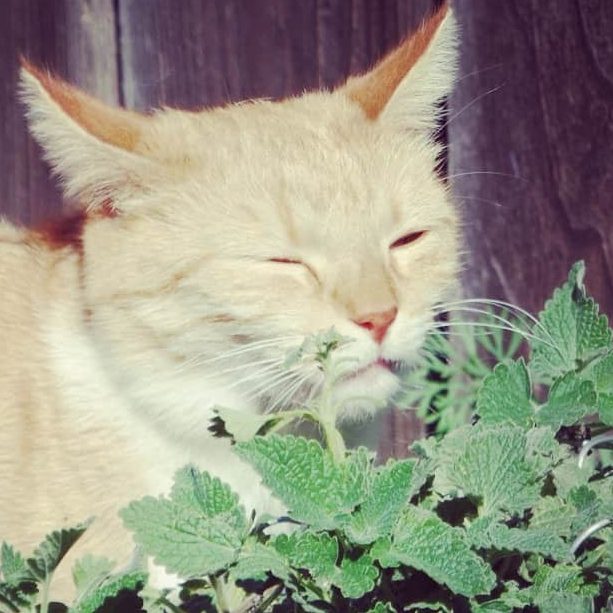
You can learn lots more about Catnip and how it can help you with feelings of anxiety and fear in the Neurological & Emotional Health course!
You can also download this Catnip wallpaper set for your computer and phone that will help you learn more about this plant.
Motherwort
Motherwort’s actions to help us get grounded in calmness are another example of getting emotional stability through physiological action.
You’ve probably heard people talk about Motherwort helping you hold healthy boundaries – but how does that work? Because Motherwort helps calm the physiological responses to stress: it calms the heart rate. It relaxes the tension that builds in muscles, blood vessels, and even in the eyes, that comes along with a stress response. If you’re faced with a stressful event, but you feel calm, it’s much easier to hold on to your boundaries and to respond to the event in a way that feels healthier. But if you feel your stress response building, and the whole “fight or flight – and the other things” is kicking in, well you want run away, or you want to back down to protect yourself, or you want to become as small and invisible as possible…
When everything around us is stressful, we can get stuck in this state. Stuck in that place of wanting to run and hide, stuck in feeling like we can’t defend ourselves or can’t stand up for ourselves.
Working with Motherwort helps us feel more calm in stressful events – and the more calm we are, the more we can see not only the things that scare us, but also the things that soothe us.
You can learn lots more about Motherwort and how it can help you with holding boundaries and feeling safe in the Neurological & Emotional Health course!
You can also download this Motherwort wallpaper set for your computer and phone that will help you learn more about this plant.
Linden
Linden has several actions that come together to help soothe us.
First, it’s relaxing to the nervous system. If you’ve been on high alert for i-don’t-even-know-how-long, then your nervous system is wound tight.
It’s also relaxing to the cardiovascular system: stress creates physical tension both in the muscle of the heart as well as in the thin muscular wall of the blood vessels – that tension raises blood pressure and makes circulation harder.
Linden is also moistening, which is important! Stress, fear, anxiety, heightened threat perception – these things are all extremely depleting. In other words, they cost a lot of physical resources for your body to maintain. And that can make you feel like a dried up old piece of leather – ready to crack at any moment. The moistening action of Linden (especially if you make an overnight infusion) is the antidote!
The more that you feel tense and dryed out, the harder it is to notice when some small nice thing happens in your day. But the more you can relax and rehydrate, the easier it is to tune into those moments and benefit from them!
You can learn lots more about Linden and how it can help you soften and feel soothed in the Neurological & Emotional Health course!
You can also download this Linden wallpaper set for your computer and phone that will help you learn more about this plant.
Yarrow
You may have heard Yarrow called “warrior medicine” or “battlefield medicine” at some point – it’s often called that because it’s so effective for managing bleeding and wound care.
So you might be wondering what that has to do with finding delight in the quiet moments of beauty and kindness that happen in our days, right? Here’s how:
Yarrow literally helps you pull it together. Whether it’s an open wound or your emotional state (and let’s face it, sometimes “an open wound” is a pretty good emotional description, right?)
And if you feel like you’re falling apart, like every time you go out in the world you’re just attacked by emotional papercuts (or worse!), then you need an herb that can help you heal up fast and keep it all together.
When we feel like we’re falling apart, then everything feels like a threat. Okwell, there are a lot of threats right now, it’s true. But focusing on our threat-vigilance interferes with the ability to see all the other parts of life – the parts where neighbors are helping one another, the parts where there is a bit of beautiful nature, the parts where someone is kind to you. The idea is to rest in those moments – to allow yourself to be expansive in that feeling of beauty, so that it can carry you through the hard parts of your day.
But in order to do that – in order to feel safe enough to do that – you have to feel like you’re protected, you’re together, you’re not leaking out of yourself.
If that’s a place where you need help in order to get to a feeling of calm, then Yarrow is for you!
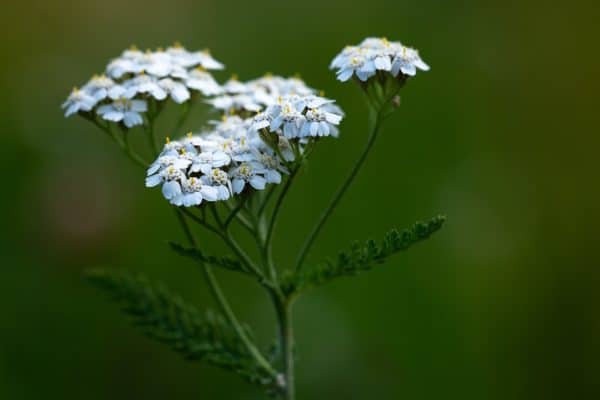
You can learn lots more about Yarrow and how it can help you hold it together in the Neurological & Emotional Health course!
You can download this Yarrow wallpaper set for your computer and phone that will help you learn more about this plant!
Sage
Sage is one of the best herbs i’ve found for getting me grounded when i’m overwhelmed – but in order for that to have real actionable meaning for anybody other than me, i need to explain the definition of “overwhelmed” – because every body is different! We all respond differently to the things that happen in a day – oh, sure, there are some universal truths! But even just among your own friends, some people think a messy home is overwhelming, or loud music, or a crowded store – whereas those things don’t bother other folks.
So when we’re choosing herbs “for” overwhelm, we need to think about what each of the different herbs do, and whether that’s the kind of thing you need.
Sage gives me the feeling – not that things are under control exactly. Not that “everything is ok”. But that i have the strength to do what i need to do, even if it’s just to get through this one day. More importantly, Sage stops the emotional dizziness – that feeling like you’re reeling out of control and you can’t reign it in – like you’ve gone off the deep end and you know it but you can’t do anything about it, and you’re just in a free fall off a cliff.
And how much more likely is that disorientation and unsteadiness when you’re carrying a pile of different things, all stacked up on top of each other? So much. It can feel like that when you’re overwhelmed, like all your responsibilities are spinning plates (with cakes on them) and firewood and a carton of eggs and a ferret, and you have to carry them all without dropping or spilling anything.
Sage makes that feeling stop. There’s still stuff to do but i can see it much more clearly. There’s still chaos around me (or in the world), but i can think about it without losing my center. Sage helps me make decisions from a more rational place, and helps me feel calm enough to figure out what needs to be done. It also helps me digest what’s heavy – and of course this is directly connected to the physical ability sage has to improve our digestion of heavy foods, fats and oils.
If overwhelm doesn’t feel dizzy and free-falling to you, that’s ok! For some people it feels like being stuck in the mud, for others it feels like fear – stay tuned for more on those! But if your version of overwhelm makes you feel like you’ve gone round the bend and you can’t find anything to hold on to to steady yourself, then Sage is for you!
You can learn lots more about Sage and how it can help you get steady in the Neurological & Emotional Health course!
Rose
Rose helps us find that calm when we’re on high alert. One thing that’s important in this state is that we can’t go from full threat mode to totally relaxed in one step – that feels unsafe and could actually create panic. Instead, Rose is relaxing and protective.
Think about how Rose grows: it’s a big bushy thorny mess. The vines grow tall and then curve over back towards the ground, like a giant thorny umbrella – which is actually exactly what we need in these moments when we feel like the overwhelm has become predatory. In nature, when you find a big wild Rose thicket, you can see little pathways made by small furry creatures who take shelter in the thorns – but the predator animals: foxes, hawks, coyote – they can’t get in.
Rose does this in the body too – it’s overall an astringent herb, but it allows your nervous system and your heart to relax. It gives you that feeling of having a protective cover, so that it feels safe to allow yourself to relax your emotional self.
You can learn lots more about Rose and how it can help you feel safe to relax in the Neurological & Emotional Health course!
I’ll be adding to this list so bookmark this page so that you can refer to it often!
The Neurological & Emotional Health course covers both the physiological aspects of the nervous system, including disorders such as fibromyalgia and MS, as well as all of our strategies for supporting emotional health – from occasional anxiety and depression through to ADHD & ASD, PTSD, and more. This course gives you a thorough understanding of how the nervous system works, how it breaks down, and how to build it back up again so that you can help yourself and help your community.
Like all of our courses, you’ll also get access to twice-weekly live Q&A sessions, our vibrant, private Student Community, and direct access to faculty to answer all of your questions – usually within a day!
Join our newsletter for more herby goodness!
Get our newsletter delivered right to your inbox. You'll be first to hear about free mini-courses, podcast episodes, and other goodies about holistic herbalism.