
Podcast 253: Bug-Out Bags & Stay-In Stashes, The Herbalist’s Way
When putting together a bug-out bag in case of emergencies, don’t forget your herbs! Just like a first aid kit, a go bag is best when you construct it according to your specific needs, and the needs of people you’ll be with. This isn’t a “one size fits all” situation!
The same goes for circumstances when you need to shelter in place. A ‘stay-in stash’ is just a go-bag without the go. It’s an orderly, intentional accumulation of all the things you’ll need if the power goes out for a week, or you can’t leave your home for an extended period of time.
Herbs, food, and ‘everything else’ all need to go in there – and don’t forget water! In this episode we discuss what to include, what to avoid, and ways to keep your stock rotating and fresh for a moment of need.
Mentioned in this episode:
We’re highlighting first aid herbalism on the podcast all month. You can use the discount code FIRSTAID during checkout for $25 off of our Herbal First Aid course for the month of June (2025)!
Our Herbal First Aid course teaches you all the fundamentals of working with herbs for acute care. Wounds, burns, sprains, bites & stings, and emotional first aid needs can all be addressed with herbs!
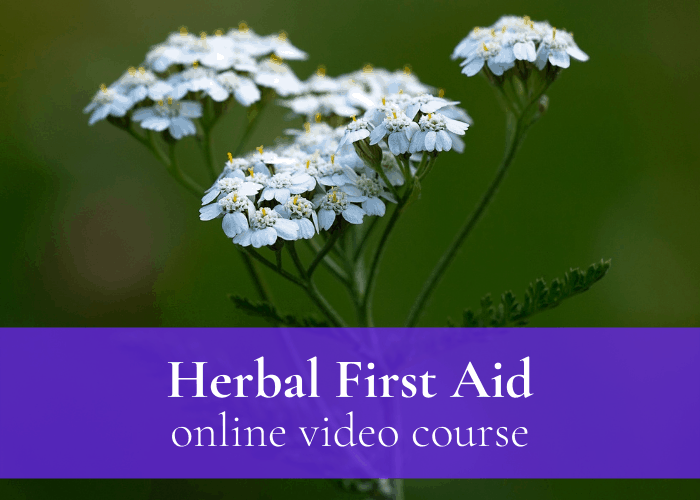
Like all our offerings, this self-paced online video course comes with free access to twice-weekly live Q&A sessions with us, lifetime access to current & future course material, open discussion threads integrated in each lesson, an active student community, study guides, quizzes & capstone assignments, and more!
If you have a moment, it would help us a lot if you could subscribe, rate, & review our podcast wherever you listen. This helps others find us more easily. Thank you!!
Our theme music is “Wings” by Nicolai Heidlas.
Episode Transcript
Katja (00:00:14):
Hi, I’m Katja.
Ryn (00:00:15):
And I’m Ryn.
Katja (00:00:16):
And we’re here at Commonwealth Holistic Herbalism in Boston, Massachusetts.
Ryn (00:00:20):
And on the internet everywhere, thanks to the power of the podcast.
Katja (00:00:24):
Woo hoo.
Ryn (00:00:25):
We’re continuing our discussion of first aid for June 2025. It’s time to do it.
Katja (00:00:33):
It’s time to do it. You know, the June part is particularly relevant at least here on the East Coast because this is the kickoff of our hurricane season. There are all kinds of reasons to be prepared. It doesn’t have to be hurricanes. It can be wildfires. It can be earthquakes. It can be tornadoes. It can be just whatever regular things that could happen. But it’s a good time to pick a time of year and just let that be your regular time that you revisit all your preparedness stuff.
Ryn (00:01:10):
Yeah. Last week we were talking about maintenance in your first aid kits. And at least once a year is a good time to open them up, see what’s in there. Make sure everything’s still effective, useful, ready to go, and appropriate to what you’re going to need.
Katja (00:01:27):
Yeah. So, today as we’re talking about bug out bags or a stay home, shelter in place, stay stash, whatever we call it. If you haven’t ever lived in an area that has regular evacuation orders or shelter in place orders due to weather related incidents or whatever, then you might not have ever needed to think about a go bag or a stay stash before. But it’s not just a regional thing anymore. It’s not just a weather thing anymore. Weather doesn’t stick to this normal pattern so much anymore. Hmm. So, just in general, it is not a bad idea for anyone to be prepared for a couple of days’ worth of interruption.
Ryn (00:02:16):
Yeah. And it’s not always a huge, life-changing event for everybody that’s impacted, you know? A year ago we had a big storm. And it knocked out a bunch of trees on the road, and took down the power lines, and all that kind of stuff, you know? And it was pretty significant. It was enough that we couldn’t all go out with our chainsaws and clear the roads on our own in the neighborhood, us, and everybody else. And we were kind of stuck in place for almost a week. Not going out to the grocery store. Didn’t really have power for most of those days.
Katja (00:02:48):
Yeah. Like intermittently maybe it would come on for a half an hour or something, but mostly we didn’t. It was not like any huge emergency situation. But we were trapped, and we couldn’t go out and get supplies. So, I just want to be cognizant that being prepared doesn’t have to be about oh, everything is terrible, and it’s a complete catastrophe. It’s just a good thing to do.
Ryn (00:03:22):
Yeah. It’s smart to plan ahead. Yeah. So, that’s what we’re going to talk about right now. But first we want to remind you that we are not doctors. We are herbalist and holistic health educators.
Katja (00:03:33):
The ideas discussed in this podcast do not constitute medical advice. No state or federal authority licenses herbalists in the United States. So, these discussions are for educational purposes only.
Ryn (00:03:44):
We want to remind you that good health doesn’t mean the same thing for everyone. Good health doesn’t exist as one objective standard. It’s influenced by your individual needs, experiences, and goals. So, keep in mind we’re not attempting to present a single, dogmatic right way that you must adhere to.
Katja (00:04:02):
Everyone’s body is different. So, the things that we’re talking about may or may not apply directly to you. But we hope that they’ll give you some new information to think about and some ideas to research and experiment with further.
Ryn (00:04:13):
Finding your way to better health is both your right and your own personal responsibility. That doesn’t mean that you’re alone on the journey, and it doesn’t mean that you’re to blame for your current state of health. But it does mean that the final decision when considering any course of action discussed on the internet or prescribed by a physician, that’s always your choice to make. So, don’t give it up.
Katja (00:04:33):
Nope.
Ryn (00:04:34):
We think maybe you should choose to go and check out our Herbal First Aid course.
Katja (00:04:39):
No, we think definitely you should. Yeah.
Ryn (00:04:41):
Yeah. It’s got a lot more detail on everything that you would need to take care of everything from a sports injury to something a lot more serious. And because we’re focusing on getting prepared and getting ready for this month, we made you a coupon code. So, if you go and check out to purchase the First Aid course, you can use the coupon code, firstaid, big secret there, all one word, no spaces in that. Use the code firstaid during checkout, and you’ll get $25 off that course. Nice.
Katja (00:05:14):
There is so much stuff in there to help you learn how to take care of wounds, sprains, strains, environmental stuff like heat stroke or whatever. Just all kinds of first aid situations.
Ryn (00:05:29):
And emotional first aid.
Katja (00:05:30):
And emotional first aid and trauma. Yeah. So definitely check that out. You can find it along with all of our courses at online.commonwealthherbs.com.
Filling Nutritional Gaps & Emotional Needs
Ryn (00:05:42):
That’s where it is. That’s where they all are. Yeah. Okay. So, let’s start with some herbs. Your first aid kit is going to go into your preparedness stash, right? So, we kind of have two ideas in mind at once today. We’ve got your bug out bag and your stay in stash.
Katja (00:06:01):
And they might actually be the same pile of stuff. Like for us, they’re definitely the same pile of stuff. But you’ve got your portability or your scoopability factor. As we talked about last week, the scoopability but also the convenience. And just because you could get either direction, either kind of announcement. So yeah, it doesn’t all have to stay in the bag all of the time.
Ryn (00:06:32):
Yeah. Right. So, your first aid kit has some great herbal stuff in there, right? You’ve got something for wound care. You’ve got something for infections on the skin. You’ve got something to help people calm down. You’ve got something to help people sleep. You’ve got something to help people when their guts hurt. All that kind of stuff is great, and we’re going to want to have that. But when we’re considering a longer-term or – I don’t know – a medium-term kind of a situation, a few days, a week, some stretch of time like that. Then there are a few other things that are going to want to go into your planning that wouldn’t normally turn up in a first aid kit per se.
Katja (00:07:10):
Or maybe would, but we’re going to be a little more expanded about them in your preparedness stash. Which by the way, preparedness stash is really hard to say. I just think you should try that 10 times fast. Okay. So, some examples here would be herbs to fill in nutritional gaps when you don’t have access to all your normal foods. So, in your preparedness stash, in your go-bag/your stay kit, you’re going to need some food. That’s going to be a really important part of what you pack. And the reality of emergency food, or portable food, or non-perishable food is that it’s not too hard to get protein. It’s not too hard to get carbs. Calories, that’s not too hard. But it’s not super easy to get vegetables in a portable, non-perishable kind of way. And that’s a place where herbs can really fill in the gap to make sure that you’re still getting… Okay, maybe we’re not going to get fiber that way. But with an herbal tea blend, you can be getting at least all of the vitamins and minerals that you would be getting from vegetables. And we can think about some other ways to deal with the fiber. So okay, that nutrient requirement, the vitamins, the minerals that you would be getting from the plants, that part is really critical. And that we can cover with herbs.
Ryn (00:08:54):
Yeah. So, if you’ve been following the podcast for a while, then you might have noticed that we did an episode all about this a little while ago. So, we called that emergency meal planning. And instead of recapitulating all of what we said there, we’re just going to point you right back to that episode. Check that out, and we’ll put a link right into the show notes for you. But there we were expressing our big ideas and the key concepts that you want to have in mind when you are thinking about what is the food I’m going to carry with me? What are the gaps that remain in what’s there, and how can I fill those in with the help of the plants? All right. So, we’ve got our food. We’ve got our nutritional herbs to fill in some gaps and to help to add on to what we had into there. And the next thing that I want you to be considering in your go-bag or your stay stash is herbs that are going to help people stay calm. And you know, I was actually doing a Q&A with one of our student groups earlier today. And they asked a question that was like if you only had five herbal remedies that you could stuff in a bag. And there was a big disruption. There was war coming to your doorstep, that kind of thing. What would you grab? And, you know, I named a few things off the top of my head. But I made sure to include we need a remedy for people who are feeling fear and panic. We need a remedy for people who can’t sleep because of unfamiliar surroundings, and anxiety, and discomfort. And that’s like two out of five things that are focused on emotional needs. And at least that many I think is appropriate when you’re categorizing and counting up all the items that go into your kit or into your go bag. Yeah. These are the most common problems people experience in an emergency situation.
Katja (00:10:38):
And they’re compounding problems, right? Like if you’re panicking, or if you can’t sleep because of fear, or anxiety, or whatever else, then you can’t function. You can’t make the choices that you need to make. You can’t basically do anything. In that kind of a situation then you become someone that people have to take care of instead of being a person who can provide support for the community. Now, sometimes we need people to take care of us. You’re not bad if you become someone who needs help. Wow. I just want to make that a bumper sticker. You are not bad if you need help, right? But in terms of an emergency situation, anything that we can do to help you and the people you’re with stay above that point. Stay in that place where you can be helpful. That’s going to help you get through the emergency. It’s ideal if you can get through it and fall apart afterwards, right? It doesn’t always happen that way, but that does help you get through. So obviously I don’t want to imply that herbs are the only thing in the world that you need to get through an emergency scary situation. No. But it’s a tool that you’ve got to help you to keep going, to help you manage the emotions, manage the fear, and do what you need to do in the situation.
Ryn (00:12:17):
Yeah. And I think it’s also worth pointing out that if there is a shelter that you need to go and stay at or whatever, then they’re going to have, they’re usually going to have it handled in terms of cuts, and scrapes, and bruises, and bumps, and other issues like that. They’re much less likely to have something that you’re going to be interested in taking for your emotional health and your support, right? So, one of the ways to think about this is what’s most common to occur when people need help. And we think first about the bleeding wound. But honestly in most emergency situations it’s the hurt feelings, right? Okay. And then it’s what is likely to already be covered by the conventional options available, right? The standard first aid kit that’s in the school gym already, right, things like that. And then where are the things that the herbs are able to do and are less likely to be provided or in a form that I’m interested in? I don’t want to just take a sleeping pill or whatever in such a moment.
Katja (00:13:22):
Which they may or may not even have available. It just sort of depends, but yeah. So, for this aspect, the thing to do is to think about you personally and your household. And then you can expand out however far is appropriate for your community. Maybe that is your best friends who live across the street, or maybe it is whoever. But think very personally about what herbs are important for helping you and your people manage emotions. Because the thing is that everybody’s different. So, first and foremost, have the things that you and your people need. And likely if you have those things, they will also help other people as well. But if you’re only thinking about the things that you need, maybe other people react to fear, or anxiety, or whatever differently than you do.
Ryn (00:14:26):
And maybe they don’t have a longstanding relationship with Solomon’s seal the way that I do. And the way that I’ll reach first for that when I have finally noticed how tense I’ve become. For somebody who that’s their first time taking that herb, they’re not going to receive the full context of benefits that somebody like me is going to get from it. So, on the one hand we’re saying keep your favorites with you. But on the other hand, don’t forget that they’re not going to be everybody’s favorites. Yeah.
Herbs to Help Keep Calm & Persist
Katja (00:14:54):
I want to actually talk a little bit more about that because you mentioned tension. And I think that is like a really good, like beginning of the flow chart as you’re planning these things out. When you are in a stressful situation, an emergency situation, do you tense up, or do you fall apart?
Ryn (00:15:14):
Fall to pieces.
Katja (00:15:16):
Yeah. That is a really good starting point. Now, tensing up or falling apart, it’s not necessarily zero to 60 immediately, right? So, you can tense up slowly over time until you become basically a not functional ball of knots. Or you can fall apart slowly over time until you are just a puddle on the floor, right? It isn’t just like emergency, ah, I’m in pieces. Not like that. But I mean, sometimes. Okay, sometimes yes. But I don’t want you to immediately think that. Because then you’ll say well, I don’t really do either of those things. Maybe not to extreme. But if you use that as your branch, your first branch in your sort of flow chart decision making process here. Then you realize okay, I need herbs that can release tension. I need herbs that can help someone keep it together, right? And then you can think about okay, what are some other symptoms here? Are you the kind of person who throws up in a stressful situation, or has diarrhea in a stressful situation, or gets weepy, or any of those things? And then think about okay, what kinds of nervines do I need? Because those aren’t nervous reactions, right? So, if you’re the kind of person that you throw up in a scary situation, then catnip is a great nervine. Because it’s helping with the nausea but also helping with all the other factors that come along with before and after those feelings of nausea that are not to do with your GI tract. They’re to do with your nervous state. So, it’s also fine to have ginger because that does have to do with your GI tract. Although ginger also has to do with your nervous state, so it gets you on both sides there. Yeah. That’s good. But so, that’s the logic that we want to be thinking while you are planning out the herbs that you want to have on hand for keeping people calm or helping people keep calm. But that’s also why there’s not just one standard list that you can have that would give you everything you need. That list would be enormous. It would be oh, just all the nervines. There you go. You all set. And you know, as a game we could play well, if we only had five nervines, which five nervines would it be so that we covered the most number of people in the most number of situations? And for me that would be like chamomile, catnip, blue vervain, motherwort, and yarrow. I think that would be my list. But I reserve the right to change it.
Ryn (00:18:15):
Yeah. And you, listeners, viewers, you should pause and say what would I want to throw in there right away? Or what are the herbs that I know well that can cover a broad range of possibilities? And maybe you’ve got the capacity to formulate them a little bit. Or just be like okay, take a little squirt of that, and a little squirt of this, and a little squirt of that one, and that’s your personal formula. Yeah. So, you can game it out like that. And it’s a helpful exercise. This will help you to both decide what you actually want to include, but also to think through the options and see where the edges live. Yeah. So, you know, helping people to feel calm or to feel safe to any degree is super valuable in a circumstance like that. You’re also going to think about herbs to help people keep going to, to persist neverthelessly.
Katja (00:19:10):
Yes.
Ryn (00:19:12):
Because that is a necessity in a circumstance like this, even if you’re at home, right? Even if you’re like well, we’re just going to cozy up, and we’re going to build the wood fire. And we’re going to hang out inside. And it’s like a vacation sort of, except I don’t know how to run water right now or whatever your circumstances are, right? There are going to be times when it’s like I would like to just stop and fall down, but I can’t do it. I’ve got to keep on moving. I’ve got to stay awake right now. I’ve got to put out energy I don’t feel like I’ve got. So, herbs can help us here, and not only the caffeine plants. Although I mean the reliance of humans upon coffee in moments of strife is legendary.
Katja (00:19:53):
True.
Ryn (00:19:55):
And are well proven, you know?
Katja (00:19:58):
Yep. If you, however, are a person who doesn’t tolerate caffeine. Or if you’re a person who in an emergency or scary situation, your guts just go all bananas. Then caffeine is not going to be a really great option for you because it’s going to make your guts even worse. So in that case, I really love cayenne tincture, just a couple of drops. Even just one drop right on your tongue. Yes. It is super-duper spicy.
Ryn (00:20:29):
It has to be.
Katja (00:20:30):
It has to be.
Ryn (00:20:32):
The purpose here is to eat fire and move it through your blood.
Katja (00:20:36):
Yeah, yeah, yeah. That’s literally how it’s doing its job is by being super-duper spicy, and it is waking you up. And so the cool thing is that you don’t need much of it. Even if you just had the smallest dropper bottle, you would have enough for days and days and days. Because you really only need one drop at a time. But so that is really helpful for I need to wake up now. I need to get up and go right now. And then the flip side of that is I need to get up and go and keep going. And that’s where our adaptogens really come into play.
Ryn (00:21:14):
Yes. The stimulating adaptogens that we’re always saying hang on, don’t take them without other sustaining life habits. Watch out for the credit card of the adaptogen. Like those ones are what we’re talking about in this circumstance. This is where they shine. This is the moment when it makes a lot of sense to get the high powered rhodiola extract. This is the moment when the red Korean ginseng is ready to serve you, you know?
Katja (00:21:41):
Yeah, yeah, yeah. Also for some people, eleuthero, a really good, strong eleuthero preparation or even ashwagandha can be really helpful here. Ashwagandha in particular, if you are a person who needs to keep going, but you also are a person who doesn’t have a lot of stamina. I feel like the rhodiola, and the ginseng, and even eleuthero, if you’re a person who doesn’t have a lot of stamina, but you are going to now need to invent stamina out of nowhere. I feel like those three will kind of eat up your energy resources a little too fast. Whereas ashwagandha, all right, you might not have the most stamina in the room. But you can do it again tomorrow and the day after that. If you take a ton of ginseng or rhodiola, then you’ll keep up with everybody else’s stamina, but you can only do it for a day or two, you know?
Ryn (00:22:42):
Yeah.
Katja (00:22:44):
And I mean, part of that is… Oh, sorry. Part of that is also just knowing your body. And are you a marathon body, or are you a sprint body? And that doesn’t mean… Like if you look at Ryn and I, Ryn is a sprint body, and I’m a marathon body. But you would look at me and say oh, Katja can’t run a marathon. Yeah. Not running a marathon, but I can walk for days, and days, and days, carrying all the heavy stuff. Ryn can’t do that as long as I can, but I can’t sprint. That’s never going to happen. And Ryn can.
Ryn (00:23:18):
What I was thinking of a moment ago was just like for me, one thing that would work pretty well and has worked pretty well is to combine one of those stimulant adaptogens with something a little more sustaining. So, if I’m taking rhodiola through the days, but I’m also snacking on goji berries all through the days, then that extends my capacity for marathoning.
Katja (00:23:41):
Yeah, yeah, yeah. And also part of…
Ryn (00:23:44):
I mean, that won’t work for somebody with a nightshade intolerance because gojis are in that family. But you know, just as an example of how to combine them or stack them together.
Katja (00:23:52):
I think also really important in thinking about this, even though this isn’t herbal, is recognizing that humans don’t deal with emergency situations alone very well. And this is why. Because the reality is that sometimes you need to sprint, and sometimes you need to marathon. And so together we can handle different kinds of situations. Ryn can sprint, do what needs to be done, and then rest. While I can be marathoning in the background and not need the rest. I’m moving slower, but I don’t need to stop. And those are different skill sets, and you need both of them. So, it’s not like oh, I need a group full of sprinters. Or I need a group full of long endurance workers. No, you need both. So, having the herbs that can keep both groups going. And then bonus if you have the management skills that you can be resting your team members at the appropriate times. Okay, that’s extra, extra awesome. But really thinking about keeping everybody in the team going, even though people have different types of energy resources, and they can sustain their energy output for different amounts of time.
Ryn (00:25:17):
Yeah. Okay.
Katja (00:25:21):
I think this also maybe is one more call for herbs to help people sleep. Because if you are going to be keeping people going, you also need to nourish them with sleep whenever they can get it. And so different kinds of people keep going in different ways. But then you also have to say this person keeps going. How do I let them stop so that they can sleep now because it is their turn to sleep. And so different people stop going in different ways. And so thinking about what are the herbs that this person needs to allow themselves to turn off their energy and rest versus what that person needs to turn off their energy and rest.
Accessibility/Mobility Items & Reminder Lists
Ryn (00:26:08):
Yeah. We are trying to avoid a circumstance like I give you rhodiola all day, and then I start giving you hops to try to knock you out and make you sleep. And then like oh, okay, your shift is on. Wake up. So, take this in your mouth right now. We’re trying to avoid that as much as we can. We’re also acknowledging that sometimes that’s how it goes. And you look for the moments of respite when you can find them. Yeah. Okay. So those are some of the herbal things that are going to make their way into your go bag or your stay stash. Probably not everything. You may have other circumstantial or regional needs that you’re going to attend to in that way. But for our episode right now, we want to move on a little bit and talk about other things to make sure are included into there, right? And again, significant overlap with a first aid kit is going to be found here but not complete overlap. So, for every person in your household, for every pet who’s going to be there with you.
Katja (00:27:12):
Yeah. Or for every person who maybe isn’t in your household, but who would be your responsibility in an emergency situation.
Ryn (00:27:20):
Yours is the safe zone that they’re going to. Okay. They’re part of your group now, yep. So for all of those individuals, we want all of their medications. We want any mobility devices they might need as well as any accessibility aids. That means your glasses, your hearing aid, that kind of stuff.
Katja (00:27:42):
Yeah. And also, even if you wear glasses, a sturdy case for your glasses. Not a soft case, a really strong case for your glasses. Because if you are sheltering in place, you’re in your home, that’s not such a big deal. But if you’re evacuating, the likelihood that somebody could step on or sit on your glasses while you are sleeping or resting is enormous. And an emergency situation is bad enough. An emergency situation where you no longer have your glasses is really, really an emergency. So, if you don’t have a metal or a super strong case for your glasses, now is the time to get one and put it in your stash.
Ryn (00:28:25):
Definitely. Yeah.
Katja (00:28:26):
And the same for your hearing aid or the same for whatever other accessibility aids that you have. So, not just the accessibility aid itself. But if it requires a protective case, even if you don’t use one on a regular basis. But if it is a thing that could be broken if someone sat on it, get yourself a good, hard case. Yeah.
Ryn (00:28:48):
Yeah. Definitely. And then kind of in the range of mobility also is for the animals. Do we need leashes? Do we need carriers? Stuff like that as well. We want to make sure those are either with your go bag and all that stuff, or you know where they are. You’re going to be able to get them, right? So, that brings up something you wanted to mention here, that not everything is going to be literally bagged up and in there a hundred percent of the time. That’s not necessary. It’s not even actually helpful in all circumstances.
Katja (00:29:22):
Yeah. This is a thing we’re going to come back to multiple times. What is reasonable to pack up, keep it packed up, sure. But that’s not going to be everything. I’m not going to pack my glasses. Yeah, maybe I have an extra hard case for my glasses. But I wear my glasses every day. I’m not going to put them in my emergency bag. And, you know, whatever else. So, for all the things that you need that you can’t pack up and have at the ready. Take a big piece of paper that you might have some other strategy, but this is what I do, and it works really great. Take a big piece of paper and a fat sharpie in a bright color and write every single thing that is not in the kit because you use it on a regular basis. And pin it right to the bag. That way in an emergency situation, even if you are freaked out, even if you are panicking, even if you’re scared, even whatever. You can still not forget the things that are not in the bag because you have the list right there.
Ryn (00:30:32):
Yeah. You know, it’s the moment you’re getting your stuff. You’re like oh, we’re actually doing it. Okay. I’ve got to grab the thing. I’ve got to stuff all the things into the bag. And having that list there, it is so much more likely that you’re going to remember most of what’s on that list.
Katja (00:30:49):
Yeah, yeah, yeah.
Ryn (00:30:52):
Than if it wasn’t there at all. Yeah. Yep. Super handy.
Food Strategies
Katja (00:30:56):
All right. So, those are like the critical things for survival. Like your medicine, your whatever you need for accessibility, stuff like that. But you need to have a few days’ worth of food and water. And now again, food is covered in the emergency meal planning. But we want to still cover a few things here very specifically about strategy. And my first thing about strategy here is that yes, they make those dehydrated meals for exactly this sort of thing. And you’ll see them on the emergency preparedness websites, like a bucket of however many whatever. I do not like those at all. They’re pretty gross, first of all. They have a lot of sodium and not a lot of nutrients. And also they’re not very accommodating to food allergies. So, instead the key that we’re going for here is lightweight food because it does have to be lightweight. You might have to carry it. But real food, so this is going to be things like tuna or beef in a pouch. I think I’ve seen chicken pouches too, those foil pouches. Or jerky or pemmican bars.
Ryn (00:32:16):
Right. Pouch because it’s not as heavy as a can.
Katja (00:32:18):
Right, right, right.
Ryn (00:32:19):
And because you just tear it, and eat it, and you’re all done.
Katja (00:32:22):
Yeah. Nuts and dried fruit like those little nut butter packets, those are really handy. Also like those squeezy packs of fruit or vegetables, they’re not the most delicious things on the planet. But they still have some fiber.
Ryn (00:32:43):
And it works for a baby.
Katja (00:32:44):
It works for babies.
Ryn (00:32:45):
It’ll work for you, you know?
Katja (00:32:46):
Right, exactly. Exactly.
Ryn (00:32:48):
Yeah. Hey, how about some candy? Can we have candy?
Katja (00:32:51):
We need candy, actually.
Ryn (00:32:52):
We’re not kidding, actually. This is for real. A stress-out moment and people feeling anxious, and unsettled, and I don’t know. A little bit of sweetness, a little bit of a familiar, delightful flavor that you enjoy, it has benefits beyond the sugar content. It’s an emotional remedy is what we’re talking about.
Katja (00:33:14):
And you might be a person who like oh, well I don’t keep candy around. Yeah, okay. But in an emergency situation, it really is very valuable. And I recommend both chocolate and hard candy. One drawback to chocolate is that it melts. So, if you are in the kinds of situations regularly where things would melt, then okay, maybe not chocolate. But hard candy is important, even if you’re not a hard candy kind of person. Because if you don’t have a lot of water, then hard candy just helps you not have dry mouth. If you have a sore throat going on, then hard candy also is something soothing. And if you want to choose a hard candy that is actually a cough drop, totally fine. But make sure that it’s enjoyable because it is definitely a double purpose here. And also the sugar itself is a value. In an emergency situation you might not have a ton of calories around. The sugar calories are actually valuable, and the sugar energy is actually valuable in an emergency situation. So yeah, okay, not great for your teeth or whatever. But we’ll handle that. It really is valuable to have some candy.
Ryn (00:34:33):
Yeah. We’ll get back to controlling carb intake when we return home, and all the things are calm.
Katja (00:34:38):
And like no junk food and all that kind of stuff later, late. Not right now, yeah.
Ryn (00:34:44):
A couple other things that it’s good to include there is electrolyte packs, right? This is taking whatever water is available and making it better for you. Also sustaining, especially if there’s going to be extended muscular output. You’re going to need an electrolyte pack or something to provide the salt and well, the electrolytes to keep you moving, right? So, that you don’t end up with huge, cramping muscles or that kind of constriction around your abdomen or whatever that can come when you get depleted in those things. Yeah. And another good one actually is little condiment packages. Little whatever, a little tear thing of mustard or whatever. Because, you know, eating fish straight out of a packet is nourishing, but it’ll get old quick.
Katja (00:35:34):
Yeah. It’s not very delicious.
Ryn (00:35:35):
And even a tiny little bit of spice, or flavor, or sauce, or whatever is going to suddenly become extremely valuable to you.
Katja (00:35:43):
Yeah, yeah, for sure. Some seaweed and of course some tea is also good. Again, to get your minerals, to get your vitamins, to get all of the nutrients that aren’t covered by carbs and protein, basically.
Ryn (00:36:02):
Yeah. Don’t forget pet food, right? If you’re going to bring your pets with you, if you’re going to be taking care of them, you are going to need to feed them. So, make sure that’s part of your planning. Yeah. Okay. You don’t necessarily need to say wow, I’ve just got a big shopping list. Katja & Ryn gave me a $500 expenditure to go at the store this weekend, right? So, one option there is to say okay. I have a plan in mind of everything I’d like to be in here. Every time I go shopping I can pick out one, two things from that list, add them to my weekly groceries. And I can slowly build up my stash over time. That’s a great strategy.
Katja (00:36:45):
And, you know, some things you need more of, and some things you need less of, or they’re sold in quantities. So, having some rice or beans on hand, especially if you’re thinking about your stay-at-home stash, that’s really handy. But the bag of rice will last for a little while, whereas a tuna pouch won’t last. That’s just one serving, right? So, you can say all right. Well, this week when I go to the grocery store I’ll get a bag of rice, and I’ll put it in the box. And next week I’ll get two pouches of tuna, and I’ll put it in the box. And over time then you’ll build up your stash. And over time you will also be able to rotate your stash.
Ryn (00:37:31):
Yeah.
Rotating/Storing Your Stash & Cooking Considerations
Katja (00:37:32):
So, this actually is going to bring up a topic that I want to make sure that, that you are thinking about. Just like your first aid kit, you need to rotate your food stash as well. Even though it’s shelf-stable, and it’s a foil pouch of tuna or whatever, it has a date stamped on it. It will not last forever. And so this is why it’s really important to only stash stuff that you actually would eat normally. So, if you hate tuna, don’t stash tuna pouches. Because you won’t rotate them. That’s just going to be a waste of money. At some point when you need to replace them, you’ll just throw them away. So, if you don’t like tuna, then get chicken, or get beef pouches or whatever, or beef jerky or something. But make sure that whatever it is that you stash is stuff that you would normally eat so that every three to six months you are pulling that stash forward, and using it, and then back filling with fresher items.
Ryn (00:38:38):
Yeah. And this can all mean that you don’t actually keep all of those food items again, in the go bag or in that one spot. They can be around as long as you know how to get them from where they live to where they need to be so that you can move. You might even want to practice that sometimes. Do a little drill. That’d be great. But having your go food with your actual food is a good move in the sense that you’ll see it more often. You’ll turn it over. You’ll be able to move the old stuff to the front, and put the new stuff in the back, and like all that kind of thing just to keep them flowing.
Katja (00:39:17):
One way that I organize this, we don’t have cabinets, we have drawers. But if you have a cabinet, or you have a drawer, I just have a little box, like a plastic bin. And so there’s tuna, and then there’s the plastic bin of tuna. And that’s the stash, right? As long as that plastic bin is always full, then I’m all set. So, I have what I know that we are planning for. So I’m always bringing, like whenever I buy something, I put it in the back of the stash. And then I’m moving the stash forward into the stuff that I am cooking with right now. So, you can organize it any way. But it’s sort of like if you’re just always putting whatever you bought in the back, then you’re always making sure that stuff is fresh and rotated. And you don’t even have to spend time thinking about it. If you keep your bag packed up all the time, which might be a smart thing to do in some situations. Like if it is peak tornado season. Or if currently there are wildfires around you. You don’t have to evacuate right now, but that could happen any time. Okay, yeah. Pack it. You don’t wait till the very last minute. So, that makes sense. But if you just leave it packed 365 days a year, then at some point you have to remember to go to the bag. Empty it out, put all fresh stuff in, and rotate everything that’s in there. And it’s a little bit more work. So yes, if you’re in an emergency situation where you would not have 20 minutes to pack things up, then pack it now. But if you’re in the time when no, you would have time. Things would progress before you would get the evacuate order, and it’s not like immediate right now. Then maybe you don’t stash it in the bag because it’s easier to keep rotating that way.
Ryn (00:41:14):
Yeah. But you are trying to make it easy for yourself in the moment when you decide to go, right? So, one thing that we find really helpful is these suitcase organizer pouches or little bags that go inside. They’re made of some kind of water-resistant material.
Katja (00:41:29):
Yeah. Like that ripstop nylon stuff. They’re super, super lightweight.
Ryn (00:41:33):
Yeah. They have these nice zippers on them. You get a bunch of different sizes. And so in the pantry drawer that has protein food items, there’s one of those. And it’s stuffed full of the tuna pouches, and the beef pouches, and the beef jerky that we really like, and those venison bars that are so good. They’re all in there together. So, we can rotate things in and out of there. They’re right there with everybody. But also if we need to grab it, it’s like open this drawer, grab that. Open this drawer, grab that. They go in the bag, we’re leaving. Quick. Good.
Katja (00:42:06):
Those bags that we like are from Eagle Creek. Which is a really… Like I don’t know, I feel like they’ve kind of cornered the market in those lightweight packing bags. And so yeah, they’re made for your clothes, but you can also put your emergency food in them. And there are other kinds of things. You can also just go with Ziploc bags, like large Ziploc bags. Totally, totally works. I like to color code the bags. And you can do that whether it’s a Ziploc. You can put tape on it, or you can do it with a packing bag. So that when you are working out of your stash or out of your bag, especially if you’re evacuated somewhere that isn’t familiar to you. Then it is really easy to just be like the red bag is protein. Yes.
Ryn (00:42:59):
Right. You’re not going to try to open everything and spread it all over the floor somewhere, you know? You just want to be able to get what you want. Yeah. Nice. Cool. Okay. Oh, here’s another thing to consider. Are we going to cook any of this food, right? First, have we included anything that does need cooking? And if so, do we have a plan for how that part’s going to take place? It might be that you’re able to include a bunch of foods that you can just eat room temperature or right out of the pack wherever you need to. But you may also be including some stuff like rice or beans. Stuff that would require cooking if a human’s going to eat it. You’re not a bird, so.
Katja (00:43:39):
Plus also being able to boil water is really valuable. And you might make the choice that you’re not going to carry anything to cook with, and that that’s a valid choice in many situations. But if you think that you have the option, then having the option to boil water opens a lot of doors for you.
Ryn (00:44:02):
Yeah. So, where we live, this would require something like a camp stove. Maybe it’s like burning sterno or whatever. If you happen to live in Arizona, then maybe you can get a solar cooker. Set that up in the middle of the days anyway. We could boil water or cook some food inside of that. That’d be great. So, whatever is going to be the appropriate option for the place you live and where you are. Do be thinking about safety there. If you’ve got a camp stove, are we able to cook outside? And again, start with your home. Imagine you’re at home, but you don’t have power. You don’t have whatever. Where can I set up to be my current kitchen, right? It’s not a great idea to do this inside the house. On the other hand, humans who are in a survival situation will do all kinds of stuff that’s not a great idea. So, at least be opening windows or maybe having somebody on a giant leaf duty.
Katja (00:44:59):
Ventilation.
Ryn (00:45:00):
For the fumes. Something to keep yourself safe, please.
Katja (00:45:03):
Yeah. Also think about if your cooking solution is stable. So, a lot of those camp stoves, they’re tiny, and they don’t weigh very much. But they do have fumes, and they’re very tippy. So, if you have children or pets around, then think about that from a safety perspective. It doesn’t mean that you can’t use those things. But just think about how would you handle that from a safety perspective? Because if you have thought about that ahead of time, then you already have a plan in place. And you won’t have to figure it out when a kid comes running past, and you had not planned for that. Yeah. Speaking of no power cooking options, this involves can openers too. If you have in your stash… Cans are maybe not the most practical thing to carry someplace. But if you’re thinking about your shelter in place, maybe cans are a part of that. But if you normally use an electric can opener, then you can’t get the cans open. So, make sure that you have a not electric can opener as well.
Water & Everything Else
Ryn (00:46:14):
Yeah, definitely. Water?
Katja (00:46:17):
Water.
Ryn (00:46:18):
Water, yes. So, you’re going to need some. That’s the first thing, yeah. And if you have town water or city water that feeds right into your house, then you might not be super prepared for going without this service. You’ve had power outages before, and the water didn’t stop flowing. So okay, that’s nice. But even if that’s been your experience of prior power losses, do make a plan for what if the water coming out of the tap isn’t coming or isn’t safe anymore, isn’t good. I don’t know. There could be all kinds of things that happen. Let’s start with say an earthquake hits your city. And now the water that’s flowing out of your tap either isn’t coming or hey, that didn’t go through the filtration system it’s supposed to before it got to me. I shouldn’t be drinking that, right? Okay.
Katja (00:47:10):
Yeah. The easiest way to be prepared at home is to have a few five-gallon jugs of water. You can actually just get those at the grocery store. Like you don’t need to have a service come and deliver them. You can just get a few at the grocery store. Also, hardware stores usually have them. And if they are sealed, and you have not opened them, they will last indefinitely. They’re not practical for carrying with you. They’re wicked heavy. But they are really excellent for any kind of a shelter-in-place situation. However, you can also just buy jugs, all different shapes and sizes of jugs. And that’s also a good idea. But if you are filling those with tap water, regardless of whether you have town water or well water. This is true even if you have well water. When you fill them, that’s great. But after a certain amount of time – which could be a month, or it could be longer than that – they will get a little slimy. Because that water is alive.
Ryn (00:48:21):
It’s not sterile.
Katja (00:48:22):
It’s not sterile. Yeah. So, make sure that if you go that route where you get buckets, and you fill them – not buckets, but like containers, and you fill them – that you are also cleaning those regularly. The same if you have water reclamation, like rainwater catchment or something like that. If you have that, probably you already know that you need to do something to make sure that that water is actually drinkable. Although that water would probably be fine for washing, or flushing the toilet, or something like that. Do note, if you have never had this. If you have town water, and you’ve never had a situation where the water gets shut off, you can’t flush your toilet anymore. And I know that as we’re saying it right now, that sounds like well of course you can’t. But when it happens, it’s sort of shocking because you just flush the toilet by habit. And suddenly you can’t do that anymore. And so there is value in having water that is not drinking water, but water that could be used to clean. It’s clean enough to clean, but it’s not clean enough to drink. It does have value. But just make sure that you’re drinking water, that you’re rotating that regularly if you are filling your own containers.
Ryn (00:49:45):
Yeah, definitely. Okay. And then look, if you do have to go. If you have to leave, then carrying water is difficult. It’s heavy. There’s not a replacement for it either. This is a big problem. It’s going to be a real part of your situation. So, this is where filtration systems are going to become necessary, right? And that can be just a personal filter straw. It can be something that you can feed water through a pump. And that has maybe a ceramic filter inside. And that gets rid of all the germs, and the troubles, and everything. And you can drink it once it’s gone through there. But you’re going to need to pick one or more. You’re going to need to familiarize yourself with them. Make sure you know about the maintenance and the cleaning process that’s required for whatever your item is. And figure all that out before emergency day.
Katja (00:50:35):
Now keep in mind also that you need it for your pets as well. And so those filtration straws, they’re actually not a bad system, and they do last for a good while. You can get good ones for around $20. But when you do, make sure that you get one that will accommodate many situations. So, some of them, it is literally only a straw. And you have to lean over a pond, or a creek, or something and straw the water out of it. That’s fine for taking a drink. That’s not going to help you if you need to wash a wound. And that’s not going to help your pet, or a child who’s too young to use a straw, or something like that. There are other ones that have bags or the ability to turn upside down. So, you can use it as a straw, or you can use it as a filter. And then you could put it into a cup. There are ones that have universal screws that will fit any plastic water bottle, any commercial, like you just bought it at a drugstore or something, disposable water bottle. They also make them that fit Nalgene camp bottles or whatever. But whatever your choices are, just make sure that there are lots of different… Make sure that you know there are lots of different options. And when you’re choosing your filter, that it will actually accommodate the needs of the people in your household.
Ryn (00:52:07):
Yeah. Okay. And then you’re going to need everything else. No, I’m being silly, but that’s a catchall category here for a bunch of different things. Like say some more socks, some nice underwear. Well, sturdy.
Katja (00:52:23):
Yeah. Fresh. Like a change of socks, a change of underwear. A toothbrush is not frivolous. Please bring a toothbrush because if you don’t have the chance to take care of your teeth, your gums and stuff can really get into trouble soon. A toothbrush doesn’t weigh much. Floss doesn’t weigh much.
Ryn (00:52:44):
Plus floss is helpful for more than just teeth cleaning in first aid. Yeah.
Katja (00:52:49):
Yeah.
Ryn (00:52:51):
Some wipes are handy for your hands, for your face, to get a feeling of okay, I’m at least a little cleaner than I was a moment ago. Even if it’s just once or twice a day, that can really improve your quality of life. Yeah. Some light, a flashlight, maybe a solar light. Maybe a little hand crank flashlight so you’re not going to be dependent on batteries. That kind of thing can be really handy. You probably want to bring some batteries with you though, for anything that you have that runs on batteries that you really need to not fail you in the moment. A hearing aid comes to mind.
Katja (00:53:24):
Yeah. And then a multi-tool is a really good option. But make sure it is a good one that fits in your hand and also that’s super usable. So, if you aren’t the kind of person who carries a pocketknife or a multi-tool with you all the time. Then take a little time to pick the one, and make sure that you actually can open out the blades. Some of them are super tight, and they’re just really hard to open. Or maybe they have a bunch of tools in them, but you don’t need them. Or maybe they’re just too big to be comfortable in your hand. So, just think about actual usability. It would be better to have just a plain, single blade pocketknife that doesn’t do all the fancy stuff but feels really good in your hand, and you feel comfortable and confident using it. Even though this is just something that’s going to go into your emergency bag. And you might be thinking well, it’s just for emergencies. I might not need it, whatever. If it’s an emergency, it needs to be comfortable to use. So, take a little extra time with that.
Ryn (00:54:40):
Not a great time to be breaking your thumbnails as you try to open the little Swiss army whatever. Yeah, no.
Katja (00:54:47):
For real. A set of camp silverware and a cup and a bowl. Again, one of everything is fine because everybody can share or whatever. It’s great if everybody has their own, but that’s not always practical to carry around. But you can get lightweight sets, and you are going to need a cup. You’re going to need a bowl. It’s just a reality. Yeah.
Ryn (00:55:12):
Yeah. You’ll feel happier with your own. That’s for sure.
Katja (00:55:17):
Yeah. And then of course, menstrual management. If anybody in your household menstruates. Or if they don’t, because you will certainly meet people who menstruate and didn’t maybe have the opportunity to plan for that.
Ryn (00:55:29):
Yeah. Bring them anyway.
Katja (00:55:30):
Bring them anyway. Even if you’re all guys. Bring them anyway. And so, tampons, pads. Pads are better in an emergency situation. You know, better… It’d just really hard to… The reason that it’s standard knowledge, wisdom to say that pads are better is because if a tampon is in for too long, then that can cause health problems. But pads aren’t always comfortable. This isn’t like super awesome, but if you have both options, then you have both options.
Ryn (00:56:09):
Better, yeah. We’re going to want to bring some extra Ziploc bags just to stash things in, keep them dry and all that. And one of your Ziploc bags should have some documents in it, right? Make sure that when you have that list of things not to forget that you staple or you pin to the outside of your bag when it’s waiting. Make sure you write on there Id because you’re going to want to want that. A driver’s license, a passport. If it’s a minor, maybe you need their birth certificate. But those are going to be helpful to you, especially if it’s a more serious or a more extended kind of an emergency situation.
Katja (00:56:50):
You know, while we’re talking about documents, it can also be handy to have a paper map of the area, like the old-fashioned kind that you can’t fold. You can unfold it, but you can’t fold it back. Because what if there’s no GPS? What if there’s no cell phone? What if whatever? It’s handy to have a map so you can toss it right in the bag with your important documents.
Ryn (00:57:14):
Yeah. I guess on that line of ancient technology, it could be helpful to have a radio around. Sometimes that’s the only way that messages can get around. They can fly through the air, but the wires aren’t wiring.
Katja (00:57:29):
Yeah,
Ryn (00:57:30):
There’s always going to be this balance though between what do I need? What could I need? And what can I carry, right? Even if it’s only like ‘ve got to carry this from the home to the car. And then from the car through some amount of parking lot, to some amount of standing in line as we get processed, to some amount of finding our way to where we’re going to hang out at the shelter for who knows how long, right? That could still be a pretty long what do you call it? Haul.
Katja (00:58:01):
Yeah. A long time of carrying things. Yeah.
Ryn (00:58:04):
So, be thoughtful about it.
Your Bag & Go/Stay Packing
Katja (00:58:05):
You know, because of that, your go bag won’t have as much stuff as your stay bag, your stay-at-home stash. And it’s a lot easier if you’re sheltering in place because you have all your clothes. I mean, unless it’s laundry day. You have your stuff around you if you are sheltering in place, and that’s a little bit more comfortable. You don’t have to think about how heavy the water is that you can carry or whatever else. But so there just is that tension. Make sure that your bag is comfortable, that you can carry it, and it is not at the limit of what you can carry. Because what if you have to carry a person or help a person? Maybe you’re not going to carry the whole person, but you’re going to carry some of their weight to help them move, right? If you are so tricked out with your go bag that you are using all of your capacity to carry it. Then you’re well supplied, but you’re not very adaptable to what situation might come your way.
Ryn (00:59:15):
Yeah. That’s going to matter. Right. So, your preparations can overlap, right? You can be prepared to go if you need to. Be prepared to stay in if that’s possible. You don’t need duplicates of everything we mentioned here. These are the only ones that travel, and these are the ones that only stay home. No, that’s fine. But setting up some designated area for where the supplies are going to live, and where the list of stuff that’s not there already is going to be easy to find, visible, and well-marked, right? Like on that list of everything on this list needs to go into this bag before we leave. It’s a good idea to include on your list where each of those things can be found inside of your house. Now you already know where they are because you compiled your list. That’s great. But what if somebody else is helping you? Or what if you weren’t even there that day, right? What if you’ve done all of this planning and all of this processing, and I’ve got everything ready to go. I drilled myself where I can run around the house and get it all together inside of 10 minutes. But you just were the only one involved. The kids, the spouse, the whatever is just like that’s their weird hobby. I’m not really paying attention. What happens when you’re not home on the day that the tornado comes, right? Yeah.
Katja (01:00:29):
And just like don’t pack too much in your go bag. Okay, don’t put too much detail in this list. Because the idea is that the checklist is big and easy to read, easy to see, even if you are feeling some amount of panic. So, you know, just have enough details so that somebody else in your household could find that item. But not so much detail that it becomes an overwhelming wall of words. Yeah.
Ryn (01:00:59):
Totally.
Katja (01:01:00):
In our house most of our stuff does not live in the bags. But almost everything is together in a space. So, we have a mudroom-pantry kind of entryway. And that’s where the extra dog food, and the extra cat food, and stuff like that lives normally anyway. And so that’s where our bags are. And there’s a lot, like that’s also where the pantry food is. That cabinet is also there. So, it’s kind of most of the things that would need to get into the bags is there.
Ryn (01:01:43):
It’s kind of all within arm’s reach, basically.
Katja (01:01:45):
Yeah. And so it makes it pretty easy. And then there’s just a few things that oh, okay. I’ll go grab a pair of socks upstairs or whatever. Yeah. But the point here is that you don’t need to just keep it all packed all the time. And I feel like keeping it all packed all the time is like a barrier to entry for some people to have this kind of preparedness. Because if you keep it all packed all the time, then that means you need a duplicate of everything, and that’s expensive. But if you just sort of keep your bags in a place ready, your list ready, and things reasonably organized wherever they are that you could grab them. Then it becomes an exercise in fairly quick assembly, but you don’t have to have a duplicate of everything.
Ryn (01:02:39):
Yeah. Which is nice because that could be costly. Actually some related thoughts on costs. You know, we mentioned before the idea of okay, I go out shopping. I grab one extra thing to go into my stash, and then I’m all set. We build up our reserves over time. Another thought in the same kind of direction around cost is to reuse what you’ve already got around. If you’ve got a duffle bag, if you’ve got a decent sized backpack that you can utilize there, that’s great. It’s going to get dirty anyway, right? It’s going to get kicked around anyway, so this shouldn’t be your brand-new beautiful item.
Katja (01:03:18):
Yeah. Just as long as it is sturdy, that’s all that matters, sturdy and reasonably comfortable to carry. It doesn’t need to be fancy. It shouldn’t actually be fancy. Except your socks and underwear. Just have one pair of socks and one pair of underwear in there, but don’t put your most worn-out pair that you were just about to get rid of. Well, I’ll just put it in the emergency bag. No, actually put your favorite pair and maybe a fresh pair, a new pair of your favorite kind of underwear and your favorite socks. And the reason for that is just that if you have to live in only what you can carry with you, only what you’ve got for several days in a place where you maybe can’t take a shower and whatever else. Then you really want your underwear to be comfortable. I know it sounds ridiculous, but it actually makes such a difference in terms of like attitude and emotional health. If your socks are dry, and your underwear is not squeezing anything weird, yeah. It matters. So, those two things, don’t skimp on those two.
Ryn (01:04:33):
Yes. Smart wool. Smartwool is the way to go. Wait, they’re branded now. Is there a more general term?
Katja (01:04:40):
Yeah. There are lots of companies that make clothing out of the wool that is the kind of wool that Smartwool uses.
Ryn (01:04:49):
It’s some combination of fibers together, but it is the best thing. It’s so good.
Katja (01:04:53):
It dries fast. It’ll keep you warm even if it’s wet. And it doesn’t smell funky. Or it takes longer to smell funky. Yeah.
Pooling Resources & Evacuation Planning
Ryn (01:05:01):
Definitely. Definitely worth it. Hey, another thought on this topic is that you aren’t actually all in it on your own, right? Even you, the household. Consider pooling resources with some friends, with some neighbors. If you’ve got a neighbor around that you can go with, or you plan to go with, or that you could shelter in place together with. Then each of those households could say all right, well I’m responsible for collecting half of the items that we all together need. And we can shelter together, we can evacuate together. Again, we don’t have to have duplicates of everything in my house and yours across the street.
Katja (01:05:41):
Right. This can be really handy because if part of your shelter-in-place requirement is because of extreme weather, it’s a lot more cost-effective to heat one space or cool one space for two households than it is for each household to heat or cool its own space. And so just all the way around, plus more hands means more work can get done. So, more hands is more support. Yeah. Now you might not have neighbors that you feel comfortable in an emergency situation with. But you might have close friends who you do make plans with or whatever else. And so in a shelter-in-place situation… I’m just thinking back to the time that our street was cut off by really big trees down on both ends. Okay. We would not have been able to get to anybody except our immediate neighbors because we couldn’t leave the street. So, think about that when you’re thinking about planning, if you are planning with friends who don’t live close to you. It doesn’t mean that you can’t plan together. It just means that your evacuation timeline would be different, or your shelter-in-place timeline would be different. You’d need to go earlier so that you didn’t risk being like… You know?
Ryn (01:07:02):
Yeah. And I mean, if you’re planning something like that, they need to have at least two viable routes to get to you from where they are.
Katja (01:07:08):
Although we had two viable routes, and both ends of the road were totally blocked off, yeah. So, you know, whatever. But at any rate if there are people around you that you can plan with. And if you aren’t sure, then hey, this is a great time to reach out to your neighbors and talk about a neighborhood mutual aid, neighborhood community preparedness kind of situation. It’s a good way to get to know the neighbors and get prepared for anything that might be coming.
Ryn (01:07:43):
Yep. Coming and going. If you have to go, you might need to drive. If you need to drive, you might need some gas in the car. And if you are in the habit of letting the car get almost empty before you put more gas in it, we encourage you to change that habit.
Katja (01:07:57):
Yeah, yeah, yeah. If you just say my gas tank is never more than half empty. Like as soon as it hits half, I fill it. Well then it only costs half a tank to fill your gas, and it’s always available when you need to go somewhere. So, it’s a habit to start now if you haven’t already.
Ryn (01:08:19):
Yeah. And just like we said, planning for what is going to be the evacuation path, including if that’s somebody coming to you to shelter with you. Are you going to a friend’s place to stay there? Or if you’re thinking ahead, and you’re like okay, well what if there was a big serious disaster in my community? Where would they even put a community shelter space? What would become that, right? If you don’t know already, somebody in your town should. If they don’t, something really went wrong. And you need to like – I don’t know – run for office or something.
Katja (01:08:53):
In most towns this is a job that you can have. It may be part of some job. It might be that some member of the emergency services department coordinates this. And in some towns there is just an administrator who does this emergency planning. But evacuation shelters are usually static locations. So, maybe it’s the high school gym, and it’s always the high school gym. And it’s always the same place on purpose because that way they don’t have to keep moving stuff and planning stuff differently every time. Now, of course if that place gets washed away, obviously it would be someplace different. But generally the planning is static. So, learn where your evacuation places are, where your emergency gathering point places are, and figure out your routes to get there. There is a really great app. It’s the FEMA app. It’s made by FEMA. I don’t know who they actually had make it. But it has all of the evacuation information, all of the shelter information. And it even gives you alerts when there are evacuation notices in your area, or shelter-in-place, notices, or any other kind of thing. It usually gives those alerts early, like as soon as there is the warning of a tornado, or a hurricane, or a whatever. It’ll start telling you preparedness things for your area. Now, FEMA might not exist forever. But it does right now, and this app is pretty good. So, it is worth checking that out. Even if the app disappears, a lot of that planning might still be valid because some of that planning is happening at the most local level. So, definitely get educated about it now. Plus, even if the app still exists, your phone might not. Your phone might be out of battery or something else. So, use the app or other planning tools. Talk to your local fire department or your emergency services dispatcher. Find out if your area has a CERT administrator.
Ryn (01:11:13):
It’s a Community Emergency Response Team. Yeah.
Katja (01:11:16):
Yeah. And that is volunteer emergency services that are activated in emergency situations. And that administrator would be the person who is also doing the emergency planning. Whatever it is, find out these resources now so that you know them when you need them.
Ryn (01:11:38):
And look for the details that are going to matter for you and your pack. Because your pack might have some four leggeds in there, and they might not be welcome at these shelters.
Katja (01:11:46):
Yeah. Not all shelters except pets.
Ryn (01:11:49):
You want to know that as far in advance as you can. So you can figure out if there is another plan to be made or, if you’re going to be kind of on your own in that regard. Yeah.
Katja (01:11:58):
Also have a plan for family members who have special needs or accessibility needs. Make sure that the shelters that are nearest you can accommodate the needs that everyone in your household has. And if not, find out where the nearest shelter is that can Yeah.
Ryn (01:12:19):
Right. You might also want to have a plan or to discuss these plans of yours with other people in your family and other friends of yours. And I am including there people who aren’t in your town, who aren’t in your region, in your country or whatever. Just to be like hey, listen. Yeah, I live in tornado alley, and I have a plan for what happens if one of them is coming our way. This is what it looks like. This is where we would likely be going to shelter if we needed to. That gives them some peace of mind in those moments. Because you know, they’re going to see the tornado news alert. And they’re going to be like wait, my family lives over there. And they’re going to not know if you haven’t talked about it in advance. But it will give some peace of mind for them to be like okay, they’re not out there totally blindsided by all of this. They know what to do.
Katja (01:13:11):
Speaking of knowing what to do, you are safer together. You’re safer if you have more people around you. You’re stronger, you’re calmer, and you have more skills. Because not any one person can have all of the skills. But if you gather up a group of people, then you have more skills at your disposal. So, talk to folks in your neighborhood, your friend group, wherever you feel at home, and make plans together. Again and again, even though the horror stories are what they are, like the movies or whatever.
Ryn (01:13:47):
There’s going to be looting. People are going to turn into rapacious hordes of zombies overnight. That’s what everyone gets worried about when they see about a disaster like that. Beyond, you know, I got hit by the flying bricks or whatever. They get scared about that kind of thing happening, but it’s largely an invention of our news culture.
Katja (01:14:07):
Yeah. It doesn’t really happen. It doesn’t really happen. What really happens is that when there’s an emergency, people help each other. We are humans. It’s built into our DNA. When we see somebody in trouble in an emergency situation… Yeah. People can be pretty cynical and crass on just any given Tuesday. But in an emergency situation, people help people. And so, the more that you are already prepared in your household and in your community to help each other. The more that you’re going to be able to help people who weren’t prepared. Or who were prepared but got hit harder or like 10 million other things. You just can’t go it alone. Don’t try to plan to go it alone. Plan for together.
Ryn (01:15:00):
Yeah. And you don’t have to wait for an emergency to come around to do that planning. It’s always better in advance, right? How you’re going to support each other, how you’re going to take care of each other. And think too about what you bring to that effort, right? Since you’re on this particular podcast feed, I’m thinking some of that’s going to be your herbal skills. Those are going to be really valuable. So, that’s why we think it’s so good for you to be well educated, and to develop your skills, and to experiment and to push with them. And don’t worry, we have some more resources for you to do just that. Yeah.
Katja (01:15:35):
Well, the Herbal First Aid course has everything you need to build your first aid kits to respond to emergency injury kind of situations. Also just sports injuries or whatever, all of those skills. So, you can grab that. You can grab that for the whole month of June 2025 for $25 off if you use code: firstaid, all one word. And you can find it at online.commonwealthherbs.com. And if you’re really into nerding out about this stuff. And you already have first aid skills, but you want more. You want like really intense, first responder-level skills, then the Emergent Responder course is available for you. And that covers way more in depth, longer term. Like we just got hit by a hurricane, by a tornado, by a whatever, and we need to rebuild so many things. That level of disaster, if you want those kinds of skills, we have them for you. So, check out the Emergent Responder program, which you can also find at online.commonwealtherbs.com.
Ryn (01:16:49):
All right. So, we – believe it or not – do still have more to say about first aid and about emergency response. But we’re going to call it for this one today, and we’ll have some more of that on the feed soon. Yeah. Until then take care of yourselves. Take care of each other. Check on your go bag, check on your stay stash, and take care of each other. Yeah.
Katja (01:17:15):
Bye-Bye.
Join our newsletter for more herby goodness!
Get our newsletter delivered right to your inbox. You'll be first to hear about free mini-courses, podcast episodes, and other goodies about holistic herbalism.